The AfD and its Leading Personnel: Between Closeness to the People and Raucousness
The state elections in Saxony-Anhalt and now in Mecklenburg-Vorpommern have featured a different type of politician for the AfD than before. What strategy lies behind this?
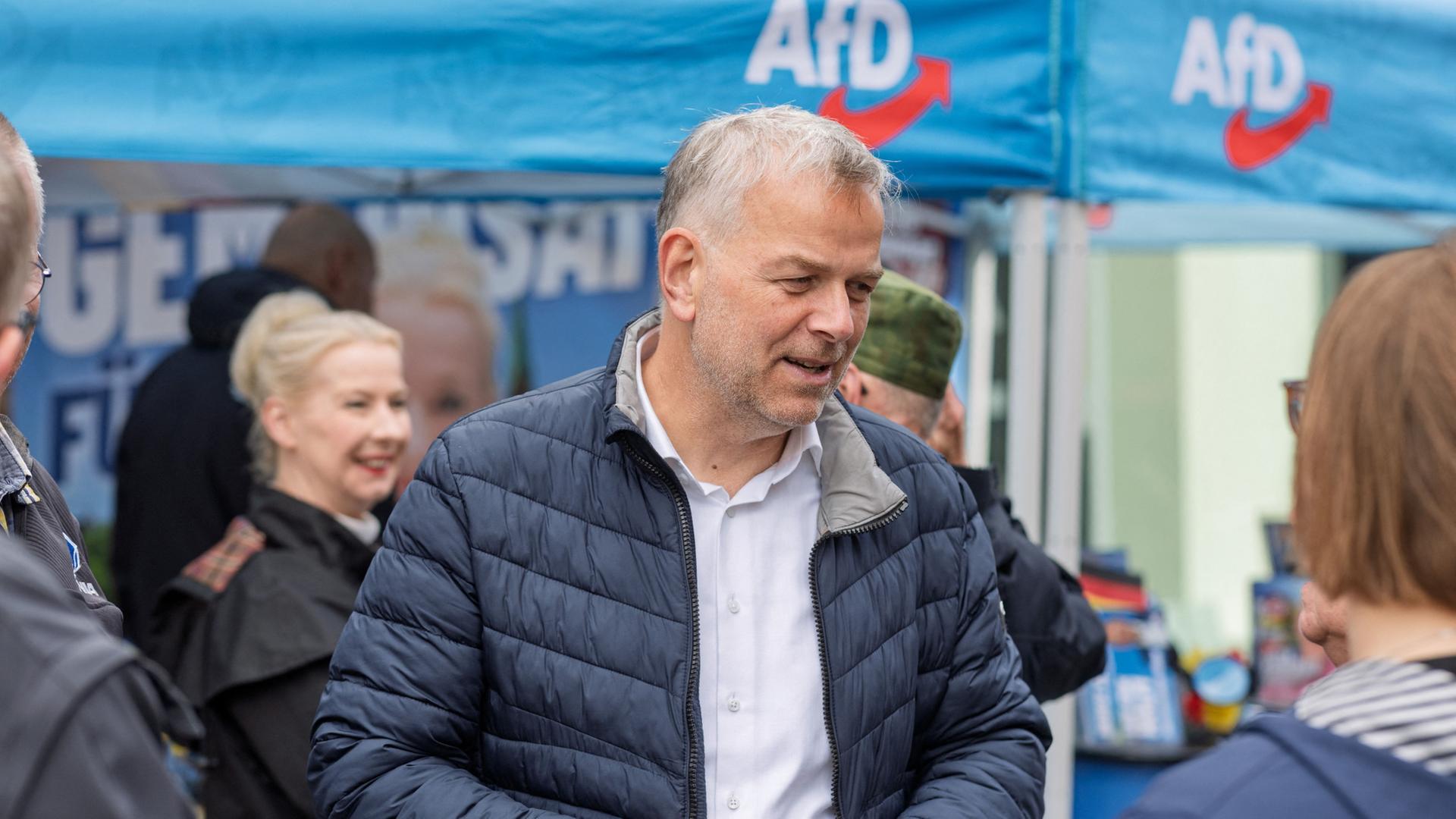
Leif-Erik Holm has four young children – and he is happy to show them off in a campaign video. The leading candidate cooking, having family meals, going for walks with his wife, children and dog. The message that can be read into this video: this man may belong to a party with partially extreme positions – but above all he is one of their own from Mecklenburg-Vorpommern: "This is where I grew up, in a wonderful village. (...) Nobody had to look out for us, because life was simply safe and you had the freedom you need to grow up," says Holm at one point in the nearly four-minute, polished home story.
Holm, born in 1970 in the GDR, is tapping into a feeling that Ulrich Siegmund already targeted in Saxony-Anhalt: when will things finally go back to the way they were – at least in memory? And – who could possibly be afraid of men like these?
"Ultimately, the fact is: once we are in government, (...) this fear will also disappear," says Holm in another video, in conversation with AfD leader Tino Chrupalla. And further: "That's what they're afraid of." Chrupalla supports the narrative, which goes as follows: only the other parties should fear the AfD, no one else.
A new role model within the party?
This stands in stark contrast to the conduct of many other AfD politicians. At the forefront is Alice Weidel, head of the party, the parliamentary group and the "attack department," as she recently demonstrated once again in the general debate in the Bundestag.
The AfD has now existed for 13 years. What long united most of its leading politicians was a talent for and enjoyment of political raucousness. Loud, extreme – something that was attractive to some and repellent to many others. Candidates like the former radio presenter Holm or the sales talent Siegmund come across differently: they usually appear smiling, rarely blustering, and are not troubled by their party's partially extreme programme. Is this becoming the new role model within the party?
Probably not. On the one hand, candidates like Holm are very presentable thanks to their smooth manner, but also somewhat interchangeable, and are sometimes met with amusement rather than admiration within their own party. On the other hand, Holm's case shows that this approach does not automatically lead to success. Although he has tried similar methods to Siegmund, he cannot, from the AfD's perspective, generate the momentum that characterised the election campaign in Saxony-Anhalt.
They embody two different styles within the AfD: Alice Weidel and Ulrich Siegmund.
The best example: a ride on the cult moped Simson in Schwerin last weekend attracted only a handful of participants in persistent rain. Siegmund had produced images at such events that generated attention far beyond the small state of Saxony-Anhalt.
The AfD has so far done well with an ambidextrous strategy. In Saxony-Anhalt, hardliners like Hans-Thomas Tillschneider shape the radical platform, while politicians like state leader and federal executive member Martin Reichardt flank the considerably more streamlined Siegmund. Reichardt's speech about "Father State" and "Mother Tongue" shortly before the election is evidence of this. A sample: "Mother tongue today is a bloated, intersectional-feminist floozy (…), because Father State genders her three times a day."
AfD voters are "not a homogeneous group"
There is also this: the voters of the AfD have different motives for voting AfD and "are not a homogeneous group." That is what Céline Teney, Professor of Political Sociology at the Free University of Berlin, says. After the 2025 federal election, she created a typology of AfD voters' attitudes. The result: approximately 20 percent fall into the category of "radical-right authoritarians" in her framework, while the majority are classified as more or less staunchly conservative. "Only a small core of AfD voters is also very strongly extremist," the researcher emphasizes.
One can read from this: the party must continue to represent the radical position — extremist particularly on the issue of migration — but the somewhat softer "when will things be like I remember them" line of Siegmund and Holm completes the profile of an AfD that, if it wants to govern, is dependent on its own, and therefore large, majorities.
Focus on non-voters
Another development is equally important: in places where the AfD achieves results as high as it currently does in Saxony-Anhalt, most voters do not come from other parties — but from the pool of non-voters.
"This means that the AfD manages to mobilize people who do not necessarily have very strong political views," analyzes political sociologist Teney. "Because those who normally don't vote tend to be those for whom politics is somehow irrelevant."
This explains a party strategy that at first glance seems somewhat contradictory — "nobody needs to be afraid of us" and human-interest stories on the one hand — and sharp, often aggressive appearances, as cultivated by, for example, Thuringia's state leader Björn Höcke or Alice Weidel. Even the party leader, who often comes across as dismissive, now sometimes presents herself as close to ordinary people.
Two recent campaign videos illustrate this: in one, Weidel climbs onto an excavator at a business in Lower Saxony. In another, during a campaign appearance in Berlin, she even approaches some anti-AfD demonstrators and greets them in a friendly manner.
This shifts quickly, however, when the demonstrators ask her why she engages in "hate and incitement" against foreigners whom the AfD wants to "remigrate." Weidel changes her tone, raises her voice, and asks rhetorically: "The enforcement of law and order — what do you have against that?" — making it very clear that the AfD continues to rely on one recipe: the combination of emphatic closeness to ordinary people and blustering political uproar.