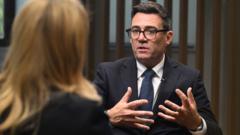
Prince William wants to shape the monarchy for a new generation but can this future king regain public trust in an ancient institution under fire?
Prince William was playing a charity polo match on the day his brother Harry and his family made their long-awaited private reunion with the king and queen at Highgrove House on July 10. King Charles hadn't seen his American grandchildren in four years, but William kept well away from the drama of the Sussex homecoming.
The Guards Polo Club event is a regular royal annual fixture and cheering from the sidelines on the 30-degree day was Princess Catherine in a sleeveless gingham sundress, bare legs, sparkling eyes, beaming smile.
For the past two years the princess has stayed away from the event, recovering from cancer, so to see the 44-year-old mother of three looking so radiant by her husband's side was a good news story lapped up by world media.
It didn't quite drown out coverage of Prince Harry's chaotic visit, but no doubt Kensington Palace was pleased with the outcome.
Afterwards the future king and queen kissed, walked hand in hand, and laughed and chatted. Their public displays of affection have become more frequent, it's a stark comparison to the stiffness of previous generations of royals, but also noticeably different from this couple's "on duty" behaviour in years gone by. Tactile informality has been in evidence at public engagements too: impromptu hugs with members of the public, eager hand shaking, heartfelt back pats.
This evolution of royal behaviour is partly a sign of generational change — let's not forget Queen Elizabeth II was born in 1926 and raised in an era of rigid social etiquette — but commentators are also characterising it as a notable change in how this Prince and Princess of Wales are feeling.
There's no question that royal work involves a degree of artifice — indeed Queen Camilla has said that the king benefited greatly from his experiences acting in the Cambridge University Footlights as an undergrad. But with the intense media and public scrutiny it's practically impossible to fake emotions.
Prince William described the year following the cancer diagnoses of his wife and father as "the hardest of his life…brutal".
"Trying to get through everything else and keep everything on track has been really difficult," he said.
Those comments unmasked William's extreme levels of anxiety behind the scenes, America-based royal biographer and journalist Christopher Andersen told the ABC.
His wife had been in hospital for abdominal surgery and was initially told the procedure was a complete success but then days later everything changed when doctors mentioned cancer. It floored William, Andersen said.
"Considering all that he has gone through — his parents' turbulent and often violent marriage, his mother's soul-crushing car crash death, the sad disintegration of his brotherly bond with Harry — that is really saying something," he said.
"William could not fathom how something like this could happen. Serious illness can bring family members together or tear them apart, and in this case, it cemented their already strong relationship even more. Kate and William feel they have been given a new lease on life, and in consequence they are less likely to feel the need to hide their affection for one another."
Also cemented was the importance of protecting their close-knit family unit and not unduly worrying their three young children, Prince George, Princess Charlotte and Prince Louis. Catherine quietly retreated from public life to concentrate on her treatment which was kept top secret. But Andersen writes about the "crushing burden" carried by William whom he explains was "always more emotionally fragile than Kate".
The William we rarely see
Over the past decade, the Prince of Wales has honed a confident, chatty, public image and because of his height, physical fitness and good looks, with that ever-present familiarity of looking so much like his mother, he's striking when you meet him.
But Andersen explains there's also a vulnerability to the royal that we're starting to see glimpses of.
"William has always been incredibly protective of Kate, fearing that she might buckle under the pressures of adapting to the demands of royal life and worrying that she might be hounded by the press the way his mother Diana was," he says. "But what most people don't realise is that Kate has been just as concerned about her husband. William has spoken openly about the psychic trauma he suffered in the wake of his mother's death [and] about the emotional scars from having to walk with his brother Harry behind their mother's coffin through the streets of London, about the fact that he never received any offer of counselling back then and that as a result he still suffers from PTSD."
Early in their marriage, from 2015-2017, the prince took on a civilian day job as a helicopter pilot for the East Anglian Air Ambulance service which utilised many of the skills he had learned from seven-and-a-half years of military service, including four years as a Search and Rescue pilot with the RAF. He later told the BBC that being "exposed to such high levels of sadness, trauma, death …impacts your own life and your family life".
The prince described being left with "a very negative feeling where you think death is just around the corner. I could feel it brewing up inside me, and I could feel it was going to be a problem."
When William talks about his mental health it is incredibly powerful and builds empathy with this public figure, breaking down that ivory tower loftiness that can separate royals from the people they serve.
The princess has talked extensively about how her cancer journey inspired a new outlook on life. For William, a likely bi-product is the sharpening of his vision for the future.
A close colleague described his "laser focus" to use his position to make a difference. Much of that urgency to fix the world has surely rubbed off from King Charles, but William wants to do it his way and at the same time modernise how "The Firm" runs.
When a recent report revealed that a host of royals were paying little or no rent for Crown Estate lodgings, Kensington Palace was quick to point out that the Prince and Princess of Wales pay £307,500 a year ($588,000) to rent Forest Lodge, the heritage listed Georgian mansion on the Windsor Estate they moved into in 2025, signing a 20-year lease. It has also been noted that like his father, Prince William has no intention of living in Buckingham Palace when he ascends. It will remain monarchy HQ and open up more for public events.
Privilege to share around
As heir to the throne, William was born into singular privilege. How he uses it and the work he chooses to pursue presents a manifesto of sorts for the king he will become.
The day Will Bax first met the prince is one he'll never forget. The property executive had been headhunted for the Duchy of Cornwall's Chief Executive top spot and who should walk into the room at his interview, but the Prince of Wales himself.
"He's one of these people that you obviously feel as though you've known all your life… there's a familiarity there. [Only] I remember thinking you're a little different in person, to how I imagined," says Bax, who wasn't expecting the lack of formality he encountered nor to immediately connect with the future king.
"He was very human, warm and engaging. He's good at putting you at ease so we flowed quite quickly into conversation that explored who we both were and why we came to be sitting in that room together, which was largely a conversation of why I was interested in the job," he says.
When the prince's grandmother Queen Elizabeth II died in September 2022, he inherited the dukedom of Cornwall and the duchy estate from his father who had run it for 70 years. The duchy is a land and property empire covering about 531 square kilometres dotted across 23 counties, with 13 per cent in Cornwall. The private parcel of land and property dates to medieval feudal times, its role to fund the life and work of the Duke of Cornwall. Last year it provided an income of more that £20 million ($38 million) for the royal.
Incredibly, ancient charters dictate a female heir to the throne cannot take over the duchy. In that circumstance, such as when Queen Elizabeth was heir, the estate would be returned to the sovereign — just one of many outdated aspects of royal circumstance William may choose to address.
After 18 months spent learning the ropes — and a testy TV documentary exposing millions charged in rent to public service organisations such as the army, schools and charities by the Duchies of Cornwall and Lancaster (the latter funding the monarch) — William was ready to shake things up with some bold ideas, hence the need for a new general in Bax.
At their meeting the prince talked about a new chapter and Bax says what really struck him that day was William's "sense of ambition to do things that are going to be catalytically useful in terms of responding to some of the biggest social and environmental challenges of our time, and the fact that he wanted to use the Duchy of Cornwall as a microcosm for a way of showing what leadership in action could be".
This framework of impactful change is how Prince William envisions his royal future. You can see it represented in a suite of big picture initiatives rolled out over recent years.
His approach isn't without critics. The traditional day-to-day royal duties of shaking hands, cutting ribbons, supporting hundreds of charities have been replaced with altruistic passion projects focusing on the environment, wildlife, homelessness and mental health issues. This leaves both the Prince and Princess of Wales consistently performing far fewer duties than other, much older, senior working royals. Whether the British public supports William's vision is yet to be tested, but there's no doubting his resolve.
"I want to create a world in which my son is proud of what we do, a world and a job that actually does impact people's lives for the better," he told Eugene Levy at Windsor Castle in an interview for the US actor's TV series in October last year.
Avoiding a tarnished crown
A month after that interview premiered, the king stripped Prince Andrew of his final titles. The scandal surrounding Mountbatten-Windsor's friendship with convicted sex offender Jeffrey Epstein had reached fever pitch, further damaging the monarchy's brand and the king did what his mother had failed to. Charles's disgraced brother, Queen Elizabeth's second son, the one-time spare to the heir, would no longer be a prince nor a royal highness. Many commentators believe William had a hand in that decision.
According to Andrew Lownie, whose meticulously researched book Entitled revealed the extent of then Prince Andrew's arrogance and shocking behaviour, William would have preferred "The Firm" to have moved more decisively. "If William had been in charge, he would have cut the York family off sooner and more ruthlessly," he said. "William can't stand Andrew personally and can see the huge reputational damage the Yorks have done. He'd like his father to clear up the mess rather than pass on the problem to him, as the Queen did to Charles. It's a subject of great tension between the King and the heir and has constitutional implications," Lownie added.
Christoper Andersen agrees "the monarchy is in crisis because of Andrew's involvement in the Epstein scandal".
"Nobody understands that better than William's wife Kate, who was the first royal to turn her back on Andrew, and the first to refuse to speak to him even at private family functions. She banned him from her annual 'Together at Christmas' concert at Westminster Abbey," said Andersen, whose new biography Kate! paints the future queen consort as the monarchy's trump card.
While Mountbatten-Windsor continues to profess his innocence, without his mother to protect him he has been effectively exiled