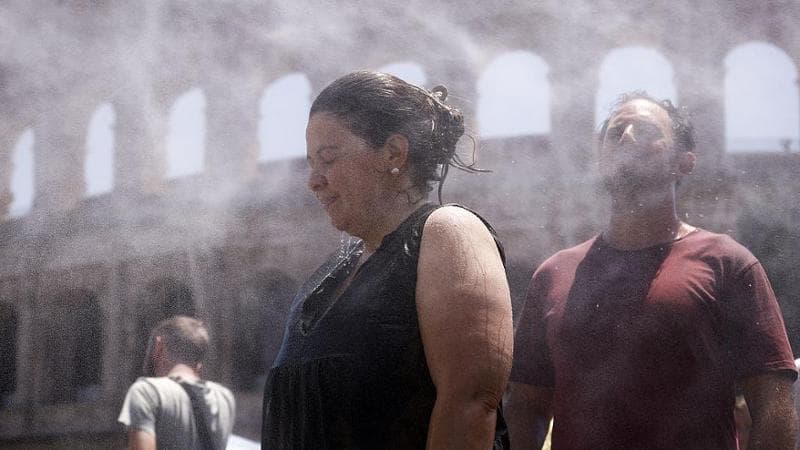
Italy is once again in the grip of the heat. This is the fourth heatwave of the summer of 2026 and, according to the bulletin issued by the Ministry of Health, today the red alert — the maximum warning level for the effects of high temperatures on health — applies to Campobasso, Perugia and Rieti. Tomorrow the number of cities under alert will rise to eleven, with Rome, Florence and other regional capitals in central Italy joining the list. Temperatures of up to 40 degrees Celsius are expected across several areas of the Peninsula.
The African anticyclone continues to dominate the Mediterranean, bringing very hot days, tropical nights and high humidity that raises the perceived temperature and makes it harder for the body to recover during the nighttime hours.
From heat to wildfires
The consequences extend beyond public health. In Piedmont, the grape harvest is preparing to begin somewhat earlier than the seasonal average. The accelerated ripening of grapes is one of the effects that farmers are observing with increasing frequency during summers marked by high temperatures and prolonged periods of drought.
On the Gargano promontory, meanwhile, the wildfire emergency has returned. Vegetation dried out by the heat and the lack of rainfall creates ideal conditions for even minor ignition sources to rapidly turn into large blazes.
Climate change
Scientists urge a distinction to be made between weather and climate. A single heatwave cannot automatically be attributed to climate change. Nevertheless, the broader picture is by now very clear. According to the Intergovernmental Panel on Climate Change (IPCC), the rise in the planet's average temperature caused by greenhouse gas emissions is making heatwaves more frequent, more intense and longer-lasting in virtually every region of the world. Europe is among the areas warming most rapidly, and the Mediterranean basin is considered one of the planet's principal climate hotspots.
The European Copernicus programme has also been recording rising average temperatures and a growing number of heat records for years: the European continent is warming at roughly twice the global average rate, increasing the risk of extreme events such as droughts, wildfires and heatwaves.
Climate attribution studies, developed by the international scientific community — in particular by the World Weather Attribution network, which brings together climate scientists from universities and research centres in various countries — further show that global warming significantly increases the likelihood that extreme heat episodes will occur and reach intensities that, in a climate unaltered by human activity, would have been far less probable.
Health risks
Heatwaves are among the most dangerous weather phenomena for public health. Intense heat can cause dehydration, heatstroke and the worsening of cardiovascular and respiratory conditions, especially among the elderly, young children, pregnant women and people with chronic illnesses.
For this reason, the Ministry of Health recommends avoiding direct sun exposure during the central hours of the day, drinking frequently even when not feeling thirsty, eating light meals, limiting outdoor physical activity and paying particular attention to the most vulnerable individuals.
A summer that confirms the trend
The new heat wave is part of a sequence of increasingly extreme summers affecting Italy and the entire Mediterranean. These are not simply very hot days, but phenomena with concrete consequences for health, agriculture, water resource availability, ecosystems and wildfire risk.
In other words, exceptional heat is no longer merely a weather story. It is one of the most tangible effects of a changing climate which, according to scientific projections, will continue to produce increasingly frequent and intense heat waves if global warming is not kept in check.