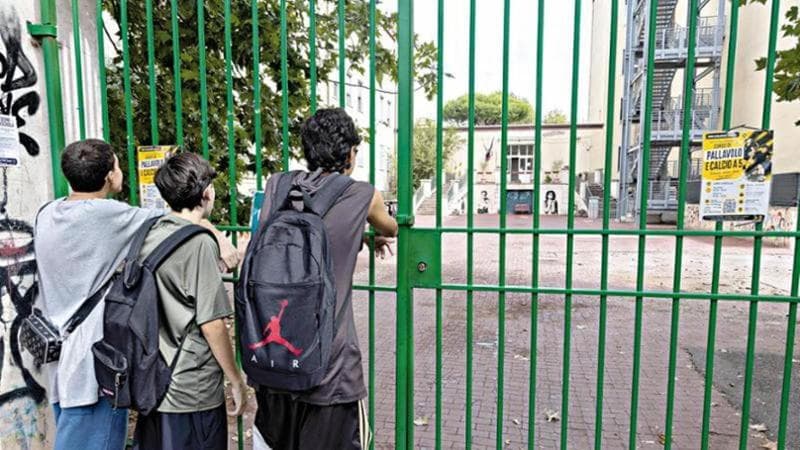
The Carabinieri carried out a digital search on the mobile phone of the 13-year-old who yesterday in Rome attacked a teacher at a middle school in the Centocelle neighbourhood, and on his mother's phone, which had stored the credit cards used to purchase the knives. Investigators also proceeded with a forensic copy. The aim is to reconstruct the contacts made by the minor before the attack and to determine whether anyone may have incited him to assault the teacher. As part of this investigation, the social media profile that the young person had opened, which had four followers, will also be analysed. The 13-year-old had, in fact, started a social media live stream before launching himself at the woman.
Psychotherapist: 'We need to talk about it and understand, but at home, not on TV'. Lancini: Italian juvenile law is highly advanced, but adults have normalised violence.
"We need to talk about it and understand, but at home and within the family, not on TV," given that "we adults have normalised violence: in politics, wars, the killing of children and individualism. This perhaps has an influence. We behave as if death has been normalised." This is the general comment by psychotherapist Matteo Lancini on the incident in which a teacher was stabbed yesterday by an adolescent in Rome.
Lancini, president of the Minotauro Foundation, spoke at Pordenonelegge to present his latest book. "Italian juvenile law is highly advanced," he explained. "People come from all over the world to study it, every week from Japan and the United States, much like what happens with the nursery schools of Reggio Emilia. I justify nothing — on the contrary, the law to help this boy will run its course," he continued. "This boy will not have a life as though nothing happened. I believe there is today an enormous difficulty in dealing with the complexity arising from our fragility in accepting that a thirteen-year-old who commits such an act is a thirteen-year-old who has not expressed his emotions in any other way." However, "let us not forget that the preferred way of expressing distress in recent years has been self-directed." The true emergencies in "neuropsychiatry worldwide are linked to male social withdrawal: the well-known phenomenon of hikikomori is the equivalent of an eating disorder." Lancini then touched on the subject of suicide: "We don't talk about it, and then we say that young people are taking their lives because of AI. Instead, we should talk about it at school and in the family, since it is a way of expressing distress." These forms of violence are "emotions that have found no language," less devastating ways of expressing oneself. We continue to believe that "if we talk about suicide, then young people will do it — but the opposite is true," he concluded.
Reproduction reserved © Copyright ANSA