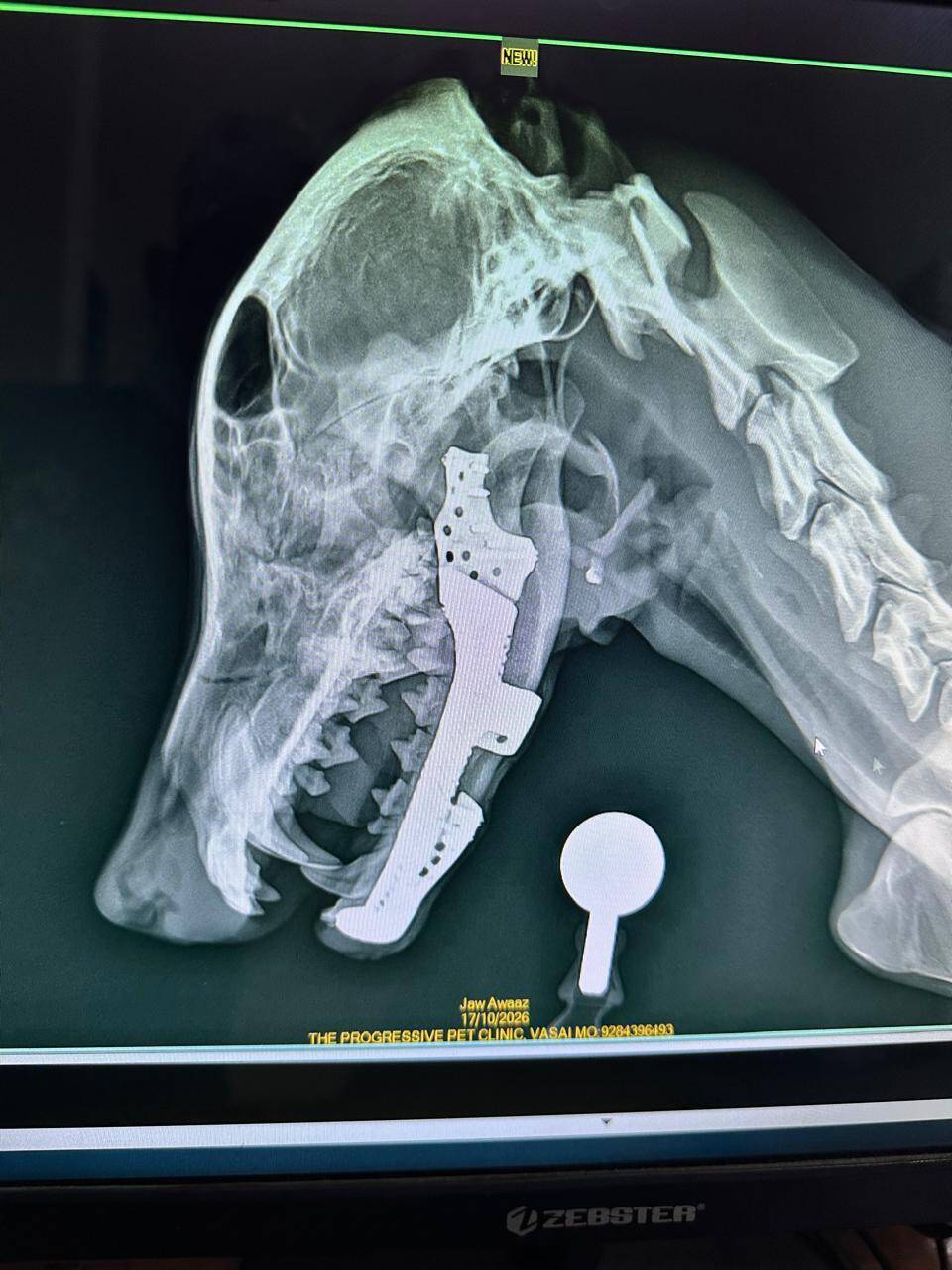
Mumbai: Innovation, collaboration and compassion came together to give a stray dog a second chance at life. A team of veterinarians in Vasai has fitted a rescued female dog with a customised 3D-printed titanium alloy lower jaw after a road accident left her mandible severely damaged, marking a rare veterinary reconstruction in India.
The dog, now named Jaw, was rescued from Nalasopara (E) by AWAAZ Voice of Stray Animals a few weeks ago and treated at Progressive Pet Clinic in Vasai.
Faced with an injury of this magnitude, one possible treatment approach would have been to remove the affected portion of the mandible. The team instead chose to explore a more ambitious alternative: reconstructing the damaged jaw to preserve its anatomy and function.
The team conceptualised a patient-specific mandibular implant, beginning with the development of a three-dimensional (3D) model of the remaining jaw. The implant was manufactured from lightweight titanium and customised to complement the remaining mandibular structure and then fitted into the dog. (See graphic)
This out-of-the-box approach turned out to be successful. Jaw is now eating well with her new titanium alloy lower jaw and is on the path to recovery.
The approximately three-hour operation was performed by Dr Nishit Gokarn, Dr Gail Barros, Dr Komal Gaikwad and Dr Aadesh. Dr Indraneel of Fredna Vet Diagnostics led the implant design and provided crucial CBCT imaging support for the case. This technology helped provide the detailed anatomical information needed to plan such a complex reconstruction.
Shoy Biomedicals and Orthotech India Pvt Ltd supported the technical and manufacturing aspects of this initiative, helping translate the implant design into a practical surgical solution.
The founder of Awaaz Voice of Stray Animals, Amit Pathak, said: “We had first consulted Dr Gokarn who suggested that we try to fit the stray dog with a titanium implant lower jaw. This was a new tech venture in the field of animal welfare, and we thank all those who helped save Jaw.”
Dr Gokarn said: “The stray, Jaw, has slowly gained control of her lower jaw movement, and she is eating normally. Unlike humans, dogs do not excessively chew their food, and only tear and break the food chunks, which are then digested inside.”
Sometimes, the greatest advances in medicine begin with a simple decision: not to accept the conventional answer as the only answer.
How Jaw got a new titanium lower jawA CT scan of the injured dog is taken to measure the exact dimensions of the mandible
A 3D model of the lower jaw is made with plastic material to check if it properly fits into the animal
A permanent titanium alloy jaw of the same dimensions is then created using 3D printing technology. This titanium lower jaw is then implanted into the injured animal
The stray dog, now named Jaw, has gained muscle control of her lower jaw and can eat by herself
The first recorded lower jaw implant with 3D technology on a human was in June 2011 on an 83-year-old woman in the Netherlands. She was suffering from a chronic bone infection
The custom titanium lower jaw was designed in collaboration with researchers at Hasselt University in Belgium and manufactured via laser-sintered titanium powder by the Belgian company LayerWise
The first recorded clinical applications of 3D-printed lower jaw (mandibular) implants in animals began appearing in the late 2010s in Europe and the US, notably with custom titanium and bio-composite reconstructions in companion animals like dogs and cats