Pressure on Trans People in the USA: "This Is Dehumanizing"
Since returning to the White House, the Trump administration has been working to curtail the rights of transgender people. Most recently, payments for treatments for transgender youth were halted. How is the community coping?
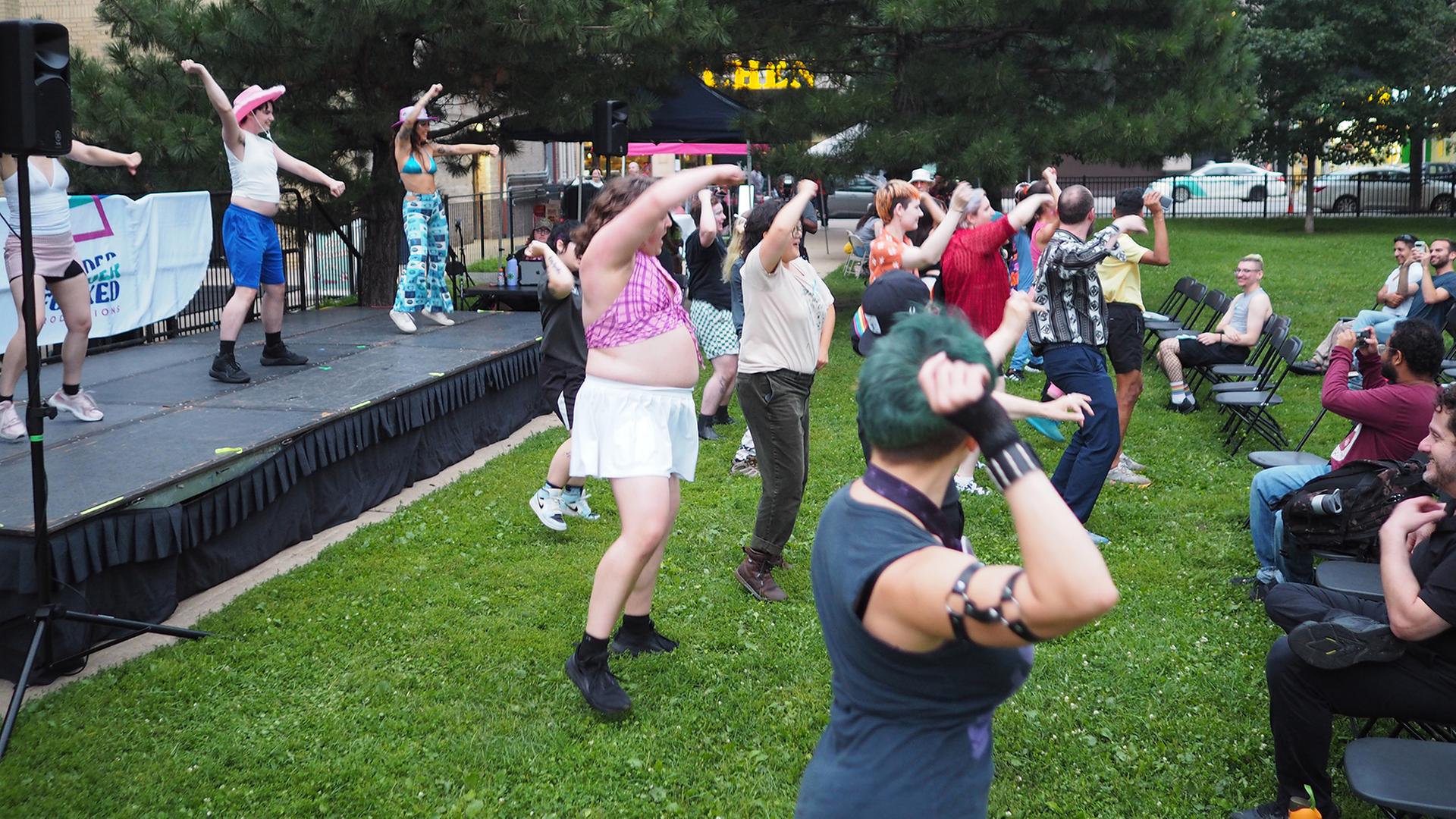
The area in front of the stage at Gill Park in Chicago is still empty — in about half an hour, the city's first Trans Pride Festival will kick off its second edition. For months, a group of activists has been preparing the small festival, booking bands, stand-up comedians and emcees. They are all trans — meaning they were not born with the physical characteristics that match what they feel, and how they want to be seen.
Dawn Heilung founded the festival, called Transilience — a portmanteau of "trans" and "resilience" — and is visibly delighted as more and more people fill the small park. She moved to Chicago from Texas.
"That we as trans people can feel and express joy — that is political. That trans people can come together in a world that says we shouldn't exist is an important act of resistance."
Heilung says that an ever-growing stream of laws, announcements and government harassment targeting trans people is having an effect: "This is dehumanizing."
Dawn Heilung (seated in the center) founded the festival.
Transgender Youth in the Crosshairs
Citing child protection, the U.S. government has recently targeted transgender youth in particular. More than 20 medical centers across the country halted treatment for transgender youth following threats from the Justice Department. The Department of Education is investigating school districts that allegedly fail to notify parents when their child presents at school under a different name, pronouns, or gender identity than the one assigned at birth.
The administration has also announced it will challenge before the Supreme Court a ruling that had found the exclusion of already-serving transgender individuals from the military to be unlawful. Those wishing to enlist have already been barred from being openly transgender since 2025.
In addition, a new directive from the U.S. Department of Health and Human Services will take effect in October: the federal health insurance programs Medicaid and CHIP — a form of basic public coverage for low-income families and children — will no longer be permitted to fund gender-affirming treatments for minors. This includes hormone therapies, puberty blockers and surgeries.
States may continue to fund such services from their own budgets, and private health insurers are not affected by the rule. Nevertheless, the measure is likely to hit low-income families with transgender children who depend on Medicaid particularly hard.
"I Don't Know Whether My Medications Will Continue to Be Covered"
Neil is a nurse and came to the Transilience Festival still in his work uniform. Neil has been taking testosterone for 13 years. For him, political developments are no longer an abstract debate but part of everyday life — the 31-year-old works at a public hospital.
"I don't know whether my medications will still be covered by my health insurance next year — because of the laws that have been passed," he explains. He is also no longer allowed to include his pronouns in his official email signature. And discussing the topic with patients — some of whom are also trans — is likewise prohibited.
And this is not contingent on the new Medicaid rule taking effect. He is already affected by restrictions on federal employees — and serves as an example of how political pressure is building on multiple levels simultaneously.
By now the stage program has begun: a young comedian jokes about his transition to being a trans man, about still being attracted to men, and about becoming the "perfect target." Laughter and also determined applause from the audience.
Scarlet Witton (right) and her wife Gilian (left) recently moved to Chicago.
Rules vary across the United States
Scarlet Witton, 65 years old, recently moved from Seattle to Chicago together with her wife, who accepted a job at Northwestern University. Safety was the deciding factor.
Chicago and the state of Illinois are considered a comparatively safe place for trans people in the United States: while states like Florida, Texas, Tennessee, or Louisiana already have their own — often even stricter — state laws, Illinois is taking a different path.
There, for example, Medicaid coverage for gender-affirming treatments is mandated, as is protection for treating physicians. For exactly that reason, several people on the ground say, many trans people from other states are currently being drawn to Chicago.
Memories of the 1980s
Scarlet's wife Gilian is also a British citizen — in the United Kingdom, following a Supreme Court ruling, trans people are not permitted to use public restrooms that do not correspond to their birth sex. "I'm certainly not going to use the men's restroom," says Scarlet.
She is already very worried right now, she adds. At the same time, Scarlet draws a historical comparison to a former U.S. president: "I lived through the Ronald Reagan era — he was also pretty terrible to the gay community during the AIDS crisis."
She has lived long enough to know that things come and go: "This too shall pass."
Further lawsuits?
The new Medicaid/CHIP directive is unlikely to be the Trump administration's last move. Federal courts have acted against earlier measures by the administration, and similar legal challenges to the current regulations are considered probable.
Until then, what remains for many of those affected is above all a growing uncertainty — and, as expressed at the Transilience Festival, a deliberate attempt to counter that uncertainty with visibility and community.