Greens Chair: Fact-checking the Interview with Brantner
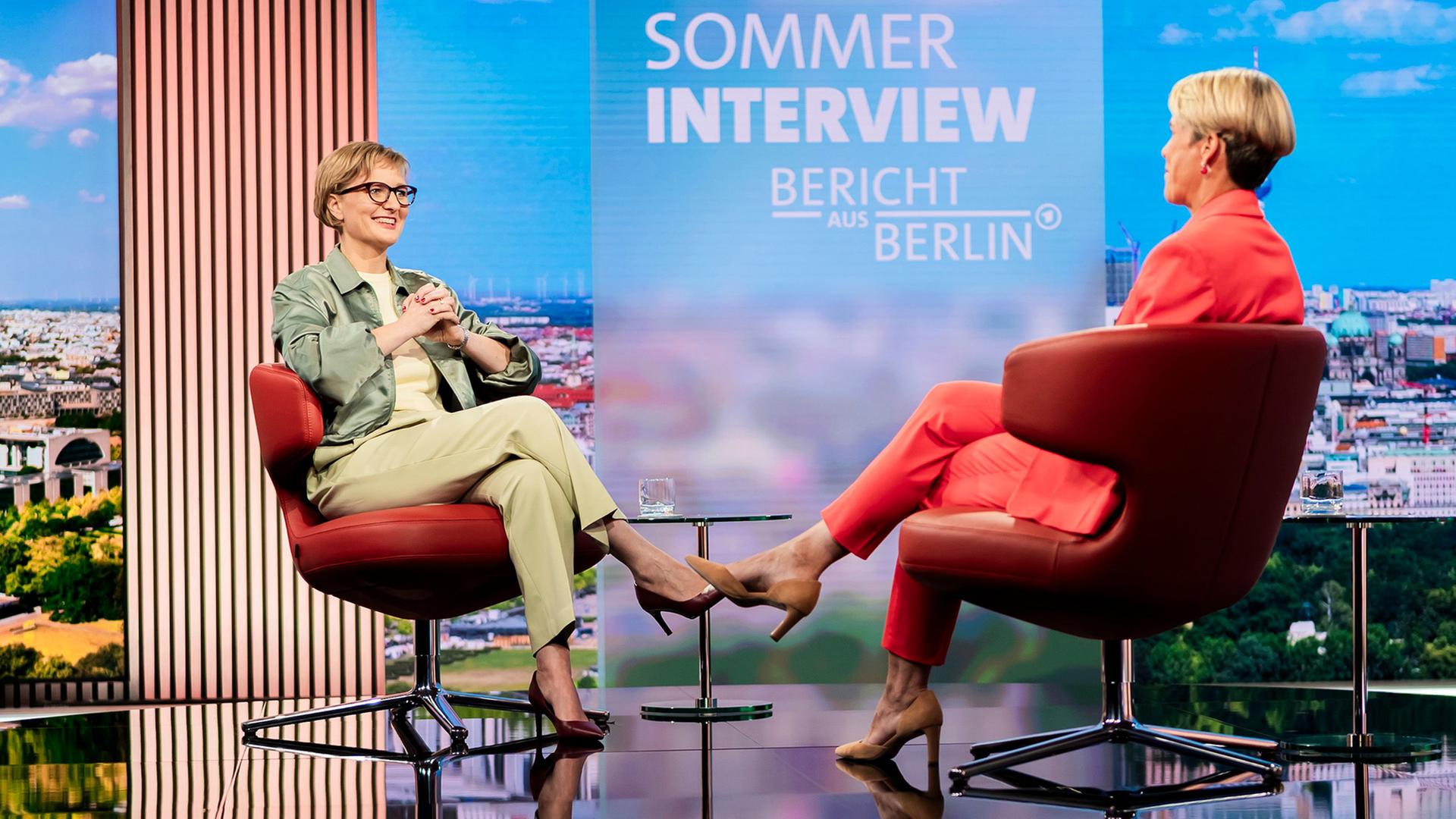
Greens chair Brantner appeared on the ARD summer interview. Most of her statements hold up to scrutiny. However, she was imprecise on matters such as the election in Saxony-Anhalt.
The ARD summer interview and the subsequent questions from the community with Greens chair Franziska Brantner focused primarily on economic policy and the upcoming state elections in Saxony-Anhalt and Mecklenburg-Vorpommern. Throughout the conversation, Brantner largely stayed close to the facts.
Since it is not always possible during such a conversation to immediately correct false or misleading claims, several of Brantner's statements are examined more closely here.
Greens alone cannot prevent an AfD majority
According to Brantner, one of the "most effective means" against the AfD governing alone in Saxony-Anhalt would be for the Greens to clear the five-percent threshold and thereby enter the state parliament. This would mean there would be "essentially virtually no chance of an AfD single-party government."
In order to govern alone in a federal state, a party needs an absolute majority of seats in the state parliament. It can achieve this by receiving more than half of the votes.
However, because of the five-percent threshold, it can happen that smaller parties fail to enter parliament. Their votes are therefore effectively "lost," which also shifts the balance of majorities in parliament. Theoretically, it is therefore possible for a party to obtain an absolute majority with less than 50 percent of the vote.
In polls, the AfD in Saxony-Anhalt stands at approximately 40 percent. The Greens, FDP, BSW, and sometimes the SPD are polling near the five-percent threshold. Should none of these four parties make it into parliament, the AfD would in all likelihood hold an absolute majority. This would probably also be the case if only the Greens were to clear the five-percent threshold. Conversely, the entry of several other "small" parties could prevent an AfD government even if the Greens were not represented in parliament.
AfD most popular among middle-aged men
Young men and the manifesto on "modern masculinity" recently published by Greens politicians were also discussed in the interview. Brantner said: "What concerns me is that in the younger generation we are seeing so much support for the AfD among young men." Here, however, context is important.
While it is true that the AfD, with 27 percent, was the strongest party among young men between 18 and 24 in the federal election, the AfD also increased overall across both genders in this age group by 14 percentage points compared to 2021, reaching a total of 21 percent. In the same age group, however, the Left Party had also gained 17 percentage points, achieving its best election result in this age group with 25 percent.
In general, the Left Party tends to be voted for more by young women, and the AfD more by young men — a phenomenon that, according to various studies, can also be observed across Europe and is referred to as the "youth gender gap."
Nevertheless, according to the representative electoral statistics, the AfD is most strongly supported by middle-aged men between 35 and 59: the AfD achieved its best results here with 24 percent among 25- to 34-year-olds and 26 percent among 35- to 44-year-olds, and also stood at 22 percent among 45- to 59-year-olds.
According to a recently published analysis, however, the overall picture is also important: barely four percent of all AfD voters in 2025 were young men between 18 and 24 years old. This is also related to the fact that this is a proportionally small group within society and that young people between 18 and 24 make less use of their right to vote: voter turnout in the 2025 election was below the average for the overall population.
What does the AfD plan regarding inclusion in Saxony-Anhalt?
The AfD was also addressed on another point. Brantner said that a child in a wheelchair would no longer be able to attend school if the AfD came to power in Saxony-Anhalt. However, this requires a more nuanced examination.
According to the AfD's government programme, the party considers the "inclusion experiment" to have failed. This refers to the joint schooling of children with and without disabilities and the abolition of special needs schools. Children with disabilities should receive teaching tailored to their situation, which according to the AfD is only possible at special needs schools. The AfD therefore wants to end inclusion immediately and expand special needs schools.
AfD education politician and state parliament member Hans-Thomas Tillschneider explained to MDR Saxony-Anhalt upon request, however, that the plans would apply to children with cognitive disabilities, but not to children with physical disabilities.
In the state parliament of Saxony-Anhalt, he also stated as early as August 2024: "It goes without saying that mainstream schools should be adapted so that children of normal cognitive ability who use wheelchairs can reach the classroom and participate in lessons." Joint teaching should also be pursued for children with hearing and visual impairments, insofar as technical aids allow.
In the AfD's government programme itself, however, the relevant passages only refer to "normally gifted children" and to "disabled children," with the type of disability not specifically differentiated.
Whether the complete abolition of inclusive teaching provisions would even be legally permissible under a sole AfD government is, however, questionable: Article 24 of the UN Convention on the Rights of Persons with Disabilities stipulates that signatory states must guarantee an inclusive education system at all levels. The equal treatment principle of the Basic Law could equally be invoked.
Inheritance tax dependent on various factors
A more differentiated look at Brantner's statements is also worthwhile on several economic issues. In connection with inheritance tax in Germany, she said: "If you have 300 residential units today, 300 houses, and you pass them on to the next generation — then the next generation pays not a single cent in inheritance tax. That's insane!" This statement is only partially accurate.
Under German law, there are tax-free allowances for inheritances that are determined by the degree of kinship of the heir. For example, a tax-free allowance of 500,000 euros applies to spouses and registered civil partners, 400,000 euros for children and stepchildren, and 200,000 euros for grandchildren. If the value of the inherited assets exceeds these amounts, inheritance tax becomes due.
The situation is different, however, when the inherited real estate belongs to business assets that are recognised as qualifying for preferential treatment. This is because exceptions and reliefs apply in such cases, as set out in Section 13b of the Inheritance and Gift Tax Act. Under certain conditions, inherited assets can in fact be heavily tax-privileged or pass on virtually tax-free.
Tax expert Julia Jirmann from the Tax Justice Network criticised in April, speaking to NDR: "Business assets are largely exempt from taxation without there being a sufficient economic justification for this."
Given the scale of inherited real estate mentioned by Brantner, one can probably indeed assume the existence of business assets — that is, a residential property company — but the statement is not generally accurate.
Heat pumps as air conditioning units too?
Brantner emphasised that heat pumps can also be used as air conditioning units. In principle, this is possible. However, the devices must be designed for this purpose, which is not the case with all models. Furthermore, heat pumps are not as effective at cooling as conventional air conditioning units and cannot generate a cool airflow. Dehumidification of the air is also not possible with these systems.
The efficiency of heat pumps in this application depends significantly on the heating and cooling elements installed in the rooms to be cooled, which are supplied by the heat pumps. Conventional radiators, for example, are not particularly well suited for this purpose. Heat pumps that operate on the air-to-water principle — which account for around 95 percent of heat pumps in Germany — also consume electricity when lowering temperatures.
Contributors: Philip Kuntschner and Ruth Kirchner, ARD Berlin Studio