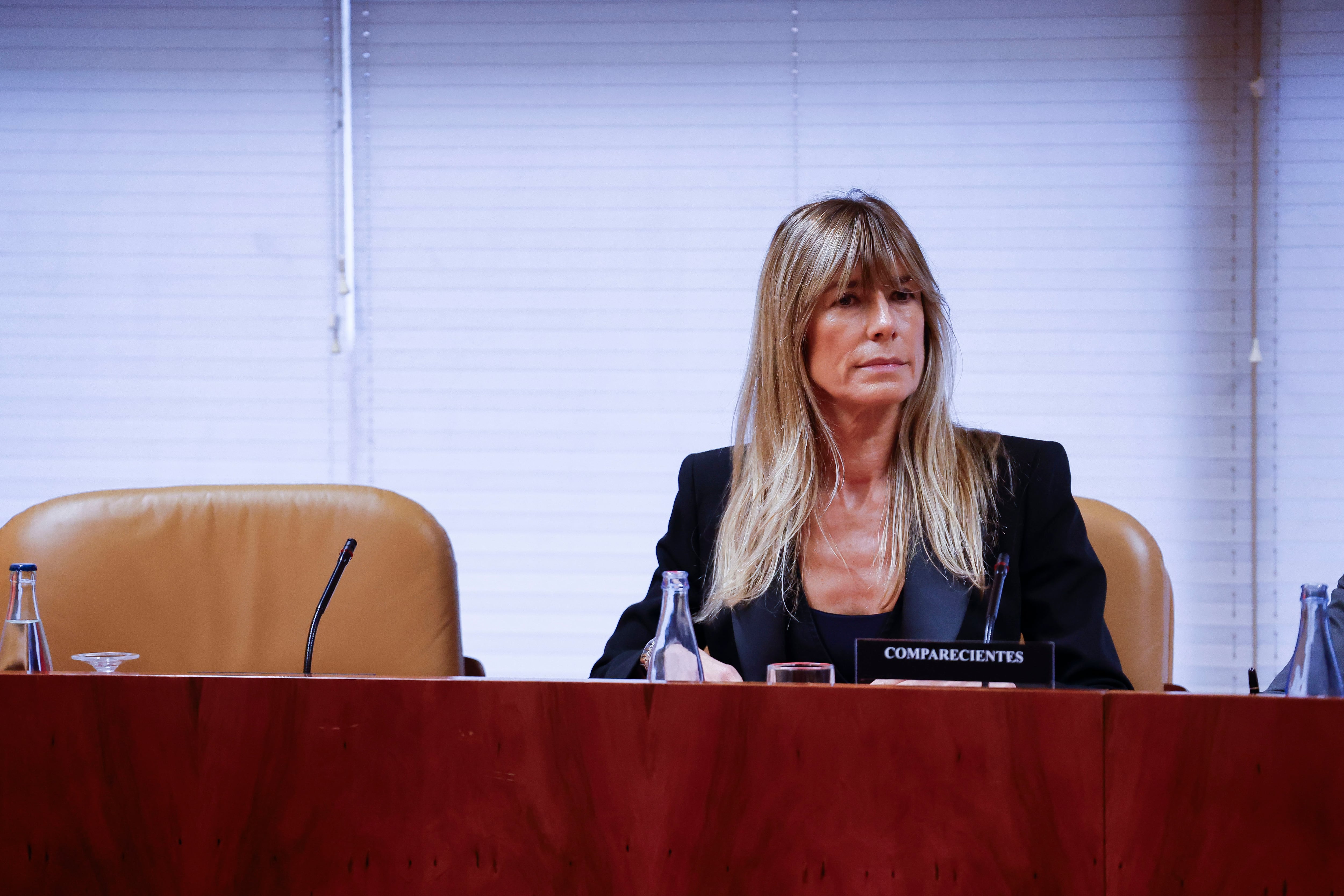
Magistrate Juan Carlos Peinado has led for two years and five months a controversy-laden investigation against Begoña Gómez, wife of Prime Minister Pedro Sánchez. For the first time in Spain's democratic history, an examining judge has charged, prosecuted and sent to trial — a decision he signed this very Monday, barely six days before his retirement — the partner of a head of government. Although the Provincial Court of Madrid has guided part of his inquiries and set the path along which the case could proceed, Peinado spearheaded the initiative to have Gómez appear before a jury of nine citizens. But from now on, the matter is entirely out of the hands of the controversial magistrate. What begins, in the words of sources close to the case, is the "post-Peinado era."
At 10:18 on Monday, Peinado signed the order opening oral proceedings against Begoña Gómez on charges of influence peddling and embezzlement, and against her assistant at La Moncloa, Cristina Álvarez, on embezzlement charges alone. This was a step anticipated by both the defense and the prosecution. No one expected that, at this stage of the case and with the Madrid Court already having endorsed the prosecution of both women on those charges, the examining judge would make a 180-degree turn and shelve the inquiry he had driven — one that made him a central figure in this country's political and legal debate. For weeks, therefore, the parties have been thinking about what comes next. The following are some of the key questions that will shape it:
Which judge will take over the case? The file will be referred in the coming days to the Madrid Court, which will be responsible for the future trial. Once all documentation has been received, this court — the largest collegiate body in Spain, with nearly 180 magistrates — will have to determine which of its specialized criminal sections receives the case by assignment. Sources from the Superior Court of Justice note that the provincial court has 15 sections dedicated to that area, but three are ruled out from the outset: two because they focus on gender-based violence matters, and a third — officially designated as Section 23 — because it is considered tainted, having already been exposed to the contents of the case file when ruling on appeals against decisions made by examining judge Peinado.
Once the section is determined, the time comes to identify which magistrate will take on the proceedings — who will, among other matters, preside over the jury trial, rule on any new preliminary questions raised (such as rights violations) and draft a future verdict. Each section has five judges and, according to legal sources, an established rotation is followed based on seniority within the section.
Can the trial end up not being held? The law contemplates this possibility, but it will not be easy. The Jury Law establishes that, when appearing before the provincial court, the parties may raise preliminary matters prior to the trial (for example, nullities and rights violations). Defense sources explain that they plan to use this opportunity to ask the new magistrate to dismiss the case based on an argument that Peinado rejected this Monday: that the accusation brief filed by the ultra-Catholic association Hazte Oír, which leads the only private prosecution in the case, contains "serious" technical "defects" incompatible with the regulations and already "irremediable"; meaning it cannot be accepted and, since there is no other, the case must be closed.
What timelines are being considered for holding the trial? Legal sources emphasize that, from the time the case enters the court and goes to trial, the provincial court works with timelines ranging from five to ten months. These sources stress that this is an estimate and will also depend on how long the newly designated magistrate takes to resolve any preliminary matters raised, as well as to decide which evidence will be accepted for presentation before the newly selected jury members. In this regard, government sources estimate that a possible trial would not take place until well into 2027 and, therefore, it is being considered that it may not be held before the general elections.
For now, in his ruling this Monday, Peinado himself notes that the Prosecutor's Office is being given a ten-day period to submit its brief of provisional conclusions — it has already indicated it will seek acquittal. Once the public prosecutor does so, all parties will have another fifteen days to appear before the Madrid Court and raise their preliminary matters. Afterward, the newly designated magistrate will need to resolve them and issue a new ruling to, among other things, "specify the act or acts subject to judgment" in the future trial. According to the law, the magistrate "shall also set a date for the oral hearing" and for the formation of the jury, which will be conditioned by other proceedings in which the magistrate is involved.
Will Pedro Sánchez testify? Among the matters the new magistrate will need to resolve are the evidence to be presented during the trial and the witnesses to be questioned. The popular prosecution led by Hazte Oír has called for nearly a hundred people to testify, including Pedro Sánchez; Félix Bolaños, Minister of the Presidency, Justice and Relations with Parliament (whom Peinado attempted to charge and the Supreme Court dismissed for lack of evidence); and lobbyist Víctor de Aldama, convicted of corruption in the Koldo case. However, sources close to the case explain that the magistrate has the option to pare down that list and that, precisely, the examination of such a large number of proposed witnesses opens the door to further delays.
In her defense brief, Begoña Gómez did not request that her husband testify at the trial. Along these lines, when Judge Peinado went to La Moncloa during the investigation phase to attempt to question the Prime Minister, the latter exercised the right of every citizen not to testify in proceedings opened against his spouse.