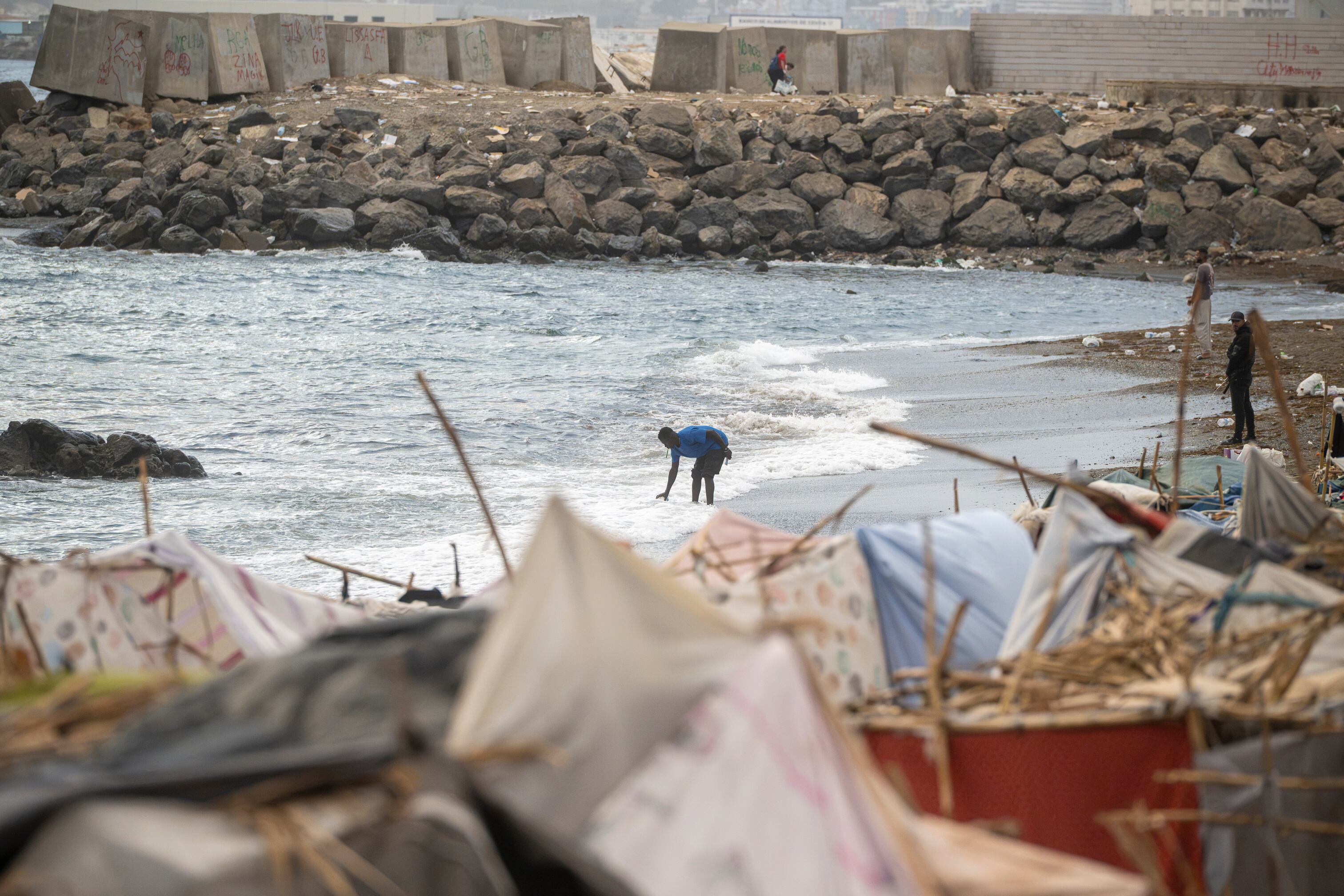
"I am very much PP, but I represent all the people of Ceuta. I cannot blame the minister for doing what I asked him to do." These are the words of the president of Ceuta, Juan Jesús Vivas, to EL PAÍS in August 2021, following the migration crisis triggered in the city by the arrival of 10,000 people in just two days, while his party was calling for the resignation of the Interior Minister, Fernando Grande-Marlaska. After visiting Pedro Sánchez at La Moncloa, he declared: "Thanks to the reaction of the Spanish Government, with the president at the helm, disaster was averted." Today, both administrations are accusing each other of "entrenching" a crisis of far greater dimensions following the entry, at the end of last July, of some 80,000 immigrants — nearly the equivalent of Ceuta's original population. The Government estimates that around 10,000 remain in the city. The reasons behind the entrenchment of the problem speak to everything that has changed over the past five years, both inside and outside Spain. Neither the Government's discourse, nor that of the PP, nor that of the international community is the same as in 2021. Experts from various disciplines explain to EL PAÍS how the evolution of the national and international political context has shaped the relationship between the institutions that must provide the solutions.
The permanent campaign
All those consulted for this report agree that the central Government reacted too slowly. Nearly a month after the mass entry of immigrants into Ceuta, the Executive agreed to declare (until 31 December) the "situation of national security interest" which, under the law, is provided for events that, "due to the severity of their effects and the scale, urgency and cross-cutting nature of the measures required for their resolution," call for "enhanced coordination of the competent authorities in the exercise of their ordinary powers, under the direction of the Government." In May 2021, following what had until then been the largest simultaneous entry of immigrants into the autonomous city, Sánchez cancelled a planned trip to Paris to travel to Ceuta and Melilla accompanied by the Interior Minister, while a crisis cabinet convened at La Moncloa and after he had briefed the King and the PP leader, at that time Pablo Casado.
"What has to do with," notes political scientist Pablo Simón, "the anticipation and immediate management of the crisis is a mistake by the central Government, which should have assumed command earlier. We are now in the phase of managing the consequences of that crisis, and the Ceuta government is starting to engage in some filibustering, placing the Executive in an impossible position, since it opposes ceding spaces in the autonomous city and also fails to promote transfers, especially of minors, to the mainland, because it understands this could be interpreted as saving Sánchez and because it shifts the problem to its fellow regional barons, given that the majority of communities are governed by the PP. The moment is very different from 2021 due to the proximity of several electoral dates, which dramatically increases the incentives to shift responsibility onto the other side, to dig in, and to refuse to bear political costs. This is what explains the hardening of Vivas's discourse." The minutes of the meetings of the situation committee in which the president of Ceuta participated with Sánchez and the ministers involved in the crisis show, for example, that—after opposing other suggested locations—the Ceutan president supported the use of the port to house the migrants wandering the streets of the city, although subsequently the PP criticized the installation of a provisional camp there, and the Port's Board of Directors, controlled by people trusted by Vivas, rejected the use of these facilities.
Carmen González Enríquez, principal researcher at the Elcano Royal Institute, where she heads the areas of Public Opinion and Migration, agrees that "the reaction of the central Government was extremely slow" because "it did not properly heed prior warnings" and because "it lacked reflexes," as "it should have placed the floating barrier that was installed after the crisis much earlier, when it received those warnings or when the Supreme Court ruling preventing the immediate return of people who arrive by swimming created an extra migratory incentive." But the researcher adds that in this phase of managing the consequences of the mass entry of migrants into the autonomous city, "the context of political polarization and the proximity of elections" also plays a decisive role, "making loyalty between the parties involved impossible." "All the actors," she concludes, "are using the crisis politically."
Narratives versus competencies
Magistrate Joaquim Bosch explains that "the declaration of unified command does not alter the distribution of competencies, as it is a coordination instrument. It falls to the central Government to register and identify adults and minors, and to the government of Ceuta to provide guardianship of the latter, as the Constitutional Court has already established, equating the autonomous city to the autonomous communities in that regard."
The Ministry of Interior must handle the registrations, and from there, the responsibilities shared between the central government and the autonomous city administration are activated to organize returns or to assist those who remain. Marcelo Belgrano, a lawyer with 35 years of experience in immigration law and a member of the immigration subcommittee of the CGAE (General Council of Spanish Lawyers), describes this as "the chicken and the egg" because it is the Ministry of Interior that carries out the registrations, but to do so it must have spaces in which to conduct screenings, and it is the autonomous city that must provide them.
"The Government," Simón notes, "does not have a UME of civil servants to send to Ceuta to resolve cases swiftly. It is a long and complex process, but because no effort has been made to explain this to the public, public opinion holds the central government more responsible than Vivas's administration, because people saw Vivas there from the beginning and not Sánchez."
The crisis has shown, in Bosch's view, that "despite the precedent of 2021, there was no plan to deploy an immediate response structure, with a sufficient number of police officers and professionals from various fields, and that coordination between administrations has failed. The legal framework clearly establishes what must be done and, contrary to what the PP maintains, there is no alternative because Spain is a state of law. The fact that some of those minors and the adults who exercise their right to asylum may remain in Spain is not a legal problem, but a political one for those parties that believe it could come at an electoral cost. If the money the Government has offered Ceuta does not seem sufficient to them, they should say so and explain why, but what they cannot do is obstruct viable solutions."
Lourdes Reyzábal, president of the Raíces Foundation, which has spent 30 years assisting minors like those who have arrived in Ceuta, stated after visiting the autonomous city this week that the situation is "absolutely devastating." Nearly two months after the crisis began, she was able to confirm that "there are many children still living on the streets, unidentified, without access to a toilet or a shower and exposed to all kinds of abuse." Some of them, she says, "are not gaining access to the family reunification procedure despite having parents in Europe, and in other cases where they could return to Morocco they are also unable to do so because they have not been identified or because of the difficulty of having their country respect the legal procedure." The current method, she adds, is "ineffective": "There are days when, despite there being available places in some protection facilities, some children are unable to occupy them due to a lack of police officers to carry out their registration. It makes no sense that, with places available, a child of 12 or 13 years old, who clearly looks like a child, should spend another night on the street because the protocol dictates that they must first go through the Police."
Contradictions and changes of course
Another of the major differences compared to the 2021 crisis on which the consulted experts agree is the general hardening of discourse on immigration and the advance of the far right across Europe. "Today," notes Carmen González Iglesias, "it is much easier than it was then to employ a tougher tone because the majority of states and public opinion has shifted in that direction — toward a heavy-handed approach and the priority of national interest over a humanitarian approach. In 2021, the European Commission immediately expressed its solidarity with Spain, but this time the first reaction was a document signed by 22 states holding Spain responsible and linking what happened to the extraordinary regularization."
"In 2021," adds political scientist Pablo Simón, "immigration was not on the national and international agenda with the same intensity as it is now, when the security framework has clearly prevailed over the humanitarian one, and not only on the right." The PP has signed regional government agreements with Vox in which it explicitly commits to not accepting what they disparagingly call "menas" (an acronym for Unaccompanied Foreign Minors), and this very week it backed an initiative by Santiago Abascal's party in Congress to reject their relocation to the mainland. The proposal did not pass because it failed to gather the necessary votes and, in any case, current legislation obliges regional governments to accept them, despite which some administrations, such as that of Madrid, have taken the matter to the courts. Bosch points out that if Ceuta were to fail in its responsibilities regarding minors, "Article 155 could even be applied — the constitutional article that allowed intervention in Catalonia during the procés — but although it would be legally viable, politically it is not, because there is no sufficient majority and the cost would be very high."
The government of Ceuta and the PP insist that the national government must return the minors to Morocco, even though, as magistrate Bosch recalls, "it knows that what Morocco says is one thing and what Morocco does is another, since in practice it rarely complies with the agreements it signs or places obstacles in the way. The reports of the Public Prosecutor's Office tend to reflect this." The Minister of Youth and Childhood, Sira Rego, recently stated that before the mass arrival on July 31, Spain had already sent Rabat around 600 case files on minors in order to seek family reunification, and that the response had been "absolute silence."
Vivas, who is familiar with these difficulties, now insists that the minors be returned to Morocco, but in 2024 he supported the establishment of a mandatory distribution of unaccompanied foreign minors among the autonomous communities, despite the fact that the leader of his party, Alberto Núñez Feijóo, claimed it would cause a "call effect." At that time, that is to say barely two years ago, the president of Ceuta publicly assured that the PP was not going to "submit to the pressure from Vox" and criticised their position in these terms: "The only thing they propose is the return of minors to their countries of origin. These are absolutely unviable proposals and reflect ideological positions that we do not share at all." Abascal's party ended up breaking its coalition agreements with the PP for accepting that distribution of minors in 2024, but when the conservatives again needed their votes to renew their regional governments, they agreed to include the phrase "no more unaccompanied foreign minors (MENAs)." Bosch, Simón and Belgrano also agree in pointing out the difficulties of sending to the mainland a particularly vulnerable group: the 500 girls who arrived in Ceuta — another difference compared to the 2021 crisis, when their presence was minimal. Vivas assured this Thursday, contrary to what had been stated