Key events
Northern Ireland’s First Minister Michelle O’Neill had condemned the late- night court ruling allowing the march to proceed.
"Our message tonight is clear. There is no going back. Not tomorrow. Not ever.”
Sinn Fein supported the residents of Garvaghy Road to protest against “this unwanted sectarian march,” she said.
Hello and welcome to our live coverage of the latest news in Northern Ireland after a Protestant march was permitted to go ahead on Sunday for the first time in almost 30 years.
The original dispute over the route of the Orange Order parade down the Garvaghy Road in Portadown became one of the defining flashpoints of the conflict in Northern Ireland.
Here is a quick recap of the latest:
-
A Protestant parade may proceed through a Catholic area, Northern Ireland’s high court ruled early on Sunday, reversing a temporary ban on the highly charged march in an area that has historically been a flashpoint of sectarian disputes.
-
The high court dismissed a new application to stop the Orange Order from going through the area of Portadown after the court of appeal vacated a temporary injunction granted on Saturday to residents who opposed the parade.
-
Residents of the Garvaghy Road area had challenged Friday’s ruling by Northern Ireland’s Parades Commission that permitted the Orange Order to march along their road, a Catholic enclave in the largely Protestant town, overturning an almost 30-year ban on the route.
-
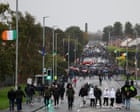
A crowd gathered on the Garvaghy Road early on Sunday morning to protest against the ruling to allow the march. In the crowd were Northern Ireland first minister Michelle O’Neill, who is also vice-president of the Irish nationalist Sinn Féin party.
-
The party’s leader, Mary Lou McDonald, posted a video on social media of the gathering. “Although the forces of darkness may want to stop us creating a new united Ireland, they will fail,” McDonald told a crowd of protesters in the clip, posted on X.
-
Annual attempts by the Protestant Orange Order to march through the area triggered unrest across the British-run region before the route was banned in 1998, the year the Good Friday agreement largely ended the three decades of violence known as the “Troubles”.
-
The Parades Commission’s determination on Friday stipulated that a smaller-than-usual 35 people could take part in the march, that it should begin by 8am (0700 GMT) and finish by 9:30am, and that no supporters or bands would be allowed.