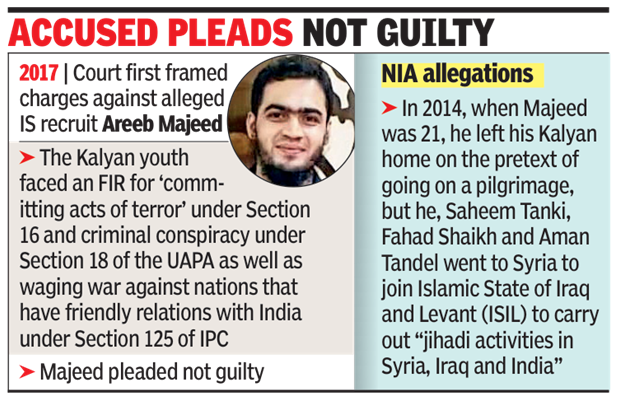
Mumbai: A special National Investigation Agency (NIA) court on Friday framed an additional charge against alleged IS recruit Areeb Majeed for allegedly receiving funds to join the terrorist organisation Islamic State of Iraq and the Levant.
Judge Abhay A Joglekar framed the charge under the Unlawful Activities (Prevention) Act following the filing of a fifth supplementary chargesheet by the prosecution. The court added this fourth charge to three previous charges framed in April 2017. Framing the new charge, the judge said, “That, you accused Areeb Ejaz Majeed also known as Guddu and Abu Ali Al Hindi, between May 2014 and Oct 2014, knowingly collected and received a sum of US$1,000 from a Kuwaiti national, contacted through persons associated with the terrorist organisation Islamic State of Iraq and the Levant (ISIL) knowing that these funds were meant to be used by you to join ISIL, for undergoing training of use of arms and explosives, and to take part in its terrorist activities, including causing Fidayeen attacks and to take active part in the war against the govts of Iraq and Syria, countries which are in peace with the govt of India and for that, you knowingly collected and received funds for commission of above terrorist acts and thereby you accused have committed an offence punishable under Section 17…”
Majeed, a thirty-three-year-old engineering student residing in Kalyan, had the contents of the additional charge read and explained in English. The judge noted that the accused understood the contents and pleaded not guilty.
Majeed and three friends, all from Kalyan, travelled to Iraq in May 2014 and allegedly joined IS. Only Majeed returned. The trial began in 2018. The fresh charge under the Unlawful Activities (Prevention) Act (UAPA) is based exclusively on Mutual Legal Assistance Treaty (MLAT) documents from
Kuwait. The agency invoked it based on the allegation that one Abdullah Hadi, who was reportedly under probe by Kuwaiti authorities for financing banned groups, allegedly transferred $1,000 to Majeed.
Earlier, the court had rejected Majeed’s plea opposing the charge. “It is axiomatic that, as further investigation has been kept open, new material relating to the offences alleged against the accused may come to the notice of the investigating agency. In that case, the prosecution and the investigating agency cannot be precluded from filing the same on record. To arrive at the final conclusion, in the interest of justice and also in the interest of all the concerned, relevant evidence has to be taken on record,” the then presiding Special Judge Chakor S Baviskar had said.
The judge also clarified that the defence would receive a full opportunity to challenge the veracity, admissibility and acceptability of the new documents. Addressing the specific fears raised by the accused regarding the terrorist funding offence under section 17 of UAPA, the court remarked, “Fear of the accused of framing charge for offence...17 of the UAPA against him, at this moment is hypothetical.” The court noted that the prosecution had not requested such charges in the current plea, which solely sought to make the fifth supplementary chargesheet, the central govt’s sanction order and an electronic evidence certificate a part of the original chargesheet. Majeed is out on bail.
