Wacken Open Air 2026: Between Village Fields and Wall Street
The Wacken Open Air takes place every year in a small village in Schleswig-Holstein. But it has long since become a global event. The ownership structure has now also turned international. What does that mean for the festival?
This story begins at the end, when the 85,000 metal fans have departed from the "Holy Ground." Then the small but world-famous municipality of Wacken in Schleswig-Holstein belongs once again to its original inhabitants and the cows that graze there peacefully.
Magnets in the Cow's Stomach
Cows are not known for their fine motor skills: with their powerful tongues, they tear clumps of grass from the ground — and sometimes metal too. Real metal, not sound waves. Tent pegs, nails, razor-sharp can tabs. Everything that gets overlooked despite a thorough search of the festival and campground ends up in the stomachs of the ruminants.
This could become a problem, but the cows of Wacken have large magnets in their stomachs. These attract the scrap metal and bind it, so the animals mostly come to no harm. That is what one farmer in Wacken does, as he told NDR. The approximately 400-hectare plot of land — equivalent to more than 500 football pitches — on which a state of exception reigns for just a few days each year belongs to 19 farmers.
The Field as a Business Model
The brief period during which they lease their land to the festival is so attractive to many farmers that they have completely restructured their agricultural rotation around it. That is what farmer Sönke Trede reports. He owns the "Holy Ground," the area directly in front of the two main festival stages: "The arable crops gave way to a grass surface, because that holds up better under vehicle traffic."
From metal fan in the village to millionaire: Wacken founding fathers Thomas Jensen (left) and Holger Hübner. Their lives have been adapted for film and television on multiple occasions.
Wall Street on the "Holy Ground"
Approaching the site, you can already see the black Wacken tower — actually a former grain silo — from a great distance. It bears the large letters W:O:A (for Wacken Open Air), like the emblem of a powerful major corporation, comparable to the logos of furniture or car manufacturers.
The financial value of the Wacken brand is difficult to quantify. In 2019, the two company founders, friends and Wacken natives Holger Hübner and Thomas Jensen sold 55 percent of their shares to the globally operating British festival group Superstruct Entertainment.
In 2024, Superstruct was in turn acquired for around 1.3 billion euros by an even larger US private equity giant called KKR, headquartered on Wall Street. According to an estimate by financial expert Stefan Loipfinger — whom the NDR 1 Welle Nord Wacken reporters interviewed for their podcast — the two company founders received a combined minimum of 40 million euros for the sale of their stake.
Fans from around the world with a fondness for dark clothing and loud music
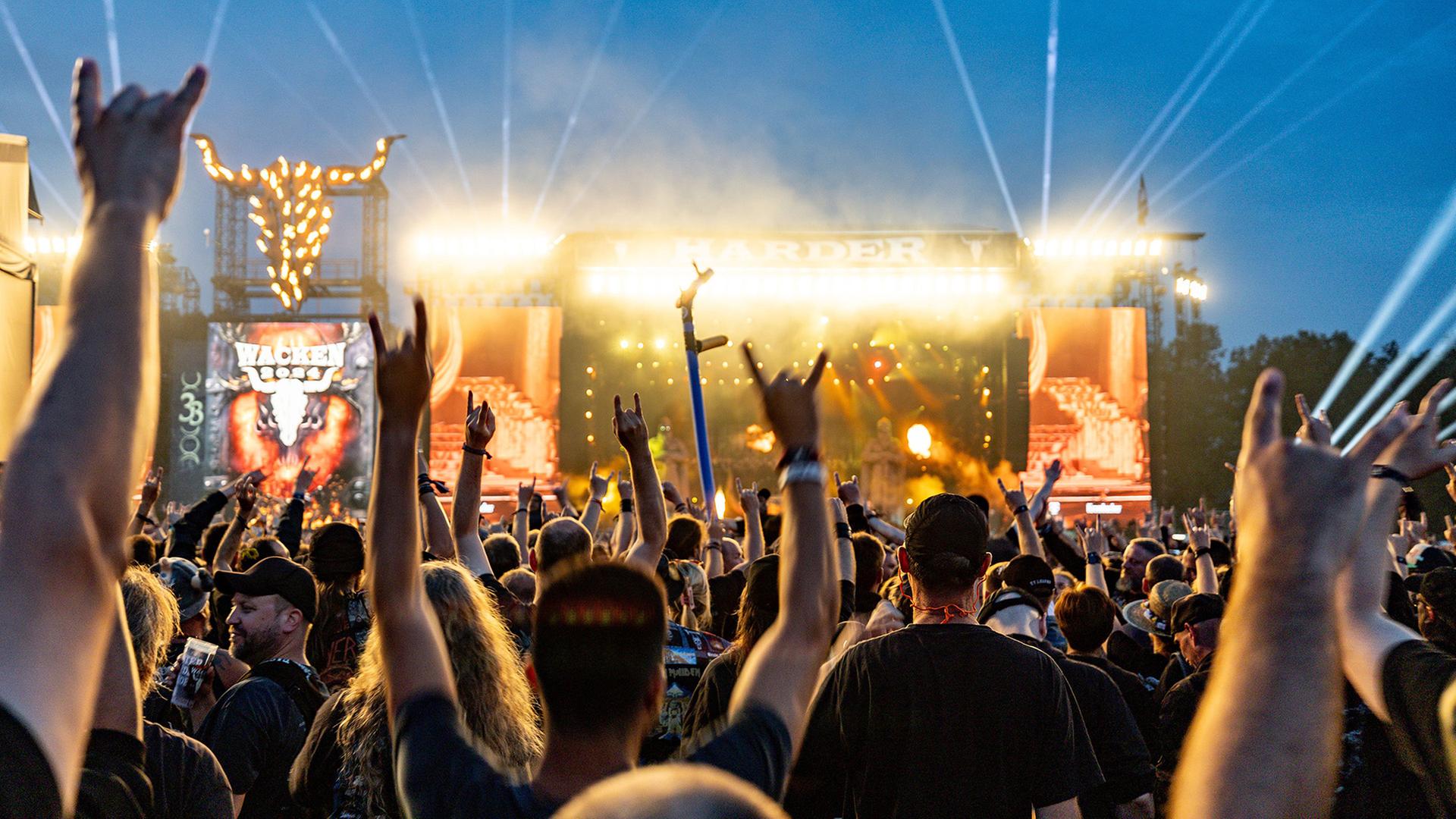
But the "W:O:A" is neither a piece of furniture nor an automobile. Wacken is a village party that conquered the world starting from a field in 1990. A grown feeling and a spirit that binds a large fanbase with a fondness for dark clothing and loud music across continents — and draws them like a giant magnet from the most remote corners of the world to Schleswig-Holstein. A fixed ritual. They storm the "Holy Ground" by the thousands, throw themselves to the ground and kiss the field, before celebrating peacefully together.
It belongs there, like tube amplifiers and decibels: rain and mud on the "Holy Ground."
**The Utopia in the Mud**
This peaceful atmosphere and the mutual willingness to help among fans, consistently observed over decades, have themselves become part of the Wacken myth. But what does that mean: myth? Could it be that myths created by mortal beings decay over time?
**Average age of the metal legends: 70 years**
Gods do not age. But the flesh-and-blood metal legends do. The average age of the three remaining musicians from the debut lineup of Judas Priest, one of this year's most prominent headliners, is 75 years.
For the guys from Deep Purple, Iron Maiden and the Scorpions, stars of past years, the average age is 70. In a room of the former village inn, there is a memorial to festival icon Lemmy Kilmister. It commemorates the legendary Motörhead frontman, who died around ten years ago. His cowboy boots and electric bass can be admired in a display case. Outside the door stands a Lemmy statue that contains an urn holding a portion of his ashes.
**New headliners and sluggish ticket sales**
Does this mean a heavy metal death knell? No, not at all. A glance at the official W:O:A website reveals: young musicians and bands are being given performance opportunities and are being supported. Wacken is also being further modernised. On the infield, the organisers have laid new drainage pipes so that rainwater can drain away more effectively.
But the festival is no longer the sure-fire sell-out it was in previous years. It sold out only late. While new metal heavyweights such as Sabaton and Powerwolf are heralding a generational shift, the power metal acts from Sweden and the Saarland are barely known outside their own scene — whereas songs like "Smoke on the Water" or "Wind of Change" have long since become part of the popular mainstream.
**Tickets, prices, cost of living: fans are calculating more carefully**
Metal fans are loyal. Many have been coming for decades already. At first they came with a tent and a sleeping mat, later they chartered motorhomes. At first you shared a portable toilet with many others, then you had one of your own. Luxury can be added step by step via electronic card.
The festival is getting on in years and becoming more commercial — not all fans are going along with that.
**Luxury in the "Moshtel"**
This includes premium living containers, log cabins and hotel-like "Moshtels": with reserved parking spaces, a dedicated catering area and a wellness bus. Up to 2,400 euros can quickly disappear from the credit card. From the investors' perspective, it is a logical development to maximise consumption per visitor and per square metre of festival space.
**Loyal fans, growing concerns**
The Rendsburg-based Wacken fan Kai Kirchner, who also has his say in the Wacken podcast on NDR1 Welle Nord, looks back on the W:O:A, which begins on July 29, with mixed feelings. Kirchner and his friends regularly set up one of the largest camps on the grounds. Kirchner remains loyal to the festival.
Last year, they had still celebrated extensively with festival founders Holger Hübner and Thomas Jensen. But at least two people from his group have definitively cancelled their attendance, he says. He fears there could be even more. The magnetic appeal of Wacken Open Air is still there. But only for as long as metal fans continue to align their inner compass with it.