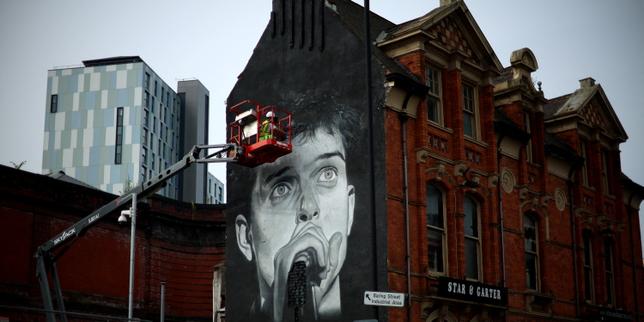
(by Paolo Petroni)
JOHAN HARSTAD, 'MAX, MISCHA AND
THE TET OFFENSIVE' (SELLERIO, pp. 1250 - 28.00 euros -
Translation by Sara Culeddu and Maria Valeria D'Avino)
A sprawling novel with a narrative current that carries you along but never overwhelms, entirely enjoyable as an involving existential voyage where nothing exceptional or adventurous happens, yet an everyday life grows that, through the affabulatory force of the writing and the richness of the storytelling, becomes life itself — thanks to the quality of the translation — made of moods and feelings, absences, desires and nostalgia. An ordinary existence that has led many to think of another large-scale novel, 'A Little Life' by Hanya Yanagihara (coincidentally also published by Sellerio years ago), but which here, since Max Hansen, the protagonist and narrator, is a director, has as its counterpart, as a mirror of the world, the theatre, in its metaphorical value and in its daily reality of rehearsals, performance, approximations, interpretation and vanity. And for lovers of theatre, this book is a true delight.
"I am not here" is a line near the end of the complex experimental intellectual drama that Max follows on his tour across the United States, feeling it to be true for its ability to trigger "every evening a sense of unease over the fact that it says nothing about where one might be. We only know that he is not here." And this disorientation, this uprootedness with which one must reckon, tied to the problem of identity, is, I would say, the central theme of Harstad's novel in its narrative multiplicity, in its digressing and reflecting without any pretension, in its confronting and interlocking past and present, places and subjects, as if through free, subterranean associations, scenes of a great mosaic capable of often surprising at their opening.
Max was born and raised in a small village on the Norwegian coast, a hub for those who work on offshore oil platforms, and his father, a pilot, uproots him from his world as a happy thirteen-year-old boy to take him to the United States to live on Long Island in 1990, where he has been hired to fly large aircraft for American Airlines. From being a member of a group of friends who roam freely, he finds himself alone and walls himself inside this solitude, rejecting the new world, until the encounter with Mordecai, who will become a lifelong friend, through ups and downs, through betrayals (when he falls in love and loses his availability), provocations and profound sharing. Then comes Mischa, a restless Canadian girl, creative, an artist, who is said to bear a striking resemblance to Shelley Duvall (whose photograph appears on the book's cover), an actress much loved by Robert Altman and a fragile figure, marked by her work with Kubrick on 'The Shining.'
Then comes the beginning of an acting career alongside Mordecai, the discovery of theatre, the commitment and struggle with texts in becoming a director. Behind all of this, casting a significant shadow over the way of living and experiencing things, is uncle Ove, who fought in the war, and the historical trauma of the Vietnam War, of which Max has always heard his parents speak — pacifists and activists of the communist party, radical Marxists until their disillusionment with the ferocity of Pol Pot and "the unknown rebel with two shopping bags in his hands who stood in front of the tanks in Tiananmen Square." There is the idea of a better world and the disillusionment, there is the fascination with 'Apocalypse Now,' a film that reveals how that war, like every war, is
meaningless for the majority of those called to fight it,
and leaves a mark on society, on individuals.
Max begins writing decades after his arrival in America
where successful immigrants are automatically ascribed
to the country and gradually forget where they come from, "while
those who are less successful continue to belong to their country
of origin indefinitely". He writes not because he believes he has
lived through anything particular or significant: "They never were,
neither then nor now. But they were our lives, they were
intertwined, and I became terrified of losing them. I have already
begun to lose you". He writes to reach the ending of this
love story for life, an ending that takes place in an
airport, which he defines as a non-place that puts you in a
spatial suspension with a day that has no beginning and no end,
and there is "a board with a map of the terminal and the words 'You
Are Here'. I am here". But now with a goal, a destination.
Just as the Tet Offensive in Vietnam was a series of simultaneous
surprise attacks - explains Harstad, the author - so I tried
to write all things simultaneously "hoping that
in the end the complete story of a life would emerge".
Reproduction reserved © Copyright ANSA