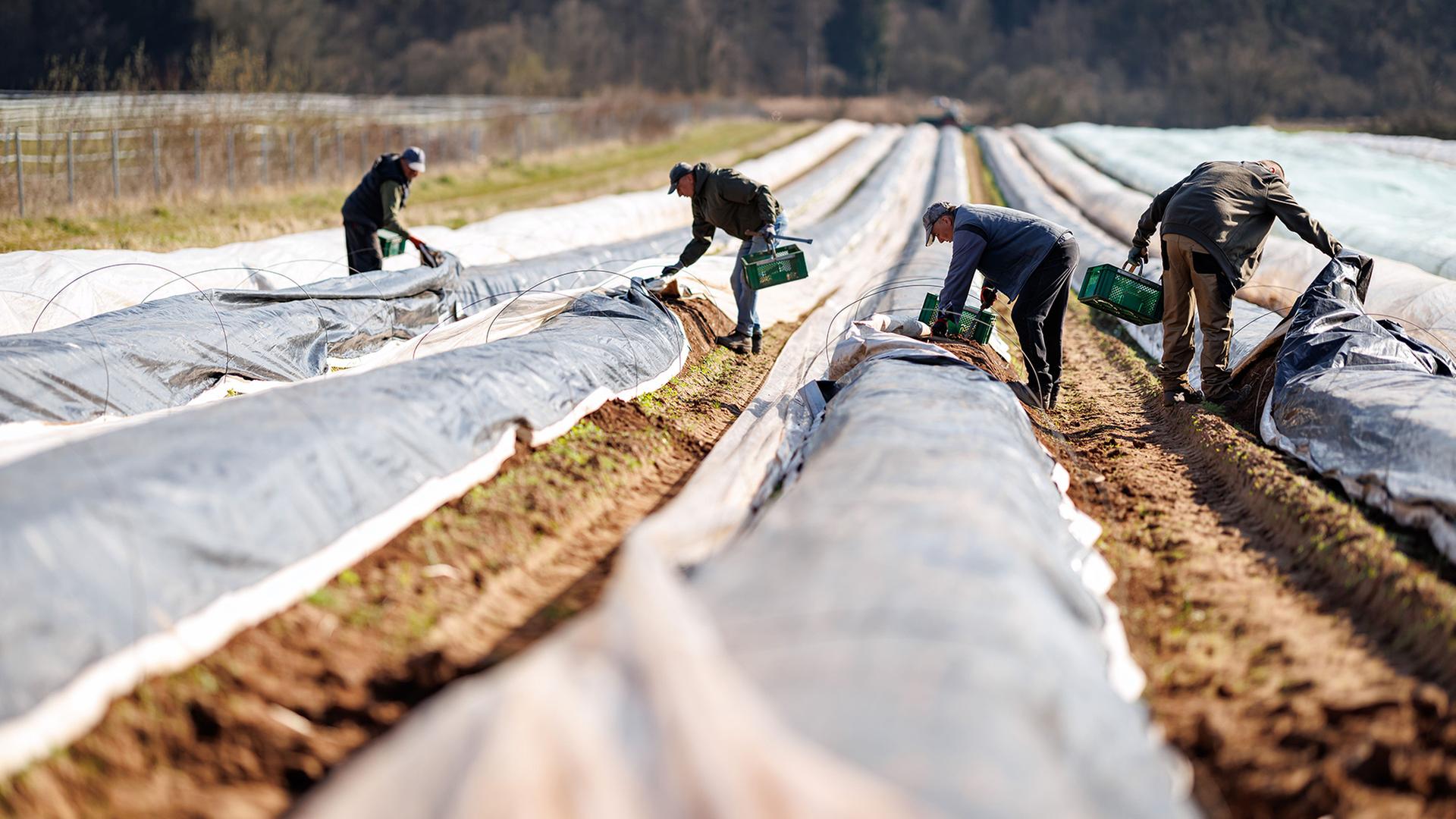
Exploitation in Agriculture: Agricultural Businesses Rarely Have to Repay EU Subsidies
When violations of labor and social protection laws occur, agricultural businesses can have their EU funding reduced. Investigations by Report Mainz show that this barely happens in practice.
A dirty mattress, a hole in the floor, a leaking window, a broken urinal: what Renate Zäckel saw at the beginning of June at accommodation for harvest workers in the Stuttgart area was extraordinary even by her standards. "We have seen very poor accommodation over the years. But this is among the worst we have seen so far," says the director of Faire Arbeit Baden-Württemberg, a church-affiliated organization that advises foreign seasonal workers, among others.
The harvest workers from Romania told her not only of the terrible conditions in the residential containers, but also of their work in the fields: they picked strawberries, bent over, often from 5 in the morning until 9 in the evening, but were allegedly not paid for every working hour. One worker states that he suffered heatstroke in the high temperatures and spent ten days in hospital.
Precarious working conditions in agriculture
The allegations the harvest workers made against the business were rejected by the company when contacted by Report Mainz. The accommodation is "thoroughly cleaned, inspected and continuously maintained before each season." Nevertheless, any indications of deficiencies are taken very seriously, and a "comprehensive modernization of our container facility" is planned. The working hours of employees, meanwhile, are recorded and "remunerated on the basis of applicable legal provisions and contractual agreements."
Setting aside this particular business: trade unions such as IG BAU repeatedly point to precarious working conditions and structural deficiencies in agriculture. To improve the situation of harvest workers in particular, EU member states agreed in 2021 on a new instrument: the so-called social conditionality. This means that if farmers treat their employees unlawfully, their EU subsidies can be reduced or withdrawn entirely. Since 2025, this regulation has been mandatory for all EU member states.
The principle of social conditionality
Reductions are possible when employees do not receive employment contracts, occupational safety briefings, or workplace protection measures such as suitable accommodation. Violations of the statutory minimum wage and working time rules are not covered, something that trade unions in particular criticize.
Countries such as Spain had introduced social conditionality somewhat earlier and have since reduced EU subsidies for several hundred agricultural businesses. In Germany, however, this barely takes place at all. This is shown by a survey that Report Mainz conducted among all 16 federal states as well as the 200 responsible oversight bodies. Nearly 95 percent of the occupational safety authorities participated and provided figures.
Thousands of violations, one reduction
According to the data, a total of 2,536 inspections of agricultural businesses in Germany have taken place in the area of occupational health and safety since 2025. In the process, 4,993 violations were identified and 51 fines were imposed. However, only a single business had its EU subsidies cut — a dairy farm in the Rostock district. According to the responsible agricultural ministry, the accommodation for employees was in a "dilapidated" condition. The business was required to repay just under 6,523 euros.
For Christian Beck, a member of the federal executive board of the trade union IG BAU, the survey is reason to call for a tightening of social conditionality. Violations of working hours regulations and the minimum wage should also be taken into account. "Exploitative businesses that gain competitive advantages through illegal practices must not be financed with public funds. Because it is precisely these practices that threaten the survival of law-abiding businesses," said Beck.
**State Secretary wants to abolish social conditionality**
The federal government is not yet willing to publicly commit to a position on the future of social conditionality in EU agriculture. It is currently engaged in consultations at EU level. "I cannot pre-empt a position by the federal government at this point," a spokesperson for the CSU-led Federal Ministry of Agriculture said last week.
Yet it appears the federal government has long since taken a position. This is revealed by a written statement from the responsible State Secretary Martina Englhardt-Kopf from late June, submitted to the Agricultural Committee of the Bundestag. It states: "The experience to date with social conditionality shows [...] that it primarily generates additional administrative burden. The federal government therefore advocates [...] not continuing social conditionality."