CSU Regional Group: A Retreat in the Shadow of Berlin
While personnel debates in Berlin are causing unrest, the CSU is presenting itself at its retreat at Kloster Banz as an "anchor of stability" within the Union, demonstratively backing Merz.
In the idyllic Upper Franconian setting of Kloster Banz, the CSU's Bundestag regional group convened for a two-day retreat. The backdrop is impressive and was intended to demonstrate how perfectly the CSU masters the combination of tradition and innovation.
The topics slated for discussion were space travel, robotics, artificial intelligence and defence technology. Illustrious guests had been invited for the occasion, including astronaut Alexander Gerst and Hungarian Foreign Minister Anita Orbán.
The "Anchor of Stability" within the Union?
But then things took a very different turn. The federal government's personnel debate cast a long thematic shadow over the CSU's summery monastery idyll.
CSU regional group leader Alexander Hoffmann is serving as acting head of the Union parliamentary group following Jens Spahn's resignation. Alexander Dobrindt, the CSU's Federal Interior Minister, was even briefly floated as a possible new parliamentary group leader. Things are going well for the CSU within the Union right now.
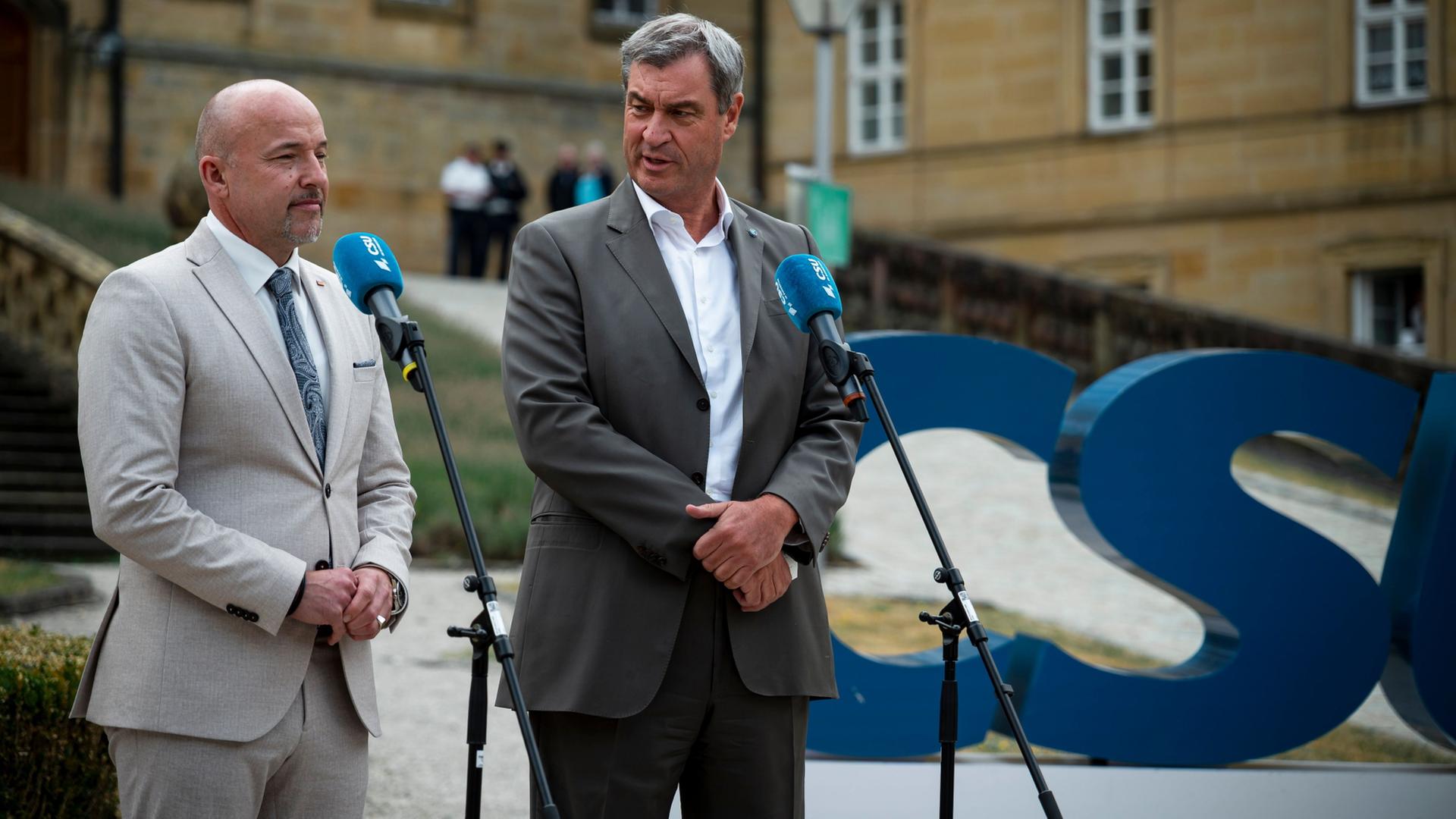
Hoffmann and Söder both used their public appearances in northern Bavaria to describe their party — whenever the opportunity arose — as an "anchor of stability" within the Union.
Backing for Merz
Nothing is meant to evoke the era when the small Bavarian sister party rebelliously pushed back against the CDU. Now is the time for support. The Chancellor in Berlin has run into troubled waters, the CDU is openly restless, and faction members are speaking behind the scenes of an immense breakdown of trust between the parliamentary group and the Chancellor.
And the CSU in Banz? Rather than piling on, it is demonstrably standing behind Merz, with Hoffmann and Söder offering him their backing. The Bavarian Minister-President, who has shown on enough occasions that he too would have liked to become Chancellor, speaks in front of the cameras of a "transitional turbulence" within the government that would soon settle down.
In Banz, Söder called on CSU members of parliament to present a united front in the vote for Torsten Frei as the new parliamentary group leader. Frei should achieve at least 80 percent, according to those in the know. Revolt is not the order of the day. The times are too serious.
A Double Signal from Banz
But of course, behind the scenes at Kloster Banz, the Chancellor's current personnel reshuffle is also being viewed with irritation and bewilderment.
For some CSU members of parliament too, the key question surrounding the allocation of posts in Berlin appears to be: who stands loyally — perhaps even devotedly — by the Chancellor's side? Critics come away empty-handed. And because the CSU has always placed great importance on its close ties with the business community, one also hears the assessment here that the way Merz is currently conducting personnel policy is no way to run a modern company, let alone a political party.
And so Kloster Banz sends out a double signal: that of stability, which the new, "well-behaved" CSU demonstrates in closing ranks behind a weakened Chancellor. The Bavarian rock in the surf, so to speak.
And a second thing one hears behind the scenes: not only is the circle of those whom Merz trusts growing smaller, but also those who truly and firmly stand behind the Chancellor are shrinking in number. And a Markus Söder has never belonged to this circle.