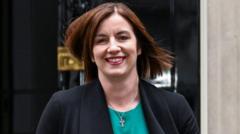
Singaporean curator Low Kee Hong has been appointed artistic director of the 2028 Biennale of Sydney, after this year's edition was troubled by controversy.
Kee Hong is the first leader of the biennale to hail from south-east Asia since it began in 1973, and follows 2026 artistic director, Emirati curator Hoor Al Qasimi.
"I'm really looking forward to the next couple of years of trying to articulate an exhibition that makes sense for now," Kee Hong says.
For Kee Hong, this means grappling with "very challenging times", where conversations and ideas are flattened by social media and a lack of nuanced engagement with difficult subjects.
"It's about leaning into how artists are reflecting this moment in time and protecting space for deep listening," he says.
"Now more than ever, it's super important that we listen to each other."
Kee Hong comes to the Sydney role with extensive credentials.
He is currently creative director of Manchester arts organisation Factory International, which runs the biennial Manchester International Festival.
Previously, he worked in Hong Kong, at the West Kowloon District Authority, and in Singapore, as artistic director of Singapore Arts Festival and founding director of the Singapore Biennale.
A troubled event
This year's Biennale of Sydney, which closed last month, was subjected to community, commercial and political pressures and accusations of anti-Semitism, which began when vocally pro-Palestine curator Al Qasimi was appointed in 2024.
Donors were reported to have withdrawn, while the contract for an ambassador for the biennale's philanthropic program, who was also vocally pro-Palestine, was terminated due to "operational constraints" following complaints to the biennale board.
Amid further complaints artists on the program were anti-Semitic, Al Qasimi conducted a walk-through of the biennale with NSW Jewish Board of Deputies President David Ossip ahead of the exhibition opening in March.
Mr Ossip told the Australian Financial Review he intended to "call out" any perceived lack of "balance".
Then, on stage on opening night, American DJ Zubeyda Muzeyyen, who performs as DJ Haram, urged attendees to "oppose the Zio-Australian-Epstein empire".
Her comments were condemned by NSW Arts Minister John Graham, and resulted in accounting firm PwC dropping its sponsorship of the biennale.
Her statements also led to a review by the biennale and a NSW Police investigation into whether she breached racial hate laws. Police found there was "insufficient evidence to commence proceedings".
While Kee Hong would not be drawn on the specifics of the 2026 Biennale of Sydney out of respect for Al Qasimi, he describes the challenge for curators of navigating a charged political climate as a "global question".
"Working and living in Manchester, we are also subject to a lot of very similar conversations that we have observed around the world, in particular America and parts of Europe," he says.
"People pulling out, cancellations, the withdrawal of funding; it's all part and parcel of working within an art institution in this day and age."
For Kee Hong, what's important is "protecting spaces for nuanced conversation", often created by artists and contemporary art.
"We live in a world that doesn't really give space for that," he says.
"It's a very quick-fire draw: Do you agree or not? If you're not for me, you're against me. That is such a difficult landscape to navigate."
Kee Hong, who lived in Hong Kong during the 2014 pro-democracy protests, sees the biennale and other arts organisations and arts festivals as exactly to place to have difficult conversations.
"I still very much believe in the power of communities coming together to celebrate each other, regardless of ideology," he says.
"Social gathering is quite powerful, to assemble in ways which are unexpected, bringing together different parts of the community that don't naturally sit with each other."
As an example, he points to Factory International's series titled Artists in Times of Upheaval, which has featured artists including Chinese artist and activist Ai Weiwei and Ukrainian playwright Tetiana Kytsenko.
"We invite artists who still live and work in the context of extreme conflict," he says. "It's not one perspective.
"For us, it's an important space to insist that you hear more and you engage more than just didactic, throwaway ideological lines."
Making connections
Kee Hong is a long-time attendee of the Biennale of Sydney, and plans to spend time in the city in October and after he delivers Manchester International Festival in July 2027.
That's when he plans to engage with artists and communities both in Sydney and across Australia, including by going on Country to learn about plant life and nature in Australia from Indigenous communities.
"[I want] to sit with Indigenous Elders so I can understand the world view and cosmologies around medicine, around food, around bringing communities together," he says.
When he visits Sydney, he also plans to collaborate with the city's arts institutions, so that works created for the biennale have a "sustained impact".
"I work a lot via collaborations," he says. "Even for a particular commission, we think about multiple partners co-investing in making a work, so we'll start to think about the future life of the projects post the Biennale of Sydney."
Kee Hong stresses the biennale is more than just a three-month exhibition.
"What happens before and after is quite critical," he says.
"We can think about projects that exist in terms of thousands of years or tens of thousands of years; the framework Indigenous communities have been operating in for the longest time.
"It's a way to approach your relationship with land, sky, sea, earth and time very differently.
"This, for me, is the magic sauce Australia and the Pacific can offer to the world."
The Biennale of Sydney begins on March 21, 2028.