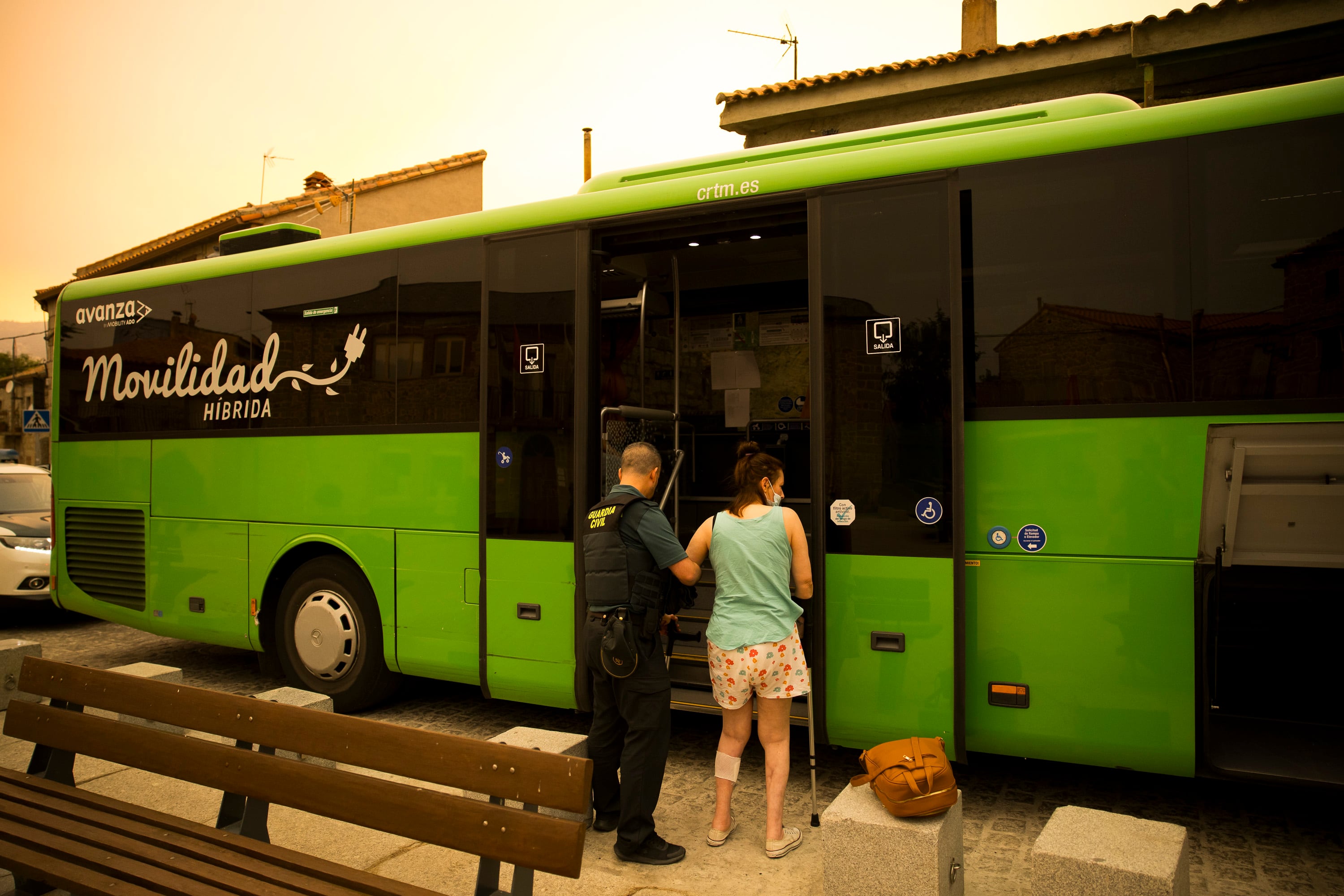
The operation to protect residents of municipalities affected by fires in the provinces of Madrid, Ávila and Toledo is unprecedented in scale. The figures have been rising since Thursday, reaching 89,763 people across 46 population centers by early Sunday morning. The magnitude far exceeds that of other fire-related evacuations in recent times.
The scale is explained both by the dimensions of this great, relentless fire and by the authorities' cautious approach. Officials, coordinated by the Military Emergency Unit (UME), want to avoid personal harm at all costs. So far no casualties have been reported, although it is known that dozens of homes have burned down.
The affected area is a broad rural territory of small towns, many with populations of around 2,000 to 3,000 inhabitants. The restrictions have been imposed not only due to the proximity of the flames but also because of the smoke, which can be highly harmful, particularly for the most vulnerable people.
Civil Guard officers have been responsible for ordering the evacuations or confinements, in many cases with such urgency that those affected left their homes with only the clothes on their backs. They were met by the green buses of the Regional Transport Consortium, though residents were also given the option of evacuating in their own vehicles.
They have been taken to sports centers and other public facilities in nearby municipalities, where some have been sleeping since Thursday on mattresses and UME bunk beds. Those who have been able to have stayed with relatives or even in hotels.
By early Sunday afternoon, the toll stood at 89,763 people affected, of whom 59,896 had been evacuated and 29,867 confined. Sources within the operation explain that the choice between one solution or the other has depended on the situation in each location: in some larger towns, such as San Martín de Valdeiglesias (9,324 inhabitants), the decision was made to evacuate residents living in outlying housing developments, which are more exposed to the fire, while confining those living in more central, safer areas. Those under confinement received messages via ES-Alert on their phones asking them to place damp towels over doors and windows to prevent smoke from entering.
In the Community of Madrid, 15 reception points were set up this weekend, sheltering nearly 2,500 people. One of the busiest was the sports center in Villamanta, where around 220 people were staying on Sunday afternoon. Nearly all of them are from Aldea del Fresno, a town that has so far escaped the flames. They were eagerly awaiting word that they could return home, longing to sleep in their own beds again. "The volunteer neighbors have been absolutely wonderful," said María Olmedilla. "Look, look. It gives me goosebumps just thinking about how good they've been."
Sitting nearby was the former mayor of her town, Guillermo Celeiro (PP), who has slept on a mattress for the past four nights. "Of course I have to be with my neighbors. I can't leave, that goes without saying," he said, expressing his gratitude to the volunteers and professionals assisting them. "Here we feel cared for, but we're also ready to go home."
All things considered, this Sunday had been somewhat eventful, as shortly after midday they had received a visit from King Felipe VI and Queen Letizia, along with regional president Isabel Díaz Ayuso. Two hours later, they were queuing to receive food from chef José Andrés's NGO, World Central Kitchen. Newspapers from that day were circulating, with terrifying images of the fire on the front pages. The children came running when they heard sweets were being handed out: "Candy, candy!"
Some recount that certain people had been granted permission to return to their homes for brief minutes with the aim of collecting basic belongings: clothes and medicines. Others went to feed their pets and farm animals such as chickens and ducks. When word spread, everyone wanted to join in, and a decision was made to put an end to these unauthorized entries.
At the sports centers there has also been a degree of paranoia over the possibility of robberies in the evacuated municipalities. A black-and-white photo of a man entering a property, captured by a security camera, had been circulating. But it was all a misunderstanding, according to the Civil Guard spokesperson in Madrid, Mercedes Martín: "The person in the photo is someone who lived there."
The return depends on the authorities monitoring the situation at the Command Center, set up on an abandoned plot in an industrial park in the Madrid municipality of Navalcarnero. The Government's delegate for the Community of Madrid, Francisco Martín, stated that they want to proceed cautiously to ensure that the conditions for return are optimal.
Soon, the displaced persons hope, they will be able to go home. At the end of the day, the delegate announced the first returns: the El Escorial campsite will reopen, and elderly residents who had been evacuated from San Martín de Valdeiglesias will be able to return to their residence.
Do you have something to share? Write to fpeinado@elpais.es