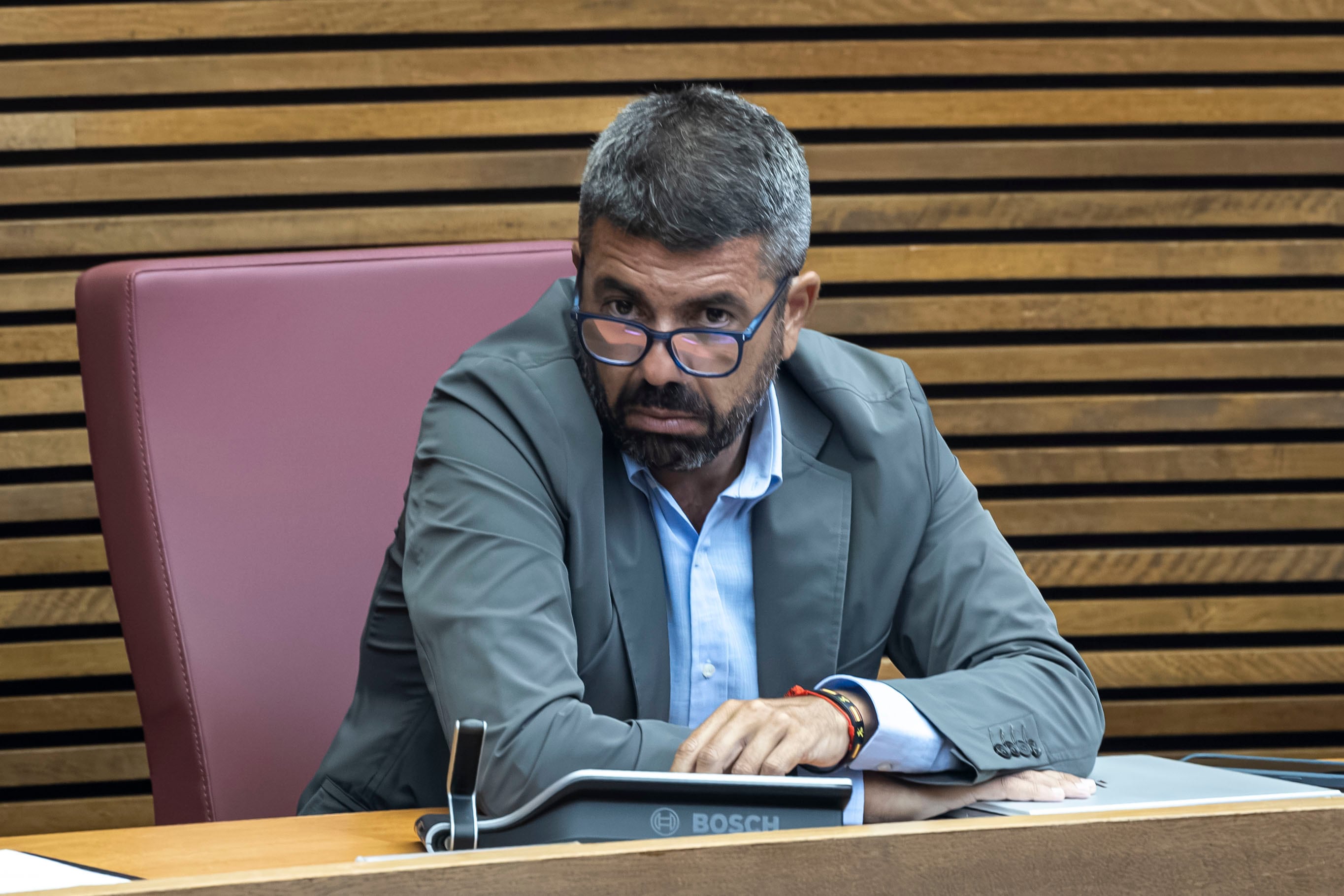
Former President of the Valencian Community Carlos Mazón, of the PP, has a gap regarding the most serious episode of the DANA storm that left 232 people dead in 2024: the overflow of the Poyo ravine. The former leader makes no mention in his submissions to the court in Catarroja (Valencia), which is investigating criminal responsibility for the disaster, of what he did on the afternoon when the flooding of this watercourse buried municipalities such as Paiporta and Catarroja, where the storm caused 55 and 25 deaths, respectively.
In a 66-page exculpatory document submitted to examining magistrate Nuria Ruiz Tobarra on 2 September, Mazón does not clarify where he was on the afternoon of the floods. Nor does he explain what role he played in the decision that sits at the centre of the judge's inquiry: criminal responsibility for the sending of the ES-Alert, the mass message sent to mobile phones that reached handsets at 20:11, when dozens of people had already gone missing, and which, according to the magistrate, would have saved lives had the Valencian regional government sent it earlier.
Mazón, who is a party to the case but is not listed as a suspect — the Superior Court of Justice of the Valencian Community (TSJCV) rejected that possibility last March, finding that the former president lacked "guarantor status" — avoids addressing in his defence strategy what he did on the day of the worst natural disaster to strike Valencia. On the afternoon of the storm, according to the judicial investigation, the PP politician had lunch for nearly four hours with a journalist in the heart of Valencia, then took a walk with her through the city centre, and arrived at the Cecopi — the regional government body that managed the crisis — 11 minutes after (20:28) the most significant decision of the day had been taken: the sending of the ES-Alert.
Mazón's exculpatory strategy rests on the argument that the former president gave no instructions for the sending of the ES-Alert; that he bore no "responsibility by omission" in the management of the disaster — as the Catarroja judge had argued in her reasoned submission to the TSJCV — ; and that the WhatsApp communications exchanged by his then chief of staff and right-hand man, José Manuel Cuenca, with the then minister responsible for the emergency, Salomé Pradas, were recorded at 19:54, nine minutes before the ES-Alert was prepared. Furthermore, there is "no evidence" — according to the former leader's submission — that Cuenca "acted on instructions from Mazón." The PP politician omits from his account that former minister Pradas spoke with him for 48 seconds at 19:43 — two minutes before the ES-Alert was finalised — and that this former official, who is today the principal suspect in the case, twice tried unsuccessfully to reach the then head of the Consell (at 19:10 and 19:36). At that moment, she was overseeing the Cecopi and the final details of the mass notification were being debated at the eleventh hour. The former president did not answer the calls and cancelled communications with his minister, according to the phone records that Pradas submitted to the court.
Mazón, who has parliamentary immunity due to his status as a regional deputy, argues that the steps taken by magistrate Ruiz Tobarra in her attempt to charge him lack justification. And that there is no reason to place him under the radar of the investigation, which is examining alleged offences of homicide and injury through negligence. "The right to a defence cannot be exercised against an unknown," the People's Party politician argues in a written submission in which he asks the magistrate to specify "whether any positive fact or action" exists against him.
The former president's lawyer, Ignacio Gally, explains to EL PAÍS that Mazón does not mention in his written submissions what he did on the afternoon of the dana because the TSJCV, in its ruling rejecting the charges against the People's Party politician, considered that the politician "deserved no criminal reproach whatsoever." And therefore, "the afternoon of 29 October [2024] no longer forms part of the proceedings." "There is no point in us arguing about something that is already irrelevant to the case [...]. We need to talk about what is criminally significant," the lawyer adds.
The investigation, however, has yet to clarify what Mazón and his then right-hand man, José Manuel Cuenca, discussed by telephone for two minutes at 19:41, at the worst moment of the disaster. And why the former president subsequently communicated with Pradas, at 19:43. "In that conversation a directive was certainly given. Cuenca alerts him to something, possibly about the confinement order, and then Mazón calls Pradas," argues PSPV-PSOE deputy Alicia Andújar. Another of the unknowns hanging over the case is whether Mazón was aware of the call Pradas made at 19:36 to Cayetano García, then regional Secretary of the Presidency and a member of the inner circle. In that communication, the then minister was asking about the possibility of confining the population due to the potential overflow of the Forata dam, an infrastructure in Yátova (Valencia) whose collapse could have caused 8,000 deaths, according to Generalitat reports.
After two years of investigation, the judge in Catarroja is maintaining charges in the case only against former minister Pradas and the person who was her second-in-command during the dana, former Director General of Emergencies Emilio Argüeso.