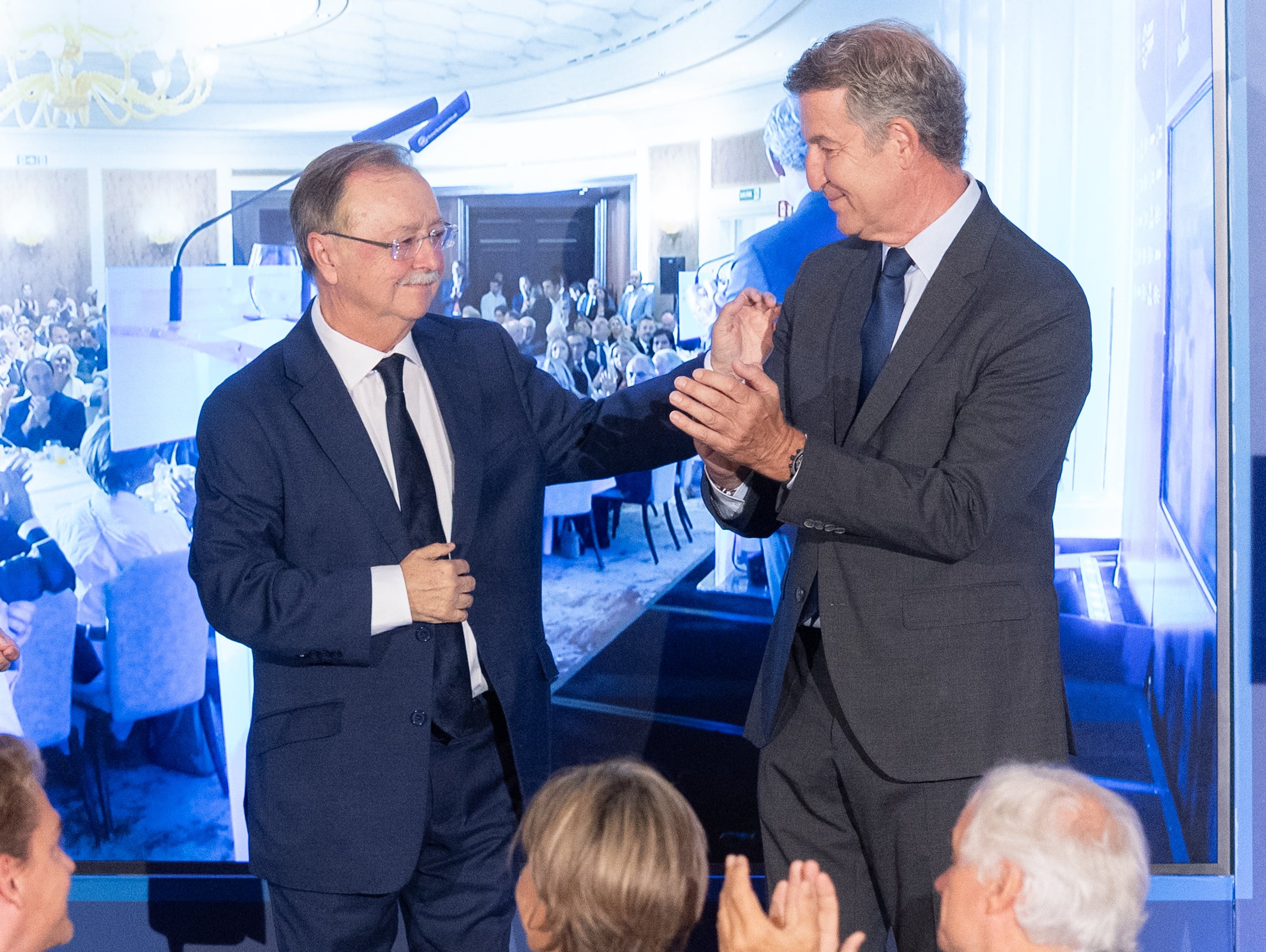
The Juan Jesús Vivas of 2024 would barely recognize the one of 2026. Two years ago, the president of Ceuta described as "unviable" the return of migrant minors to Morocco that the far right was advocating. "Vox is not proposing any solution, because what it is proposing is the return of minors to their countries of origin. And look, this, according to recent rulings from the Supreme Court, is unviable. Minors cannot return to their countries of origin unless the minor themselves wishes to do so. Therefore, I think these are absolutely unviable positions that respond to ideological stances we do not share at all," he said at the time.
It is not even necessary to go back that far. On July 29, one day before the mass entry of some 70,000 people into Ceuta, Vivas explained at a public appearance that the immediate return of migrants "simply cannot be done" due to asylum legislation and the legal safeguards concerning minors. Now, the president of Ceuta not only shares with Vox the proposal to return the minors, but has made it his own as the only possible course of action, despite the saturation being experienced by the autonomous city he leads, where approximately 2,000 unaccompanied minors out of up to 10,000 migrants who have not returned following the mass entry have now been present for 50 days.
The position of the president of Ceuta is perfectly aligned with that of the PP leadership. Alberto Núñez Feijóo's inner circle feels additionally reinforced, following the latest signals from Europe, in maintaining its standoff with the Government and flatly rejecting the transfer of the children to the mainland. And the Ceuta leader, who is the one suffering most from the consequences of failing to decongest the city by refusing the transfers, is nonetheless determined to hold that line. "Vivas knows he has to hold firm," sources within the party leadership emphasize.
The president of Ceuta justifies his change of position from two years ago with the argument that the current situation is different and that since 2024 two "relevant things" have occurred: the mass entry at the end of July this year, which constitutes a "hybrid attack" that cannot be met with an ordinary response, and the new European Pact on Migration and Asylum.
However, in the case of minors, the European pact does not allow for the relaxation of procedural guarantees, but rather reinforces them, which further lengthens the process. The Government is also constrained by a key precedent: the Supreme Court ruling of January 2024 — the very one Vivas cited that year — which declared that the return from Ceuta to Morocco of 55 minors in August 2021 was illegal, as it did not follow the procedure established in immigration law. This legislation requires an individualized administrative procedure that includes information on the minor's situation, a hearing with the child if they are sufficiently mature, and the intervention of the Public Prosecutor's Office.
The Government also requires authorization from the Government of Ceuta, which holds guardianship, while the State retains competencies over identification and immigration matters, including possible repatriation. In the midst of this political clash, the Ministry of Youth and Childhood sent the Government of Ceuta a proposal on August 8 to transfer 500 particularly vulnerable boys and girls to the mainland — a proposal that Ceuta has not authorized.
Vivas shares his strategy with the rest of the PP, for whom the transfer would create enormous tension due to the pressure from Vox in coalition governments. And, according to various party leaders who have spoken with him in recent days, he is determined to hold firm. "Vivas knows he has to hold out and that the only possible solution is to return them to Morocco, because otherwise the message would be terrible, and in the medium and long term, Ceuta would be finished," summarizes a PP leader who maintains constant communication with him.
The president of Ceuta, 73 years old, is "emotionally devastated," sources within the PP say, but precisely because he is an old political wolf (he has led the city for 25 years), "they are not going to intimidate him." To what extent Vivas has or has not subordinated himself to the Génova strategy remains an open question, but within the PP they maintain that the Ceutan president is no puppet because he is a veteran and, after the upcoming municipal elections in May, in which he will stand as a candidate, he hopes to face his final term in office.
The PP feels strengthened in maintaining this standoff with the Government by the "boost" from Europe this week, sources from the party leadership say with satisfaction, following the approval of a European Parliament resolution promoted by the Spanish PP that holds Spain responsible for the mass entry of migrants into Ceuta on July 30 and 31, and the position of the Immigration Commissioner, Magnus Brunner, who met with Feijóo on Thursday in Madrid and endorsed the return of "all" the foreigners. "The Government's hole is getting bigger and bigger," the PP leadership congratulates itself.
Capitalizing on discontent
But beyond the wear on the Executive, in the dispute over the minors there operates as a backdrop the fierce competition that the PP wages with Vox to capitalize on social discontent over immigration. Feijóo continues to accentuate his shift toward increasingly hardline positions and to adopt proposals from the far right that he did not support until recently, such as revoking the nationality of foreigners who commit serious crimes — a proposal the PP rejected in Congress in April of this year and which they have now announced as their own.
This Friday, the PP leader raised the tone against migrants in Ceuta even further following images of the chaos surrounding their transfer to the camp set up at the city's port. "We have confirmed that this is not immigration," he emphasized from Melilla. "Immigrants do not confront the police; they try to find work. These individuals are not coming to find work; they are coming to confront the constitutional public order and the security forces. The only solution is expulsion," he stressed. This Sunday, the PP leader is in Badalona alongside the PP mayor Xavier García Albiol, who for years has championed the most radical positions within the party on immigration.
The entire PP, including its more moderate wing, has been shifting toward the position once occupied solely by Albiol, convinced that it carries no political cost. "Everything you harden on immigration, within certain limits, people are going to understand," summarizes one party leader. "And now we have a very small open channel of transfer from the center and, in contrast, a very large one with our right flank."
The risk of this strategy, some internal voices warn, is that it could end up benefiting the far right, which has the most credibility when it comes to taking a hard line on foreigners. "This Ceuta situation is not going to go well for anyone," warns a leader from the inner circle, who trusts that when elections come, people will cast a more considered vote.
Feijóo has decided to stake a large part of his political offensive on Ceuta. Within the PP, the crisis is seen as "an opportunity" to erode the Government and reinforce his candidate's leadership at a time when polls continue to fall short of the result he achieved in the 2023 general elections.