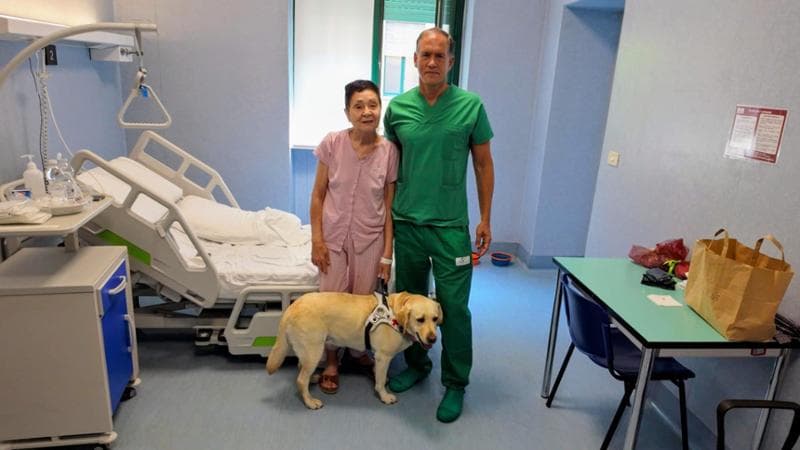
For five years, the world was nothing but darkness. Then, after nearly six hours in the operating room, Elena opened her eyes again and saw her son's face. By her side was Joe, her guide dog, who had never left her alone. This is the result of the world's first transplant of the anterior segment of the eye combined with the central portion of the retina — the macula — performed at the Molinette hospital in Turin. An unprecedented procedure that allowed the patient to recover her sight after more than five years of blindness.
The operation was carried out by the university Ophthalmology Clinic team led by Professor Michele Reibaldi. Until now, the simultaneous transplant of the anterior segment had been performed only once in the world — also at the Molinette, by Reibaldi himself alongside Professor Vincenzo Sarnicola. Never before, however, had it been possible to also transfer the macula, the portion of the retina responsible for central vision.
Why the transplant is unique in the world
The patient, 67 years old, had completely lost her sight following a serious road accident. Her left eye had been blind due to irreversible damage to the optic nerve, yet still retained healthy ocular structures. Her right eye, on the other hand, was connected to the brain but had been severely damaged by macular degeneration and the trauma sustained in the accident, making even a standard cornea transplant impossible.
This is what inspired the Molinette team's idea: to use the still-intact tissues of the left eye — no longer salvageable — to reconstruct the right one. The surgeons thus transferred the cornea, sclera, conjunctiva and, for the first time in the world, the macula as well, performing an unprecedented autotransplant.
"This procedure represents a new frontier in ophthalmic surgery," explains Reibaldi. "We are now waiting to understand how well the transplanted retina will be able to function, but the initial results are encouraging."
The lengthy operation and the awakening with Joe
The operation — a true surgical marathon lasting nearly six hours — required the coordinated work of ophthalmologists, anaesthesiologists, nurses, and the hospital's medical management. Tests carried out in the days that followed confirmed the successful integration of the transplanted tissues and a progressive functional recovery of the eye.
Elena's story is also intertwined with Joe, her guide dog, whom the hospital's management authorised to stay with her throughout her admission. "The most emotional moment," recounts Reibaldi, "was when Elena reopened her eyes and was able to recognise the face of her son and her faithful life companion."
The patient's recovery journey continues, but the goal is to restore an independence she had lost more than five years ago.
"We are witnessing a procedure at the very limits of the impossible, without precedent," says Livio Tranchida, Director General of the Città della Salute e della Scienza di Torino. "It is the result of our doctors' professionalism and of the public health system's ability to combine innovation with care for the individual. Today, Elena can look at the world again — together with her inseparable Joe."