The convent of Santa Clara in Pontevedra, founded 716 years ago and abandoned by its last two cloistered nuns in 2017, is busier than ever. Since the City Council purchased it in late 2021 and handed it over to the Provincial Council, dozens of news stories have been published; two archaeological campaigns have taken place; the remains of nuns who died in the last century have been exhumed and relocated; cleaning crews have worked tirelessly; press conferences, guided tours and dance performances have been organised. Television series such as Netflix's Los enviados have even been filmed there. From time to time, confused brides still arrive carrying dozens of eggs, hoping to secure sunny weather on their wedding day. But when they peek through the door, they find archaeologists crouched in some pit, carefully brushing a human ribcage with a watercolour paintbrush. There are no longer any nuns to pray to the Azores anticyclone. And the brides leave, crestfallen, taking their eggs elsewhere.
But this usual bustle has turned into an uproar following the discovery of a saponified brain among the ancient tombs of the nuns. The find was presented by the Pontevedra Provincial Council as a "unique" case last Monday, and just five days later, another identical organ was discovered in a second Poor Clare's burial. The appearance of viscera preserved through the natural process of saponification is not, however, such an exceptional occurrence.
Though it is better to begin the story at the beginning. Curiosity about what might appear in a 12,787-square-metre enclosure embedded within the city — yet which spent seven centuries closed in upon itself — was considerable in Pontevedra. The first campaign, directed by provincial archaeologist Rafael Rodríguez, yielded ancient burials in the cloister and woodland, the first structures offering clues about what the original convent looked like, and more than 9,000 ceramic fragments from across the world.
The Poor Sisters of Santa Clara threw absolutely nothing away. Stored inside the convent were found dozens of balls belonging to generations of children who had lost them while playing in the adjacent Plaza de Barcelos, next to the high enclosure walls — some even bearing the owner's name. Also discovered were old rapeseed oil containers, cheese wrappers, drums, tins and an enormous quantity of powdered milk boxes written in English and Spanish. These were foodstuffs that arrived as aid from the United States during the Franco era, particularly during the 1950s and 60s under President Eisenhower: "Skimmed milk powder. Gift of the People of the United States of America. Not to be sold or exchanged."
But the surprises of the second archaeological campaign, undertaken this summer and running until the end of September, have been even greater. The archaeologists from the company A Citania, directed by Israel Picón, have unearthed enormous buried structures in the woodland area, revealing the scale the convent may have reached in its early days. They also found utensils belonging to the nuns and more than 3,000 ceramic remains from Italy, Germany, England, Sargadelos, Seville, Talavera, Manises and even Chinese porcelain from the Ming dynasty. These items arrived in the trunks of novices, who surrendered their dowry upon entry. The quality of the pottery reflects the family wealth of some and the humility of others.
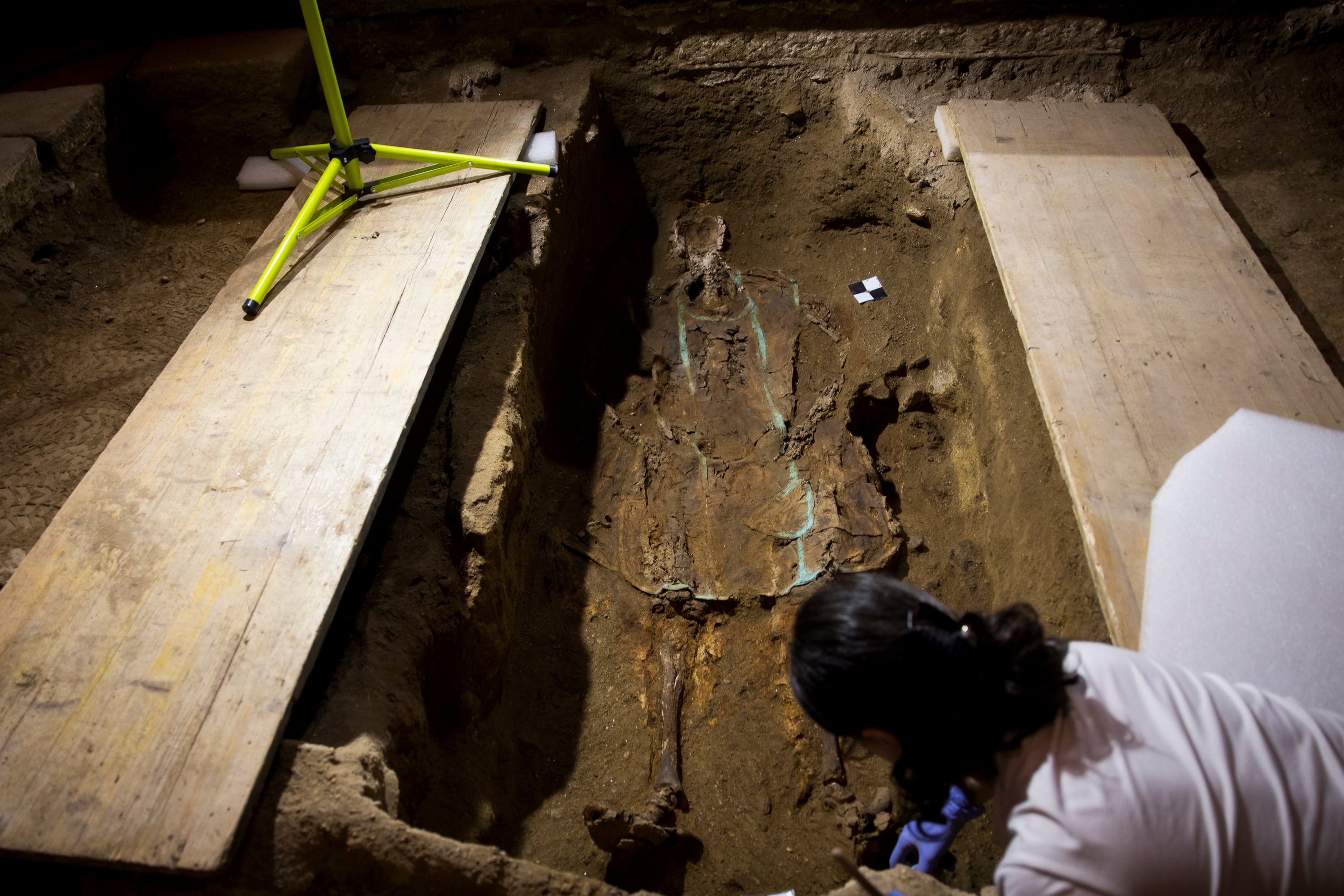
Despite the fact that what moves Picón most are the discoveries from the forest, all eyes turned to the church after last Monday the Vice-President of the Diputación de Pontevedra, Rafa Domínguez (PP), called a press conference to announce "pioneering" discoveries. During excavations of the floor of the temple and the Coro Bajo this summer, at around 40 centimetres below the surface, the bones of two children appeared; the magnificent burial of a chaplain still wearing his luxurious chasuble and shoes; and the mortal remains — not yet dated and currently under study at the Universidade de Santiago — of three Poor Clares still in their habits.
The acidity of the soil had consumed the bones of these nuns, who lived sometime between the 16th and 19th centuries, more than the fabric of their burial shrouds, but one of the nuns preserved, according to the Provincial Government, the "first documented case" of a saponified brain "on the Iberian Peninsula." The discovery was also, the Diputación emphasised, "one of the few" of this kind "at an international level," since "only three cases are found in the world: in Argentina, Chile and Italy." Saponification is a natural process that occurs in the early stages of decomposition, by which decomposition slows and the tissues of a corpse take on an appearance similar to soap or wax through a chemical reaction of the lipids, in very stable environments lacking oxygen and with high humidity. Saponification can also occur directly underwater, in rivers or freshwater wells.
The triumphant tone of the provincial vice-president reverberated across Spain in the news bulletins that picked up the "exceptional" and "unique" find. As it happened, the bombshell was dropped on the very same day that Álvaro Rodiño, adviser and press chief to Rafa Domínguez, was removed from his post. The dismissal, "at his own request," took place three days after the scandal broke over a TikTok video in which Rodiño joked, golf club raised, about hitting "orphaned children." That afternoon, out on the streets, the people of Pontevedra had no shortage of headlines to discuss, but the "unique" brain also made a splash throughout the rest of Galicia and Spain. And it continued to make news all week.
Meanwhile, professionals such as anthropologists Clara Veiga and Claudia González continued working at the nuns' graves during those days, and on Friday a second saponified brain came to light, as the body had remained in the same environment. That makes two so far. And there could be more. Any archaeologist or forensic specialist knows that the one found among the Poor Clares is neither the first nor the only case of a saponified brain in Spain. In a statement issued after this second organ was recovered, the Museo de Pontevedra clarified that, in any case, those discovered at Santa Clara "would be the first documented cases of this kind and from these dates on the Iberian Peninsula, where those found until now are from later periods."
57 Franciscan brains
There was no need to go far to verify that what the political official had announced did not hold up. It so happens that the person considered today to be the foremost expert on saponified brains lives and works a little over 100 kilometres as the crow flies from Pontevedra.
Fernando Serrulla, head of the Forensic Anthropology Unit at Imelga (the Galicia Institute of Legal Medicine), keeps more than 200 saponified brains in his department at the Hospital de Verín (Ourense), collected from various contexts. Having studied more than 300 cases in mass graves from the Civil War, among soldiers from the Falklands, and even in a Roman catacomb two millennia old, he holds custody of the largest known saponified brain (more than 200 grams, still with the projectile inside; found in the mass grave at Paterna, Valencia), though he has none belonging to a monk or nun. Nevertheless, the forensic specialist explains that in 1979, the saponified brains of medieval friars were discovered in Svendborg (Denmark). The investigation, led by Izabella Tkocz, brought to light 57 brains that had been preserved by the conditions of the cemetery at a Franciscan convent — the male order that is the counterpart of the Poor Clares.
The brain, the specialist explains, is the organ that most frequently appears in a saponified state because it has a higher percentage of fatty matter. The chemical process must take place within the first days after death, under conditions of high humidity and low oxygen, in order for the transformation to occur and for larvae and flies to be unable to carry out their work. Documented cases have existed around the world since 1791 (France), and throughout the twentieth century the phenomenon was recorded in the United Kingdom, Switzerland, Denmark, the United States (91 preserved brains in Florida), Bulgaria, and Chile. In the twenty-first century, cases have continued to emerge in South Africa, Egypt, France, Turkey, Spain, and in the Falklands.
In the mass graves of the Civil War alone, hundreds may yet be found. At the excavation of La Pedraja (Burgos), carried out in 2010 by the Aranzadi Society of Sciences to recover the remains of 104 Republicans killed in 1936, Fernando Serrulla ultimately focused his doctoral thesis. There he documented 45 saponified brains — and an even greater surprise: a heart.