Schneider in Ukraine: Environmental Protection in Times of War
The war against Ukraine is also threatening nature: a hole has opened in the Chernobyl protective shelter, and large parts of Ukrainian forests are under occupation. Environment Minister Schneider visited the site — and wants to help.
Visible from afar, the silver-grey protective shelter looms over the ruins of Chernobyl Reactor 4, which suffered a catastrophic accident in 1986. Imposing and alarming in equal measure. A metal colossus intended to protect the facility beneath it from decay and shield the environment from the release of radioactive radiation. Or rather: that was the intention. Because the shelter has been severely damaged.
In February 2025, the impact of a Russian drone tore a massive hole in the shelter. Anyone standing before the shelter this week, as Federal Environment Minister Carsten Schneider did during his visit to Ukraine, can spot the location immediately. It has been sealed. It looks like an oversized patch. The SPD politician, who is also responsible for nuclear safety in Germany, gazes with concern at this surreal place, which like few others stands as a symbol of the risks of nuclear energy. Why that is becomes clear beneath the protective shelter.
Construction was meant to last 100 years
Shortly before, there had been a brief shower of rain. Moments later, upon entering the facility, water drips from the ceiling. Puddles have formed on the floor. The shelter is leaking. The drone strike triggered a fire that then spread across a plastic layer inside the shelter.
The structure was originally designed to last 100 years. That is now out of the question. Rust is becoming a risk, explains plant director Serhiy Tarakanov: "The shelter has lost its function. As a result, the anti-corrosion measures that were built in during the development of the containment structure are no longer effective. We therefore need to begin renovation work as quickly as possible."
Given the extent of the damage, rebuilding the protective shelter is unavoidable. But it comes at enormous cost. According to estimates by the European Bank for Reconstruction and Development (EBRD), at least 500 million euros — at a minimum. Because an operation of this kind has never been undertaken before.
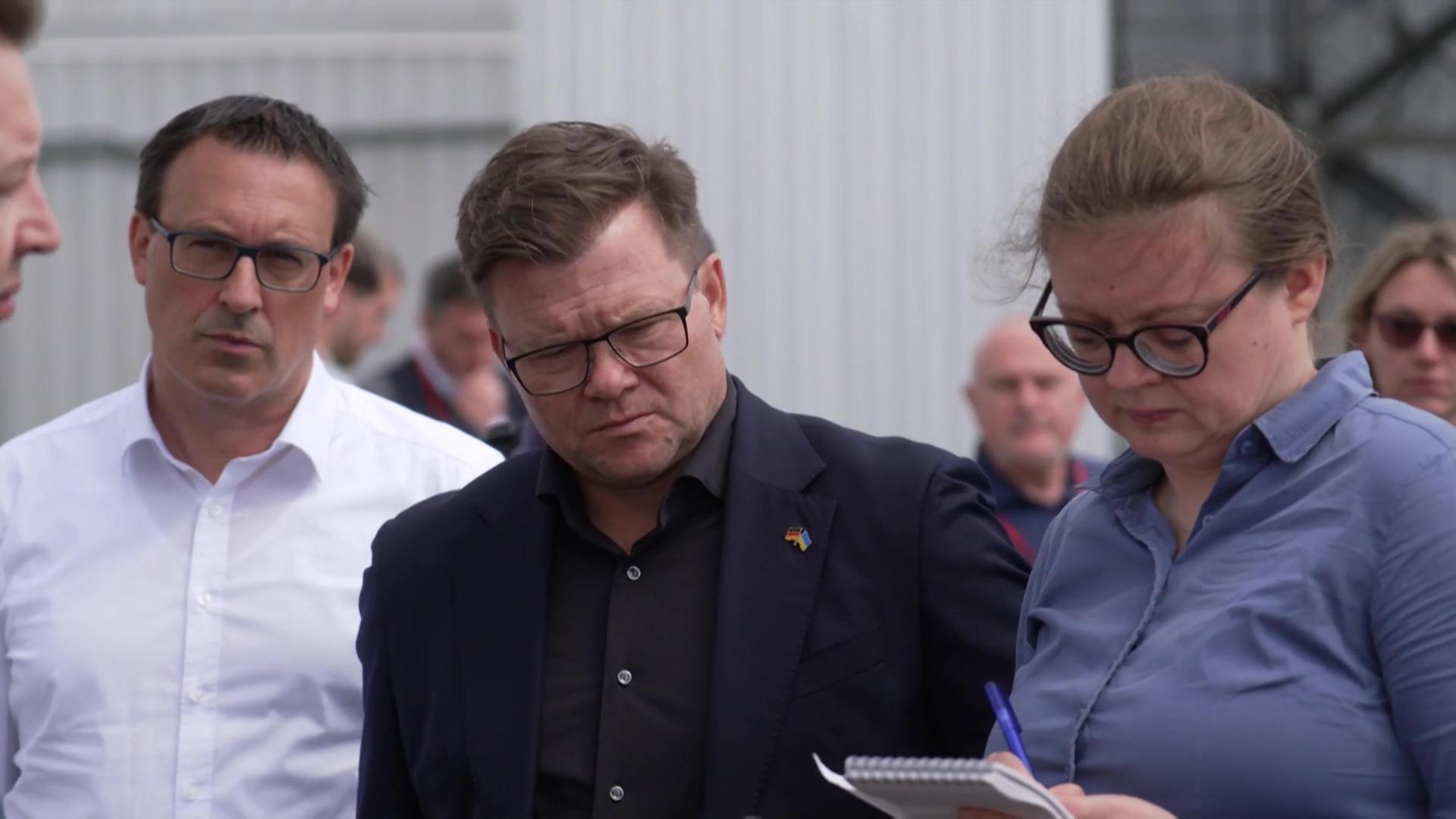
Environment Minister Schneider (right) inspects the interior of the nuclear power plant.
Germany wants to contribute to financing
Ukraine cannot possibly manage this undertaking alone. It is dependent on international partners. Germany had made a significant contribution to financing the damaged structure and intends to participate again this time — with 50 million euros, as Schneider announces at his meeting with plant director Tarakanov. This comes with the hope that other countries will follow this example. So far, the United States has pledged 100 million dollars, the EU 75 million euros, and Norway intends to contribute ten million euros.
The reconstruction is enormously challenging — not only technically, but also in light of the ongoing war. Since the Russian drone strike on the reactor ruins at the latest, the protection of critical infrastructure has become a top priority. It is barely conceivable that a new protective shelter could be built on site under wartime conditions. Yet this appears to be unavoidable. At the same time, costs are rising as a result: developing a technical solution is complex, for example through the use of robots.
Chernobyl is now a military restricted zone. Nets protect the access road from enemy drone attacks. The route passes trenches, positions and barbed wire. Heavy equipment stands across the terrain. All around lies the ghost town of Pripyat, where many nuclear power plant workers once lived. And there is extensive forest, where the absence of roads in the event of fires could hamper firefighting efforts.
Talks on EU accession and networks
The Federal Environment Minister is also experiencing the ongoing threat to Ukraine first-hand. At the very moment he steps off the train in the capital Kyiv, air raid sirens begin to wail. This happens several more times throughout the day — during meetings with the Economics and Environment Minister and other Ukrainian government representatives alike.
The talks serve two purposes: on one hand, accompanying Ukraine on its path toward its aspired EU membership; on the other, Schneider is travelling with 15 business representatives from the GreenTech sector. Solar energy, battery storage, waste recycling. Ukraine is a vast market — and even more so after potential EU accession.
"But without being on the ground, without a network and partners, it won't work," says one participant on the trip. There are also different laws and conditions that can hinder any given project.
In Lviv, Schneider visits a residential block together with Sören Bartol, State Secretary at the Federal Ministry of Construction: anyone wishing to carry out energy-efficiency renovations here must first navigate a thicket of property rights.
A national park success story under threat
The final stop on Schneider's trip is a detour into the Carpathians. "It doesn't happen often that a federal minister comes through here," says Michael Brombacher of the Frankfurt Zoological Society, which organises a wide range of initiatives and projects in the region.
With eyes shining, Vasyl Pryndak speaks about "his" Skolivski Beskydy National Park in the Carpathians. The national park director reports with great pride that they have succeeded in preserving a unique flora and fauna. Beech forests found nowhere else in the world. Sixty-six endangered plant species are established here. The number of European bison and lynx has steadily increased. The national park is a popular destination for tourists. Yet this very success story is now at stake.
Standing beside him, Schneider listens attentively. The programme point in the Carpathians is no coincidence. While much of the focus is on Ukraine's defensive struggle, he also turns his attention to issues beyond the spotlight. "In times of war, it is clear that the country is focused on its defence," he says. Nature and environmental protection risk being pushed into the background.
Fund for forests in Ukraine
Large parts of Ukraine's forests lie in occupied territories. According to the forestry authority, 500,000 hectares are mined. Observers report forest fires on a daily basis. Funding and personnel for species conservation are dwindling.
The Environment Minister wants to counter this by establishing a nature conservation fund of ten million euros for Ukraine's most valuable forests in particular need of protection. A faint smile crosses the face of national park director Pryndak.
For the environment minister, the excursion to the Carpathians was likely the more enjoyable part of the programme, while Chernobyl the day before was the more important exchange with those in charge — each driven by the idea of preserving what benefits us and allows us to live well and healthily: an intact natural environment.