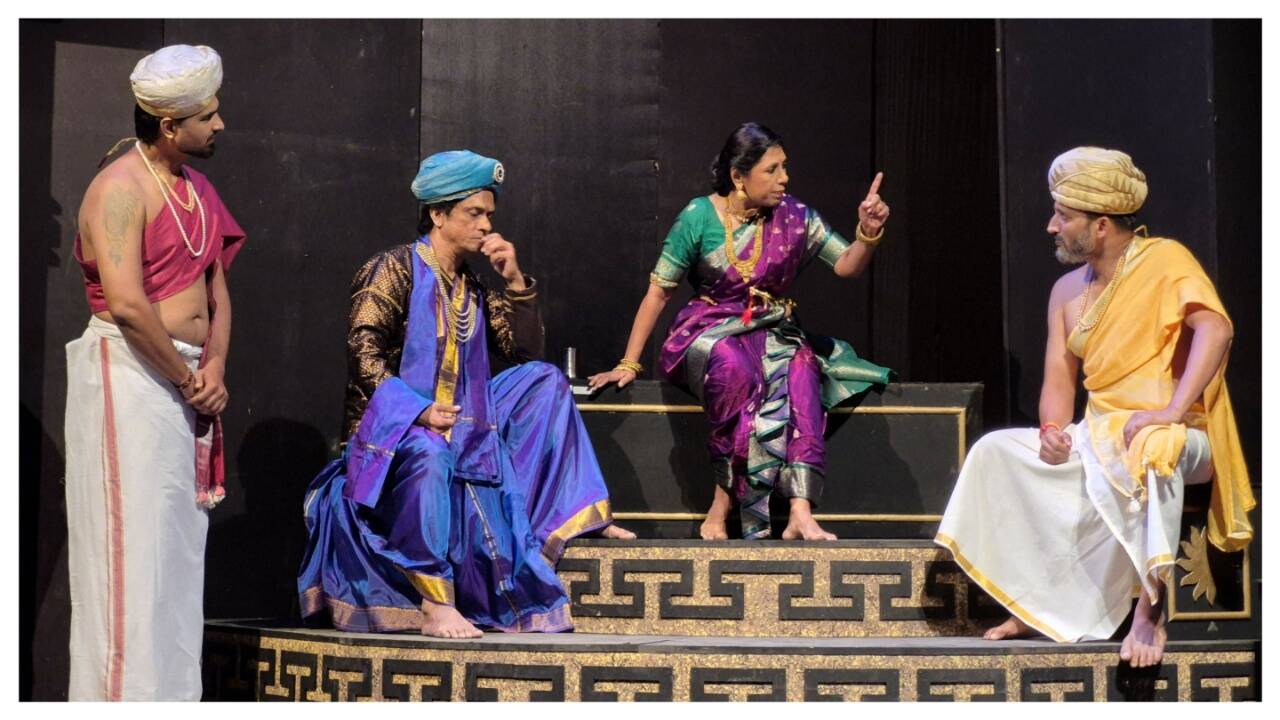
Veera Rani Abbakka (Historical biography, Folklore drama)
Critic's rating: 3 stars
Cast: Preeta Mathur Thakur, Neeta Mohindra, Ravish Kumar, Titiksha Tagar, Vikrant Chaturvedi, Kaustubh Sawant, Rafael Stemplewski, George Darley and others
Director: Preeta Mathur Thakur
Duration: Two hours
Language: Hindi
There are stories in Indian history that have survived not because they found their way into textbooks, but because generations kept telling them. Theatre, film, and television actor, director, Preeta Mathur Thakur’s play attempts to bring one such story out of the shadows; that of Abbakka of Ullala, the 16th-century coastal Karnataka queen who resisted Portuguese expansion and refused to surrender control of her kingdom and its maritime trade.
Written-directed by Preeta, with dialogues by Richa Sharad, the two-hour play is an ambitious undertaking, bringing together a large ensemble, elaborate sets, music, and movement. What makes Veera Rani Abbakka Chowtha's story particularly fascinating is that her resistance was not simply about winning a war, but about the fact that as a queen, she understood the larger danger behind the Portuguese presence on the coast. She saw through that what began as trade and promises of protection, could eventually become political control. And so, to protect Ullala’s sovereignty, she built a strong naval force, forged alliances, to challenge the Portuguese monopoly over the spice trade.
Preeta's play takes this larger political conflict and places a woman at its centre — not as a symbolic figurehead, but as a ruler making difficult strategic choices, when she is surrounded by men who either underestimate her, oppose her or attempt to use her political circumstances to their advantage.
The production’s biggest strength is its scale. With nearly 26 actors, it has the canvas of an epic, and the stage is aptly designed by the veteran thespian Atul Tiwari.
The two narrators using Yakshagana-inspired costumes and movement to introduce, explain and propel the story are an interesting theatrical device, particularly because the play is in Hindi while the legend itself has been preserved through Kannada oral traditions and folk performance.
The sheer ambition of the production, however, works against the intimacy that historical storytelling needs. With a large cast, multiple characters, political developments, battles and shifts in location, there is a lot for the audience to absorb. A tighter dramatic focus on Abbakka’s inner conflict -- the woman behind the warrior and ruler -- could make the emotional stakes even stronger.
Should you watch it?
Yes, particularly if you enjoy historical theatre, ensemble productions and stories about lesser-known figures from India’s past.
Catch the play at Prithvi Theatre on Oct 8 at 8pm and Oct 9 at 6 pm and 9 pm