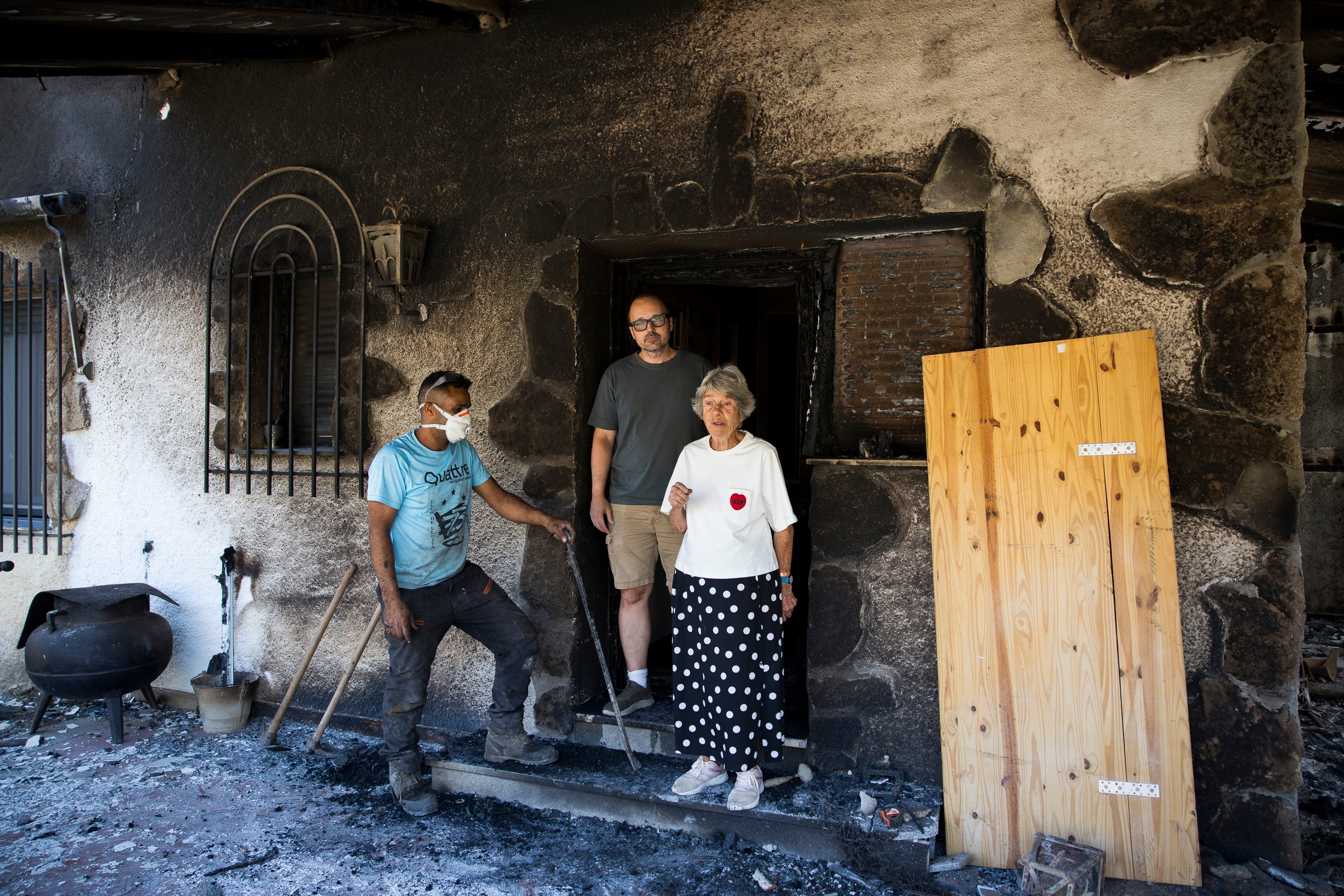
It was a beautiful stone house by a lake that the whole family loved. They spent the best summers of their lives there. Everyone tended to the plants and trees together as if they were horticulturalists in a botanical garden. Neighbors who had arrived in the area before them sent photos after the fire, but it was not until they saw it for themselves that they were able to grasp that it was a true tragedy.
The largest wildfire in Spanish recorded history has burned 77,000 hectares — 50,000 of them in Ávila — and has forced nearly 100,000 people to shelter in place or evacuate. The smoke is visible from the Meteosat satellite. In its path, the flames have destroyed forests, campsites, restaurants and rural refreshment stands, cars and homes. Those who have been able to return, even if only for a few minutes, have seen for themselves what the fire has taken from them.
Beatriz Seijas arrived accompanied at her son-in-law's chalet with Karim, the maintenance technician for the Calas de Burguillo residential development in the province of Ávila. She felt the urge to cry when she saw the state of everything. The garden no longer exists. Neither does the porch, which has been reduced to ashes. Of the tools, not even the metal remains — the extreme heat melted everything, including the floor tiles. The soot crept up the stone walls. The front door held, but flames slipped in through a side window and burned a beam, which ended up on the floor.
The Arizona cypress trees have burned and only the trunk of the cypress remains. "A lifetime of gardening work thrown in the trash," summarizes Miguel Serrano, the husband of one of Seijas's daughters. It was also their home on winter weekends, a "paradise," something of "incalculable" value. "It has been a very hard blow for all of us," he adds. Across from the house, the property faces the breathtaking landscape of the Iruela valley, currently engulfed in flames. Serrano emotionally recalls the feeling of gazing out at it. No one knows what it will look like tomorrow.
The devastation has swept through Ávila, passed through Toledo and leaped into Madrid. The fire is advancing through that triangle formed by the three provinces and has not yet been brought under control. Diego Grande Zamarano, 53, has the look of a plain man; weathered skin and several days' worth of beard — things are not exactly conducive to spending time with a razor. He works in construction, but also tends to just over half a hectare in Navaluenga that he inherited from his father, a now-retired goat herder. The fire has swept away nearly everything. "They had great sentimental value. I cannot put a price on this," says Grande, who is sleeping in a sports center that the Community of Madrid has made available to evacuees.
He didn't have the land insured, so he has no idea what is going to happen. He devoted himself to farming out of love. A true love that encompasses animals, plants, trees, the sky and the wind. He didn't want to become a goat herder because it's "very enslaving work, 365 days a year." "Anyone can look after a cow. It's easy to feed them, water them, milk them, but a goat is a different matter entirely," he explains, so that people can grasp what it means to take care of one. That's why he ended up laying bricks and mixing mortar, a trade that lets him sleep without so many worries. But that doesn't change the fact that his true calling is the countryside. He says that at heart he is a man of streams and forests. For someone like that, what is happening these days is "terrible and devastating." And his voice breaks when he thinks about how long it will take for things to look the way they did before.
If anyone understands this, it is Antonio Luis Rodríguez Zarzalejo, also a farmworker. His specialty is clearing estates. His home in San Martín de Valdeiglesias has not suffered any damage. On Thursday he tried to return there after work, but the Civil Guard, on the road leading in, stopped him. He asked them to make an exception and let him through to evacuate his dog Kiara, but they told him it was too dangerous. A brother-in-law who has remained confined in San Martín comes by every day and gives the dog food and water, and checks that nothing has happened to the house. He fears it may be broken into, but he leaves that in God's hands.
In winter, he put some sheep on the land around his house so they would eat all the grass and prevent it from catching fire. That worked. His small plot of just over two thousand square meters in the Pelayos de la Presa area, one of the places hardest hit by the fire, has not been so fortunate. It has a vegetable garden, some olive trees and a small vineyard. It's not much, he says, but it hurts him just as much as if it were the 500 hectares that Brad Pitt and Angelina Jolie had in California when they were a couple. As a divorced father, this is the summer month he gets to spend with his 13-year-old son. Since they haven't been able to go home, they are wearing clothes that have been lent to them. Antonio Luis wants the road to San Martín to open so he can go home, put the dog in the car and head over to the plot. It will be hard to see it with his own eyes, but at least, he says, he will have his son by his side.
So far, it is known that more than 40 homes have been destroyed in Madrid and nearly 300 have suffered damage of varying degrees. The first place where the flames were seen to give no respite was El Encinar del Alberche, a residential development in Villa del Prado. Its residents, on Thursday, had to evacuate urgently, though two days later they were authorized to return. This Saturday they have had to leave again. During those hours when they were able to walk through their streets, they found homes devastated, cars burnt to a shell, gardens lost forever. "I will never forget the first impression when we returned," says Emilia López, one of the residents. The structure of her house has not suffered major damage because the swimming pool, at the front of the property, acted as a firebreak. The patio, however, has been completely destroyed. She cannot shake the feeling that something has been stolen from her. The fire has robbed them all.