Migration Policy: Criticism of Family Reunification Suspension Growing
For more than a year, family reunification for persons with subsidiary protection status has been suspended. What this means for those affected and why criticism is growing even within the coalition.
The words may sound unwieldy — suspension, subsidiary, hardship clause — but behind them lie partly tragic fates like that of Youlia. Youlia was born deaf, in Syria in the middle of the war. She cannot speak, is constantly ill and urgently needs an operation. But the girl cannot be helped in Syria.
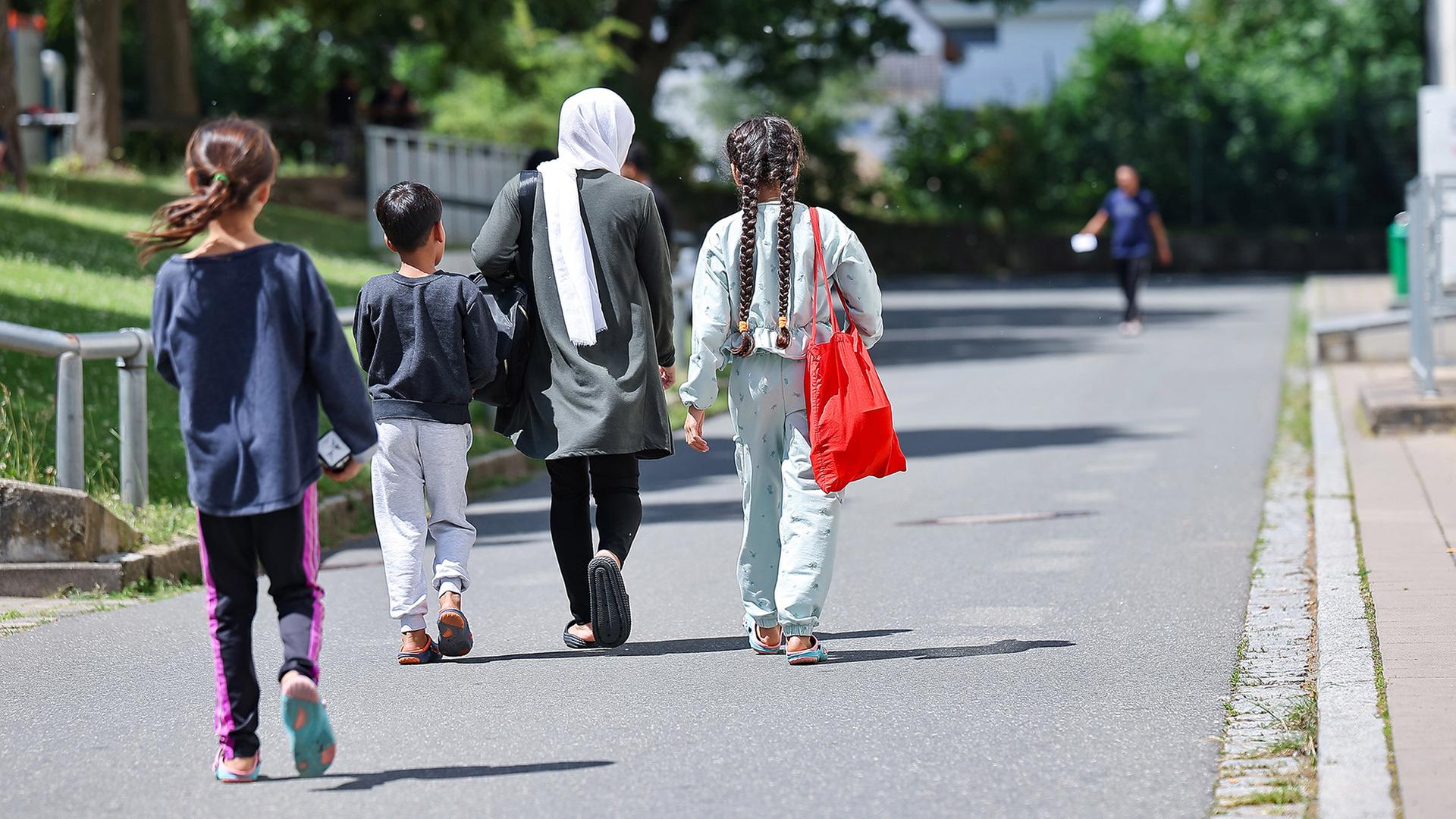
When Youlia is six years old, her health deteriorates so severely that her father decides to flee with her to Germany. First towards Turkey, then across the sea to Bulgaria. There, father and daughter are arrested by the coast guard, spend four weeks in prison, before continuing on foot to Germany. This is the account of Abdulaziz Hesso, Youlia's father. In December 2022, the two arrive in Brunswick.
Today Youlia is ten years old. She has received the necessary operation, during which an implant was also fitted. Youlia can now hear and is learning to speak. She attends a school for hearing-impaired children; her first language is now German. Kurdish, the language of her parents, is something she still has to learn, but for now the child is occupied enough with hearing itself and one language. To be able to help her with homework, her father Abdulaziz Hesso learns the German language at breakneck speed. His wife remained in Syria with their two younger sons. When they call, he translates back and forth for Youlia.
Throm: Society Has Made an "Outsized Humanitarian Contribution"
Abdulaziz Hesso belongs to the group of persons with subsidiary protection status. Family reunification for his wife and two sons has been applied for since 2023, but before a decision could be reached, this instrument was suspended in 2025. A political decision, driven by the CDU/CSU.
Alexander Throm, the interior policy spokesperson for the Union parliamentary group in the Bundestag, still considers this the right course of action today. Society has made an "outsized humanitarian contribution" over the past ten years, and this burden must be significantly reduced, he argues. The suspension is formally set at two years, meaning family reunification would automatically come back into force in the summer of 2027. However, from various quarters within Union circles, there are signals that the suspension is to be extended — as a signal against "irregular migration."
So Far Only a Few Hardship Visas Issued
From the research community comes opposition, for example from David Schiefer of the German Centre for Integration and Migration Research. He finds it "absurd" when Interior Minister Alexander Dobrindt (CSU) describes this as a measure against illegal migration. In Schiefer's view, the suspension of family reunification has ended one of the last legal escape routes to Germany.
Family reunification for those with subsidiary protection status had been strictly capped at a maximum of 12,000 people per year before the suspension. Only children and spouses are eligible to be brought over, and they are subject to intensive scrutiny by German authorities. Because family reunification applies to so few people, migration researcher Schiefer fundamentally questions the suspension. There is no reliable data, he says, to suggest that the suspension leads to fewer people making their way to Germany.
All that remains of family reunification is the hardship provision, intended for cases like Youlia's. But since the suspension, the Foreign Office has issued fewer than 20 hardship visas, compared to more than 5,000 applications.
Criticism from the SPD
For this reason, Hakan Demir, the SPD's interior policy spokesperson in the Bundestag, criticizes the hardship provision for not working. His party colleague Rasha Nasr describes the permissible separation periods for children and parents, newly defined under the suspension, as "unreasonable." According to a directive from the Foreign Office, for children under three years of age, a separation of up to five years is deemed acceptable. For children over three, ten years is considered acceptable.
In Youlia's case, this would mean: she last saw her mother when she was six and may not be reunited with her until she is 16. No wonder there are not many hardship cases left, says Rasha Nasr. Hakan Demir wishes CDU/CSU would "be honest and say: they don't want regular migration either." He firmly rejects any further suspension of family reunification. For the SPD, it was "very painful to agree to it at all" during the coalition negotiations, says Demir. He cannot imagine a further suspension during this legislative term.
Family reunification possible for skilled workers
What does this mean for the Syrian Abdulaziz Hesso and his family? Alexander Throm of the CDU advises him to work more and then bring his family over through the regular family reunification route for skilled workers. That is "the difference between the privileged family reunification as a refugee, where I don't have to prove that I can support myself financially, and family reunification as a skilled worker," says Throm. A statement that leaves Abdulaziz Hesso in despair. In Syria he worked in a car repair shop, and later in a supermarket. In Brunswick, however, he is caring for his daughter alone, and she requires special support. He cannot manage to work full-time, he says.
David Schiefer from the German Center for Integration and Migration Research argues that the suspension of family reunification has negative effects on integration processes. Research from studies shows that separation from family leads to severe psychological strain, to worry, stress and a "permanent state of uncertainty."
As a result, those affected have fewer resources to invest in learning the language or finding work. Integration processes could take longer as a consequence, and cost the Federal Republic more. "You're cutting off your nose to spite your face," says Schiefer. While the aim is to manage migration, "integration processes are also hindered by such a measure."
As long as the Hesso family's case is not recognized as a hardship case, the father and daughter will remain in Germany while the mother and sons stay in Syria. Hakan Demir of the SPD is considering reaching out to Alexander Throm of the CDU. Perhaps they could jointly approach the Foreign Office. "Because if the Hesso family's case is not a hardship case, then we are at a complete loss as well," said Demir.