Police in London Making Arrests Using Facial Recognition
London's police are praising their experiences with automated facial recognition. More than 2,000 wanted individuals have been arrested with its help. The project is now set to be rolled out further.
Data protection advocates are alarmed.
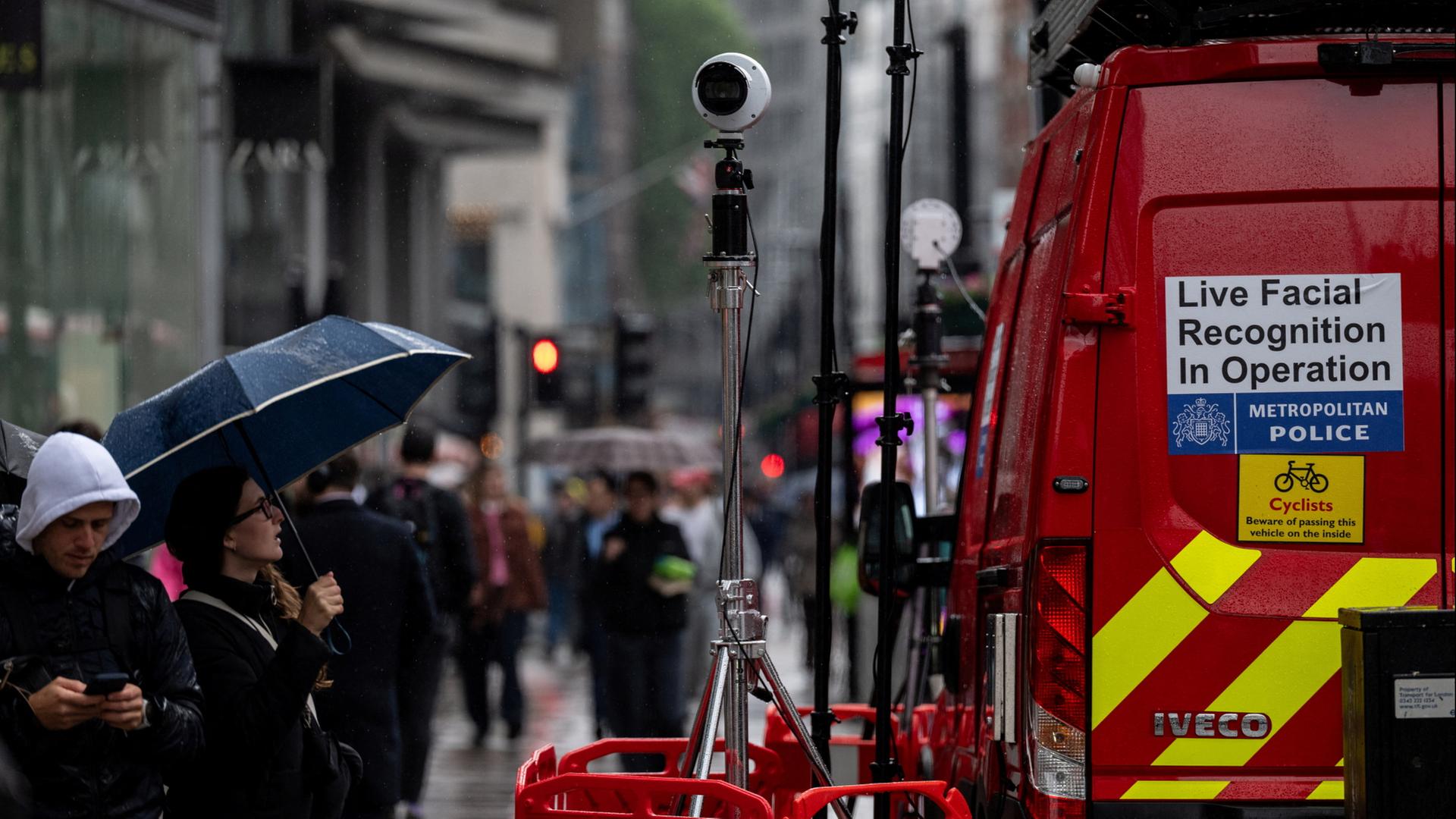
On the wide pavement of Sloane Square in London's Chelsea district stands a red delivery van. On the roof: surveillance cameras. Just around the corner: a scaffold with more cameras. In front of the van stand several uniformed police officers.
Here, on this shopping street, there is a great deal of activity. The cameras scan the faces of passers-by, and software immediately compares the images against a database of persons who are wanted. When an alert is triggered, an image appears on the officers' mobile phones. Arrests occur almost daily.
London is estimated to have up to one million state and private surveillance cameras. Now facial recognition is also set to be expanded.
Police Point to Successes
Ben Russell, Director of the intelligence division at the police, regards the deployment as a great success. Since 2024, 2,500 individuals have been arrested — nearly 900 in this year alone. The technology is highly effective, he says.
During the interview with him, a man is arrested at the next street corner. An alert had been triggered because the suspect allegedly attacked a police officer years ago.
Officers handcuff the man after establishing his identity. He is taken away. Just around the corner, a woman is stopped because she failed to appear for a court-ordered drug test.
False alarms are extremely rare, the police say. No arrest is made solely on the basis of a database match. Identity must be verified, including with the help of documents.
More Security or More Freedoms?
Among passers-by, the deployment provokes mixed feelings. A young woman believes she feels safer because of the police presence. An older lady walking past the van says one must weigh the erosion of civil liberties against the fight against crime in a city like London. Another woman complains that there is too much surveillance.
In London, cameras are installed on almost every street corner. During investigations, officers draw on the footage to catch perpetrators. This differs, however, from the live facial recognition now being introduced. Until now, an investigation had to be underway before footage could be accessed — live facial recognition searches for individuals registered in a database.
For the time being, pedestrians in London are notified when facial recognition is being used in their vicinity.
Legislation Still Pending
Critics regard the new procedure as a massive intrusion into privacy. Is this the beginning of a police state? Jack Coulson of Big Brother Watch points out that there is as yet no regulation governing how police may use facial recognition.
The facial scan is sensitive, uniquely identifiable, and could be stored. "These data could therefore be used for all manner of things. This is a serious measure and a powerful instrument for any government," says Coulson.
Organizations such as Big Brother Watch are calling for clear rules governing when, where and for what reasons police may use live facial recognition. They also want regulations ensuring that data is not stored.
A draft law is planned for the autumn. The police are already acquiring additional cameras and vans.