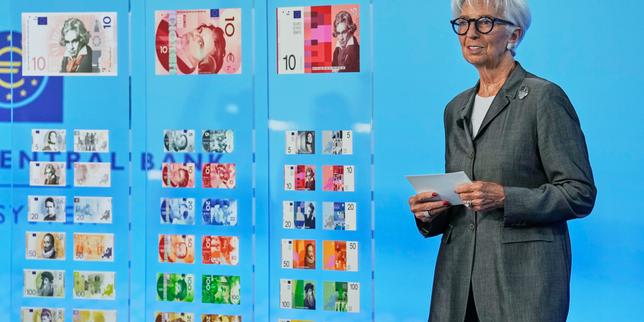
The race is open for Christine Lagarde's successor as ECB president, with a certain year but uncertain month: 2027, and one candidate, the Spanish one, currently the frontrunner. At the press conference following the interest rate decision, the head of the Eurotower — who in a recent interview had hinted at a role for herself in next year's French presidential elections — assured that "the captain stays on the ship" given the clouds on the horizon. "You won't get rid of me before 2027," she said. Her mandate indeed expires in October of that year, while the vote will be in April, meaning an early departure of a few months is possible, as is remaining at the helm until the end.
Lagarde's entry into the field comes as polls show the greatest chances lying with forces at the extremes of the political spectrum: the Rassemblement National of the Le Pen-Bardella duo on the right and Jean-Luc Mélenchon's La France Insoumise on the far left. Both are anti-European forces, although Bardella has recently said he does not want to leave the EU but to change it profoundly. An early resignation would allow current President Macron to play his part at the European level in choosing a successor, as seen at the Banque de France, where one of his close allies, Emmanuel Moulin, recently took office following the early departure of de Galhau.
And for the ECB's top seat, according to several observers and media outlets, a Spaniard could arrive: Pablo Hernandez de Cos. A long-serving central banker, after leading the Bank of Spain he is now head of the BIS, the central bank of central banks, based in Basel. Other names include Dutchman Klaas Knot, well regarded by northern European countries, and two Germans: Bundesbank president Joachim Nagel and ECB board member Isabel Schnabel, known as a "hawk."
Reproduction reserved © Copyright ANSA