The landscape of the Sierra Norte de Guadalajara is desolate. More than 32,000 hectares have been razed by the largest wildfire in the history of Castilla-La Mancha, which on Wednesday appeared for the first time to be relenting after more than six days. Some villages have been able to return their residents, while others remain confined or evacuated. The hamlet of Naharros, to the north of the burned area, was evacuated on Sunday, although residents had already spent two days watching the smoke draw closer and seeing embers larger than 10 centimetres fall from the sky. When the order came on Sunday, "everyone was ready and out the door," says its mayor, Ricardo Antón, who recalls the fire's arrival as if "hell itself were approaching": "You see the entire hillside above burning and you can hear it overhead." At that moment there were nearly a hundred people in the village, but only five of them stayed behind to defend it alongside the firefighters. One of them was the mayor himself.
"Nobody thought it could reach here, from so far away," Antón recounts, explaining how the authorities "gave them the opportunity" to stay on the condition that they be "identified." Several neighbours stayed with him, among them some over 80 years old, with difficulty moving and driving, but who knew the area perfectly. "If there's any problem, you come with me, and don't give me any trouble," the mayor warned them on Sunday night.
Once the worst had passed, they climbed one of the nearby hills surrounding the village, and from there watched the fire moving away. "The fire was so ferocious that it leapt across the valley," Antón warns. The mayor is deeply grateful for the work of all members of the emergency response, but laments that "it seems as though the villages are a burden," while pointing sadly and with frustration at the surroundings devastated by the flames. Everything is ash on the other side of the road and the firebreak, which served to protect a grove of trees. "If it had crossed this area, some house would certainly have burned," he notes, celebrating that it did not advance further, though he concludes that, in his view, "something is failing" in the management of woodland and fire prevention.
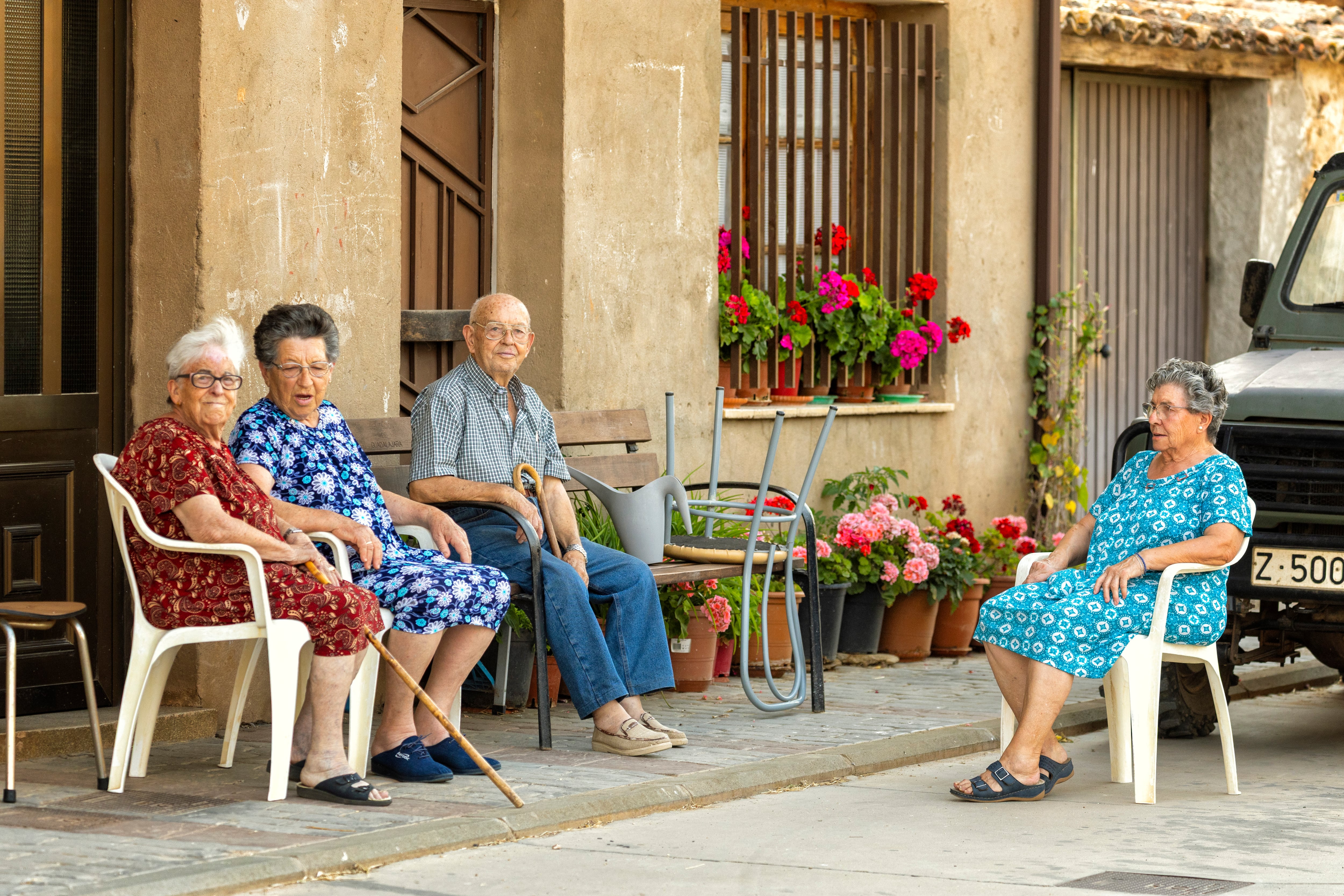
One of the municipalities that has been reopened to residents is Riofrío del Llano, to the east of the charred zone. Antonia Molinero, 80 years old and born in the village, is one of the residents who on Wednesday afternoon was already able to water her plants and chat with friends in the street after spending several days displaced. She was evacuated on Sunday night, like the residents of Naharros. The Civil Guard knocked on her door after midnight: "You don't have time to react. You just say, if I have to leave, then I have to leave." She grabbed her medication, her phone and her ID card and left her home frightened, accompanied by one of her sons. They moved to Atienza, and she recalls how from Thursday she had already sensed something was wrong: "There was a strong smell of smoke in the afternoons," although in the mornings the sky would dawn clear, and she never became fully alarmed.
This Wednesday, Molinero was one of the first residents to return to the village, but she found the streets deserted. By the afternoon, music could be heard coming from the bar, which seemed to have switched on to restart the activity of this hamlet of 49 inhabitants, where a little girl runs through the streets once more. Inside the bar, the owner prepares some ice while recounting that he went to Madrid, but that some neighbors had to take refuge in the temporary shelter in Humanes, a 50-minute drive away. "The glow could already be seen from 20 kilometers away," he recalls.
Closer to the origin of the fire, Antonio Mier, 20 years old, was driving during the morning along one of the paths crossing the devastated area. He is heading to La Mierla, his village and where the fire started. He is the grandson of the mayor and was not in the village when everything began because he was in Madrid. But he returned last Friday to see his grandfather and has not gone back since, until today. He wanted to check on the state of the village after the fire. "It is quite striking to see everything green your whole life and, suddenly, to see it this black," he says, visibly affected by the magnitude of what happened, which he had not expected to be so serious.
His grandfather, the mayor of the municipality, lived through the evacuation from the inside: nervous and "furious about the situation," although trying to stay calm. According to the account he shared, several firefighters who live in the village worked at ground zero, where the fire originated. Antonio asserts that the urban center was spared and that no homes were damaged, although firefighters reinforced firebreaks in case any hotspot reignited. He plans to stay in the village until tomorrow or Friday and hopes that residents can be rehoused as soon as possible.
Seven autonomous communities are on alert due to high temperatures, reaching 42 degrees Celsius in some areas, in what is the third heat wave of the summer in Spain. This situation is hampering the efforts to extinguish the wildfires affecting the country, mainly in Castilla y León and Castilla-La Mancha, where the worst consequences are being felt.