Latest
The Federal Reserve held interest rates steady on Wednesday, despite no recent progress on getting inflation down to the central bank’s 2 percent target.
Officials voted 10-2 to keep rates at the range of 3.75 percent to 4 percent. That range was reached in September after policymakers decided unanimously to raise rates for the first time since 2023.
Lisa D. Cook, a Fed governor who President Trump has tried to fire, issued her first-ever dissent on the Fed’s monetary policy settings in favor of a quarter-point increase on Wednesday. She was joined by Beth M. Hammack, president of the Federal Reserve Bank of Cleveland, who has dissented repeatedly this year.
In a statement accompanying the rate decision, the Fed conveyed that it had more work to do to quell inflation, which it described as “elevated.”
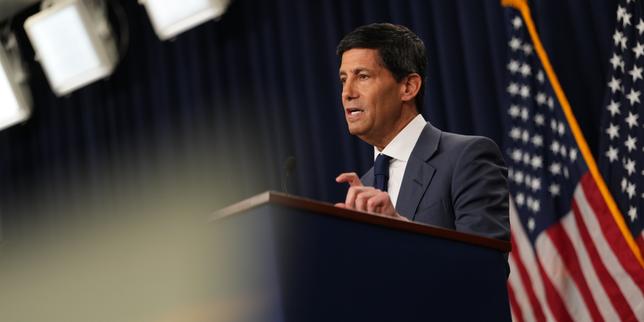
At a news conference after the decision, Kevin M. Warsh, the Fed chairman, started with an upbeat assessment of the economy, but stressed that inflation was still too high.
He also said the central bank would cut the number of meetings at which it votes on interest rates. Mr. Warsh said the Fed would still meet eight times in 2027, but one of those meetings would focus “exclusively on broad monetary policy strategy” and would not include a vote on interest rates. Starting in 2028, the Fed plans to dedicate two meetings to such broader strategy.
The Fed gathered days before midterm elections that will decide whether Republicans retain control of Congress and how much scope President Trump will have to enact his agenda in the second half of his term. Affordability issues are central for voters after nearly six years in which inflation has overshot the Fed’s target.
“Politics played no role in the decision,” Mr. Warsh said when asked about the midterms.
Mr. Warsh, who took over as chairman of the Fed in May, has made taming inflation the top priority of his four-year term.
Since officials at the Fed met in September, inflation data has been far from reassuring. Price pressures appear to be broadening out after shocks caused by Mr. Trump’s tariffs and the U.S.-Israel war with Iran. Energy prices have shot higher, threatening to spill over into other goods and services.
The economy has continued to grow at a solid pace despite these headwinds, fueled by an investment boom stemming from companies scrambling to expand their artificial intelligence capabilities. Wage gains have failed to keep up with rising prices, however, meaning Americans are earning less for an hour of work.
U.S. government borrowing costs have risen sharply, making not only mortgages and other consumer loans more expensive, but also financing for companies. Certain A.I. companies, which have issued a significant amount of debt to fund their expansion plans, appear particularly exposed.
As a result, financial conditions, which track the availability of credit across the economy, appear slightly less accommodative. To what extent this will help the Fed tame inflation depends in large part on whether these conditions tighten further.
Ms. Hammack’s dissent on Wednesday was widely expected given her views that the Fed’s policy settings are not restraining the economy. Ms. Cook’s dissent was notable in that she is locked in a legal battle with Mr. Trump, who has sought to pressure the Fed into lowering rates. Ms. Cook became a target in the summer of 2025 when the president seized on unproven allegations that she committed mortgage fraud before joining the central bank.
Mr. Trump renewed that effort after the Supreme Court ruled against him on the matter earlier this year. The White House started its own investigation into Ms. Cook and summoned her in for an in-person hearing.
The biggest question coming into the news conference was why the Fed didn’t raise rates given the persistence of inflation. I’m not sure we ever got an answer, despite the best efforts of reporters to pin Warsh down.
Warsh says the economy is strong, but not necessarily too hot in a way that is leading to inflation. “Is the economy running too hot? Is the economy too strong? That isn’t the judgment of most of my colleagues,” he says. He argues that productivity growth is picking up, which allows the economy to grow faster without causing inflation.
Warsh reiterated his comments that he “does not believe” in forward guidance. However, he was careful to include a caveat for when the economy is in crisis. Recalling his experience during the 2008 financial crisis, he said that in those moments, guidance is needed.
Warsh is asked about the role that the A.I. investment boom is playing in driving both inflation and economic growth. He says that A.I. is an important factor in the strong economy, but not the only one. And he pushes back against the idea that A.I. investments are insensitive to interest rates, noting that corporate bond investors appear to be distinguishing between A.I. companies that they view as safe and those that could be riskier. In other words, he still believes interest rates will do the job of bringing inflation under control.
Warsh says that while surveys show that consumers are expecting faster inflation in the near-term, there is relatively little evidence that they are expecting faster inflation over the longer run. That’s generally true, but there have been some hints that consumers are expecting inflation to be higher in the future as well. Economists and policymakers pay close attention to such measures of expectations because if consumers and businesses start to expect inflation to endure, it can make it harder for the Fed to bring it under control.
Warsh is asked about the task forces that he convened to look at a wide range of issues that he believes are central to how the Fed conducts policy. They include groups looking at how the Fed communicates as well as how it models inflation. He said “some, but not all” groups will have recommendations by year-end, the deadline that Warsh initially set.
Reducing the number of meetings is the most major change that Warsh so far has announced at the central bank. The reason that Warsh most often cites is that it will allow for more data to accumulate between votes on interest rates. One potential risk is that it might leave the Fed less nimble to act if the economic backdrop rapidly changes. The Fed can hold emergency meetings, but they only tend to do that during periods of crisis.
Yields have come back down to 5 percent where they started the day. It appeared investors were responding to Warsh’s comments on inflation expectations remaining anchored, despite hotter inflation data in recent weeks. It’s obviously hard to know the precise driver but what is clear is that markets are twitchy, moving quickly higher and lower since Warsh started speaking.
Warsh says the committee is “going to be able to figure out what’s the appropriate protocol” and that he is “encouraged by the progress we’ve made in a short period of time.”
It isn’t clear what progress the Fed has made, given the hot September inflation readings. But he highlights the continued stability of inflation expectations, which he said indicates confidence that the Fed will do what is needed to bring inflation under control.
Colby leads off with the central question of the day: If inflation is so high, why not raise rates today? Warsh stresses that the Fed is committed to bringing inflation down to its 2 percent target and is willing to act to get there. But he doesn’t directly address why policymakers didn’t act today. “If the crux of your question is you haven’t achieved price stability, you’re right,” he says. But he says they are committed to getting there.
Bottom line: The Fed plans to hold only seven votes on interest rates next year, and six in 2028, down from eight in recent years. Warsh first raised the possibility of reducing the number of policy meetings over the summer.
Warsh announces that the Fed will meet eight times next year, as it has in recent years. But in a change, one of those meetings will focus “exclusively on broad monetary policy strategy” and will not include a vote on interest rates. Starting in 2028, the Fed plans to dedicate two meetings to such broader strategy.
All of that strong growth rhetoric has helped push up equity prices again, with the S&P 500 rising 0.2 percent. Bond yields have also continued to push higher, with the 10-year Treasury yield rising to 5.04 percent.
Warsh says that given the strength of the labor market, and the continued elevated rate of inflation, the committee’s discussions focused mostly on the price stability side of the Fed’s dual mandate. That could be a hint that further rate increases remain likely, despite the committee’s decision not to raise rates today.
“Economic growth has strengthened,” Warsh says, pointing to recent upward revisions to GDP estimates in the first half of the year, and forecasts of strength in the third quarter as well. We will get third quarter GDP tomorrow.