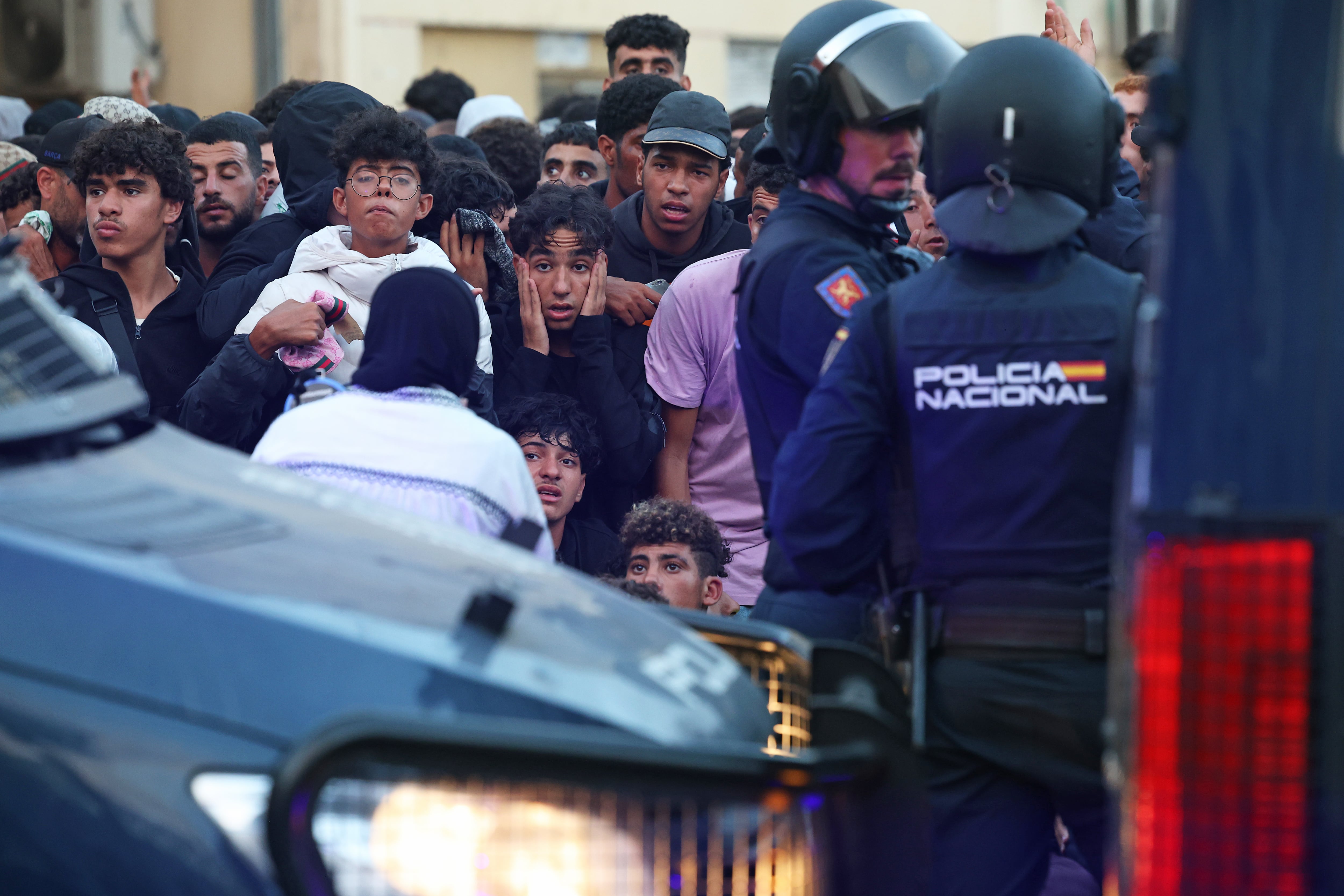
At least three regions governed by the PP and Vox — Castilla y León, Aragón and Extremadura — are currently taking in unaccompanied foreign minors from Ceuta amid the crisis, sources from the Ceuta administration told EL PAÍS. They are doing so under pressure from the team of the PP's Juan Jesús Vivas and in compliance with the obligation set out in Article 5 of the immigration law. So far, these are still children and adolescents who had entered the autonomous city before the mass crossing of 30 and 31 July, as processing the case files takes time. But the same sources indicate that some of the procedures affecting those who arrived during the crisis are already under way and are following the same steps, meaning similar channels will continue to be used in the coming weeks. Madrid, Murcia and Galicia (all PP-governed) are also receiving these minors, as is Castilla-La Mancha (governed by the PSOE).
The transfers of foreign minors from Ceuta to the mainland have been taking place both in September and throughout the previous month. By mid-July, more than 1,750 foreign minors who had arrived in Ceuta, Melilla and the Canary Islands had been relocated to other territories over the course of a year. But with the mass influx, the system in Ceuta collapsed entirely. As the days passed, and after the tremendous initial impact, case files for those admitted before the crisis continued to be resolved and new transfers to other regions continued to be carried out. Sources at the Ministry of Children also confirmed the transfers in August and September, though without specifying destinations, as this falls under the competence of the city's government.
The transfers are taking place despite regional agreements by the PP and Vox, signed between April and June, stating that they would not accept any more immigrant children or adolescents. That stance has hardened and become categorical against those who managed to cross the border on 30 and 31 July. In private, however, regional presidents from the Partido Popular and sources within Santiago Abascal's party have been acknowledging for weeks that they must "comply with the law." In practice, this means they cannot refuse the minors, regardless of how many legal challenges the regional governments have mounted against the regulation — so far without success — or how many angry speeches they have delivered in public. They also accept that they must comply not only with regard to minors who arrived before the crisis, but also with those who set foot on Ceuta's soil after 30 July if compelled to do so. The PP's headquarters at Génova, together with Vivas, are refusing and calling for all of them to be returned to Morocco.
Immigration law
The regulation requiring these transfers is Article 5 of the immigration law, amended by parliament in March 2025. Months later, in August, the government approved a royal decree establishing the number of places allocated to each autonomous community. Those territories that exceed that number threefold may request a declaration of migration contingency, and the remaining regions are then obliged to accept the relocation of minors. Ceuta is allocated 29 standard places. It currently has approximately 2,200 minors registered, with another 1,000 that La Moncloa estimates remain on the streets.
Before the mass entry, the Ceuta government was already caring for 700 minors, several of whom have been continuously transferred, amid the emergency and in application of that Article 5. During the month of September, on the 14th, Ceuta transferred a minor to Castilla y León; on Tuesday the 15th, another to Extremadura; on Wednesday the 16th, one to Aragon; and on Thursday the 17th, as many as 14 children and adolescents to Castilla-La Mancha. In addition, the autonomous city's government has planned further relocations: next Monday the 21st, one minor to Madrid and another to Murcia, and on the 24th, four to Galicia. These are just some of the figures for September, to which must be added the transfers from the beginning of the month and last August, which may affect additional regions. Sources from the Galician regional government and the Castilla-La Mancha regional government confirm the placements. Madrid responds that "from Ceuta and the Canary Islands, prior to the invasion, they have continued sending case files this summer." The remaining regional governments have not responded.
These minors are being transferred through the application of Article 5 of the immigration law. But they can also be relocated through bilateral agreements voluntarily signed between autonomous communities, as happened last week with five girls whose relocation was agreed upon between Ceuta and Navarre. Those minors had indeed arrived in the city during the mass entry. The Ceuta government is continuing with the case files, using both methods, and they expect that in the coming weeks, after relocating those who arrived before the 30th and 31st, the distribution of those who arrived in the surge will continue, in application of the legal obligation under Article 5 of the immigration law, given the refusal of the PP and Vox to receive them.
The position of Génova now is that the mass crossing is an "invasion," a security problem and not a migration crisis, meaning that the immigration law cannot be applied to those who joined the surge of July 30th and 31st. Therefore, neither Article 5 nor its mandatory nature applies to them. However, regional leaders such as the President of the Junta de Andalucía, Juan Manuel Moreno, are not making the same argument as their party's leadership and are challenging La Moncloa to impose the transfers. "The government has the legal capacity to transfer minors to the mainland; in fact, it has already done so. They have the instrument to start receiving minors tomorrow," Moreno said in an interview on Onda Cero this Thursday.