New Opportunities for Industry: Can Germany Keep Up with the Robotics Boom?
China is setting the pace in humanoid robotics. But Germany has real opportunities — and the new billion-dollar market could become a growth driver for the struggling automotive supply sector in particular.
Humanoid robots — machines resembling humans — are becoming increasingly capable: they run half-marathons, grasp and carry objects, sort packages, and are already taking on concrete production tasks in the first factories. Experts see the potential here for the next billion- or even trillion-dollar market.
A recent study by the Fraunhofer Institute for Manufacturing Engineering and Automation (IPA) projects a global market volume of around 30 billion dollars by 2030. US investment bank Morgan Stanley considers a long-term market volume of around five trillion dollars by 2050 to be possible. By then, nearly one billion humanoid robots could be in operation worldwide.
China Dominates in Humanoid Robotics
China is setting a particularly rapid pace. In the first half of 2026 alone, more than 40,000 humanoid robots were delivered there, according to Reuters. The People's Republic accounted for 97 percent of global deliveries during that period. So where does Germany stand — could humanoid robots be yet another growth market that companies here are missing out on?
How many humanoid robots are already being produced or delivered in Germany cannot currently be reliably quantified. Unlike in China, the market here is still largely in the pilot and ramp-up phase. However, Germany is by no means starting this technology race from scratch.
Germany's Strength Lies in the Automotive Industry
"In Germany, we are actually very well positioned to bring even better systems to market," emphasises Sebastian Reitelshöfer, head of robotics research at the University of Erlangen-Nuremberg, in conversation with ARD's financial desk. Robots are, after all, highly complex mechatronic systems. "And complexity, mechatronics, high quality — we're actually quite good at that. We've been selling that as automobiles for decades, in a leading position."
Indeed, the automotive industry is among the first sectors in Germany where the new robots are being deployed. BMW is already testing humanoids directly on the production line at its plants in Leipzig and Spartanburg in the United States. Supplier Schaeffler is going a step further: the company wants not only to deploy the robots in its own plants, but also to manufacture key components itself.
NEURA Robotics Bets on German Industrial Expertise
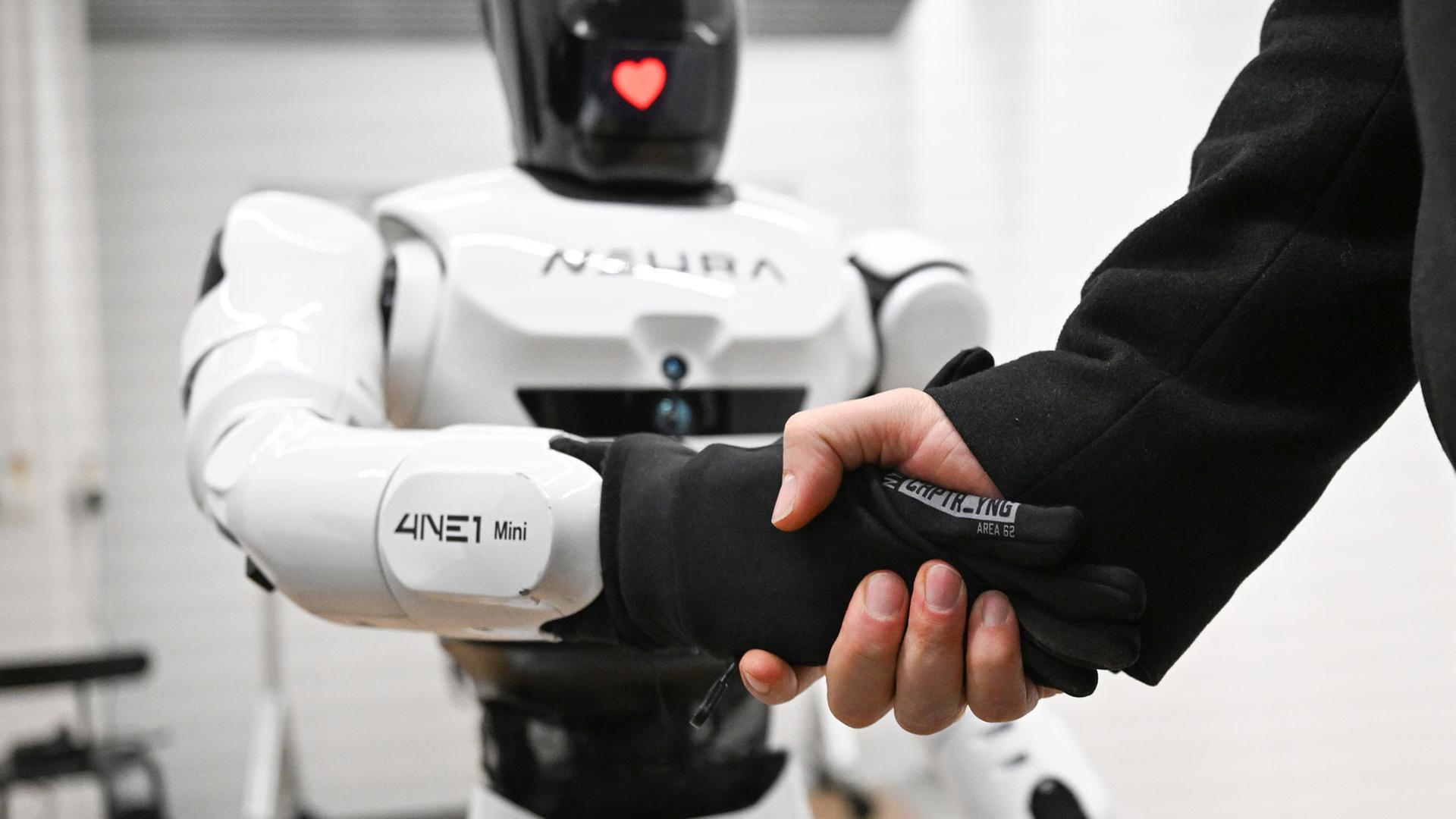
To position itself along the value chain, Schaeffler is working closely with German robotics manufacturer NEURA. The start-up, founded in 2019 and headquartered in Metzingen, Baden-Württemberg, develops so-called cognitive robots designed to see, hear, feel, and learn with the help of artificial intelligence.
NEURA's flagship model is called 4NE1 — a robot intended for long-term use both in factories and in everyday tasks. According to the manufacturer, it features fine-motor hands and can lift up to 100 kilograms. Schaeffler develops and supplies components for NEURA including compact actuators — integrated drive units for the joints of humanoid robots.
Automotive Suppliers Discover Humanoid Robotics
Besides Schaeffler, many other automotive suppliers have by now also recognized "that with their competency profile they could actually become excellent suppliers for a new robotics industry," emphasizes robotics expert Reitelshöfer. For the German supplier industry — which has been badly battered of late in the face of the automotive sector's transformation — a new growth field is thus opening up.
Looking at the robotics start-up scene in Germany, Reitelshöfer adds: "NEURA is certainly the most prominent example — but not the only one." The Fraunhofer IPA counted more than 60 young robotics companies in Germany last year.
Bosch, Nvidia and Amazon invest in NEURA
Also of interest is a look at the investors backing NEURA: alongside German automotive suppliers Bosch and Schaeffler, US tech heavyweights such as Nvidia, Amazon and Qualcomm also participated in the most recent record funding round of 1.4 billion dollars.
This shows that German robotics companies are now being perceived as serious players in the market. Especially since the models of Chinese companies, on closer inspection, often still fall short in one crucial respect: endurance.
Where humanoid robots still have weaknesses
"It's no coincidence that they recently ran a half marathon in Beijing as a PR stunt — they did it because they wouldn't be able to complete a full marathon," emphasizes robotics expert Reitelshöfer.
"Such a robot would therefore only last one or two weeks in many application scenarios, until its essential components — namely its legs — would be worn out after just over 20 kilometers." From European industry, particularly from the automotive sector, there are by contrast entirely different concepts that would last far longer.
The biggest hurdle is commercialization
But good technology alone does not guarantee commercial success. That is precisely where Chris-Oliver Schickentanz of Capitell AG sees a typically German weakness: "We are — as in many areas — relatively advanced in basic research, but we fall short when it comes to commercialization. In other words: how can I make money with this technology?"
All in all, Germany thus has good prerequisites for playing an important role in the future on the billion-dollar market for humanoid robots. What matters now, however, is turning know-how and good prototypes into a genuine industrial business.