The wildfire in the southwestern mountains of Madrid has placed the municipality of Cadalso de los Vidrios in the spotlight — located at the western tip of the region on the border with the provinces of Ávila and Toledo — after the Burgohondo fire advanced on Saturday through the Tiétar valley. An alert on mobile phones warned residents that they had to evacuate the area, including 117 elderly people housed at the Alena care home, most of them dependent and with multiple medical conditions. "Ash was raining down, the air was unbreathable," recalls Alfonso García, 65, of the short journey he made to reach the ambulance that transported him to the capital. "We all went wearing masks, some by bus and others in medical vehicles because they needed oxygen or wheelchairs," he says. The Community of Madrid has coordinated the transfer of 1,308 residents and users of social care centres in recent days.
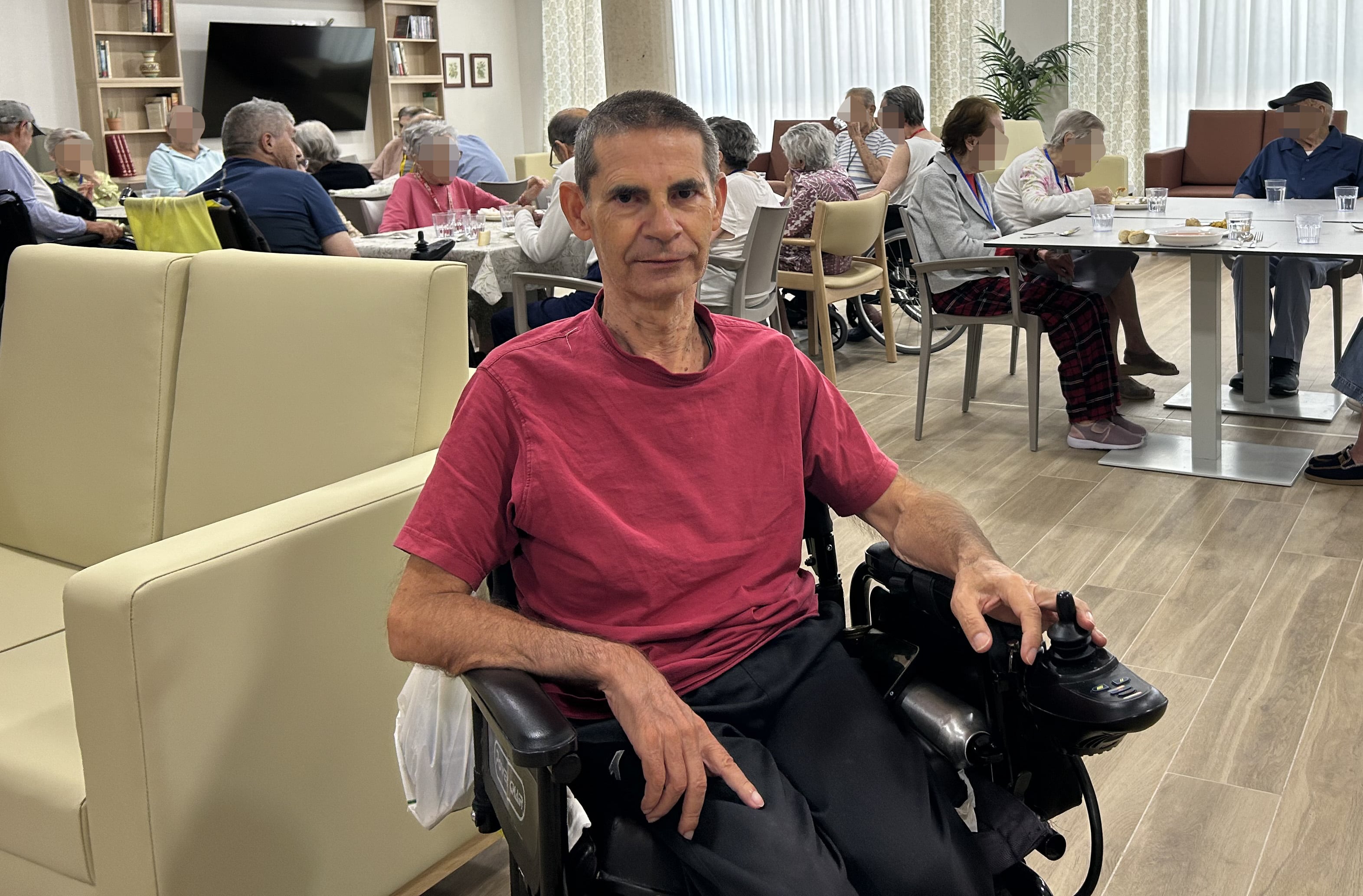
"I'm in a safe place now. The fire didn't reach where we were, but you could see the column of smoke — it was dreadful, overwhelming," says García as he waits to be served his meal at the Casablanca care home in Vicálvaro, where he and his fellow residents have been rehoused. "The evacuation was very well directed and organised; the staff who look after us handled it properly so as not to cause chaos," he insists, after noting that everyone was worried. "There are very elderly people," he explains. In his case, he had been anxious for several days, constantly checking updates on the fire's progress through his mobile phone until he lost signal as a result of the advancing flames.
"The evacuation had to be very quick, but since I feared the worst, I had packed a bag with the essentials in case we had to leave. I'd been sleeping badly for several days," says the man, who admits to having slept better last night, away from the fire and in a room of his own. "I heard some crying in the early hours, but in general we were all very calm," he acknowledges. He is grateful for the welcome at the Casablanca care home in Vicálvaro, where he says he feels very comfortable. "This place is like a castle — I could never afford it — but I'd rather go back to mine; it's my home. I'm looking forward to going out for a drink in the village and seeing that everyone is all right," he says, with no idea of when he will be able to return.
On the floor below, Piedad González, 50, weeps with emotion upon learning that her 87-year-old mother is well after being evacuated from Cadalso de los Vidrios. "I trusted the team that looks after her, but I went through moments of great anxiety. When I found out from the television that she was being evacuated, my world fell apart — she suffers from cognitive decline and becomes very disoriented by any change. My surprise came this morning when I arrived and saw her looking relaxed. She has no sense that anything serious has happened; she only mentions that there was a lot of traffic on the way," she says.
González says that some residents had to be carried out in arms due to their high level of dependency. "Their caregivers are superheroes, I don't know what I can do to thank them for what they've done. At the Vicálvaro residence they even washed the clothes the residents arrived in. Many left in such a rush that they didn't have a change of clothes," she says. Like García, she had also gone days without sleep. She had been trying to get to the residence located in Cadalso de los Vidrios, but the road was cut off by the flames. "Tonight I'll be able to rest, knowing my mother is settled in her shared room," she says.
The director general of Grupo Casablanca, which manages the Vicálvaro residence, Ignacio Fernández-Cid, says he did not hesitate for a second to offer help when the regional government contacted employers' associations looking for rehousing alternatives. "At 1:30 p.m. I was notified that they would be arriving in the afternoon. We opened the center in June and only had one of four floors occupied," he explains. For the manager of the Grupo Alena Cadalso de los Vidrios residence, Miguel Bruna, it was the best option. Without this possibility, he would have had to split the residents between two different locations.
"We are part of the social sector, so we are delighted to be able to help in an emergency," says Fernández-Cid. Previously, it had been Bruna's residence that decided to lend a hand to elderly people evacuated in San Martín de Valdeiglesias, bringing them food. This Saturday at midday, Bruna received word to be ready to evacuate the residence, as that possibility was on the table. The evacuation was coordinated with a technician from the 112 Emergency Medical Service. The center was completely sealed to prevent smoke from entering, and the residents were transferred in three buses and six ambulances.
"It was important to do it quickly, but above all to do it properly so that no one was left behind," he explains. Many of those rescued require oxygen therapy, suffer from Alzheimer's, or have reduced mobility, but no one was affected by the smoke and all are safe. "Following the contingency plan, we printed out the medical records of all the residents, their treatments and a week's worth of medications, as well as the computer equipment that provides access to their full medical histories," says Bruna, while noting with relief that the night was manageable, despite the anxiety suffered by some of the elderly residents.
"They keep asking when they'll be able to return to Cadalso de los Vidrios, but we won't move from here until the authorities consider it appropriate," he says, after thanking Fernández-Cid for his generosity, knowing this could just as easily have happened to him. "It's been a bit chaotic, but where there's a will there's a way — all the staff from both residences have been very committed and are here working right now," he stresses. The Community of Madrid provided them with nine oxygen concentrators that the residents had been unable to bring from Cadalso for logistical reasons.
The Department of Family, Youth and Social Affairs has set up an assessment centre, which was first located in San Martín de Valdeiglesias, then in Brunete and is currently in Navalcarnero, to coordinate the transfer of people in various situations of vulnerability or who have nowhere to go. The Vicálvaro centre has not been the only one to take in residents. The elderly residents of the Real de la Pinarilla care home, located in Chapinería, are now at the public Francisco de Vitoria care home in Alcalá de Henares or with their families. Those from the private Clavijo care home in Villamantilla were evacuated to the Solimar facility in Carabanchel. These are just two examples of many similar cases. "This is a sector with great professionals doing incredible work," Fernández-Cid summarises.