Art vs. AI: Is an Image Without a Camera Still a Photo?
AI-generated images present a challenge that is difficult to categorize: Is this art or manipulation? A look at the history of photography shows that controversy is nothing new.
It begins grainy and high-contrast. In 1826, the Frenchman Joseph Nicéphore Niépce captured the view from his study, creating the world's first surviving photograph. The photo seems unremarkable, and yet for the first time a slice of reality could be reproduced, according to Ursula Frohne, co-spokesperson of the research group "Access to Cultural Heritage in the Digital Age" at the University of Münster.
The first German photograph was taken ten years later by Franz von Kobell. It shows Munich's Frauenkirche in 1837. Today it is held by the Deutsches Museum in Munich. It was not until 2024 that researcher Cornelia Kemp, working at the museum, determined the age of the image.
Frauenkirche in Munich, photographed in March 1837 by Franz von Kobell.
Competitive Pressure Between Photography and Painting
The images were produced on a technological basis, and for that reason 19th-century painters denied these works any artistic merit, explains Ursula Frohne, who is also a professor of art history.
A competitive dynamic developed between painters and photographers. While painters spent days with models in their studios, photographers could produce their works more quickly and work more economically. The question of whether painting had become obsolete was raised. But this concern proved unfounded: "When a new medium emerges, it by no means follows that the older medium becomes obsolete. Innovations run in parallel," says Ursula Frohne.
Photo Composites and Deliberate Forgeries
Innovations in photography advanced rapidly. Photographers experimented with exposure techniques, and photo composites also emerged. The possibilities for deliberate forgeries grew.
Something that looks authentic soon need not be — and this was already the case long before AI, as demonstrated by an article published in 1997 in the Swiss tabloid Blick. The text was illustrated with a photograph of the Temple of Hatshepsut in Luxor, Egypt. A trickle of water snaking down the temple steps onto the forecourt had been colored red, giving the impression that water had mixed with blood. On the original photograph, by contrast, what is clearly visible is an ordinary trail of water. "Through this manipulation, combined with the text, there is an attempt to deceive," says Frohne.
Too Stylish to Be True
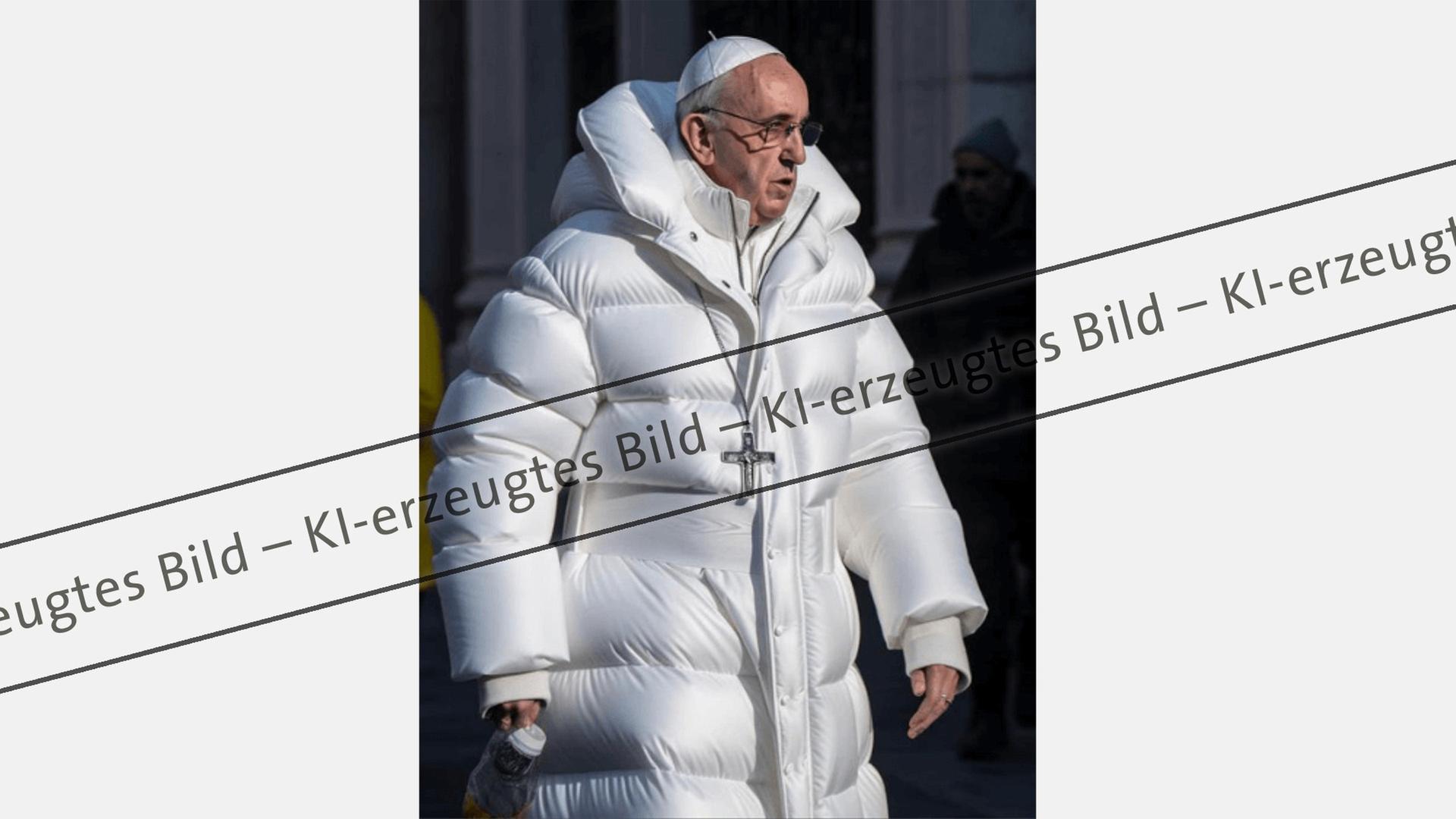
AI has introduced a new twist: in 2023, an image of Pope Francis wearing a puffer jacket went viral. "What is new is that this image possesses all the hallmarks of photographic credibility," says Frohne. Yet it was AI-generated, not photographed. To avoid falling for fake photographs, the expert advises examining the provenance — that is, the origin — of images.
Also in 2023, Boris Eldagsen caused a stir with his work Pseudomnesia: The Electrician. At the Sony World Photography Awards, Eldagsen was set to receive a prize for the image. But he declined the award. The reason: he had created the image using AI and wanted to spark a debate about AI and photography. That he achieved.
Boris Eldagsen, "PSEUDOMNESIA | The Electrician," Promptography, 2022
False Memories
Altering an image or even creating photorealistic ones carries risks. "The problem is — and Eldagsen makes this clear — that memories are being faked here, and history thus becomes open to manipulation," says Frohne.
But AI also brings opportunities. Boris Eldagsen himself has been fascinated by the use of artificial intelligence from the very beginning. He photographs himself, uses various locations, hauls props, coordinates appointments, considers questions about outdoor temperature, battery charge, and weather. And then comes the AI. "I can work as if I had a huge budget," says Eldagsen.
A New Definition Is Needed
For Eldagsen, photography is something different from working with AI. "The result may end up looking similar, but it doesn't have to. The working process, however, is different. And to avoid conflating the two, it's important to have a new term: promptography."
He sees the greatest difference in how the works are created: in photography, the artist's perception and chance play a major role. He calls promptography a mirror of the human being and of the algorithm's training material. It is more about the idea and the concept. "Those who say it looks the same now, so let's just call it photography — they're being pretty intellectually lazy," says Eldagsen. You wouldn't call photorealistic oil paintings oil photography either.
200 Years of Seeing Reality
For decades, photographs have been retouched for artistic purposes or manipulated for propaganda. AI makes this easier than ever before. For art, this brings freedoms — for artists, but also economic risks. Furthermore, the use of AI requires large amounts of energy and water resources.
Experts also agree on this: in news coverage, it must be clear whether something is a photograph or a prompted image. The works must be identified as either an AI creation or a photograph.