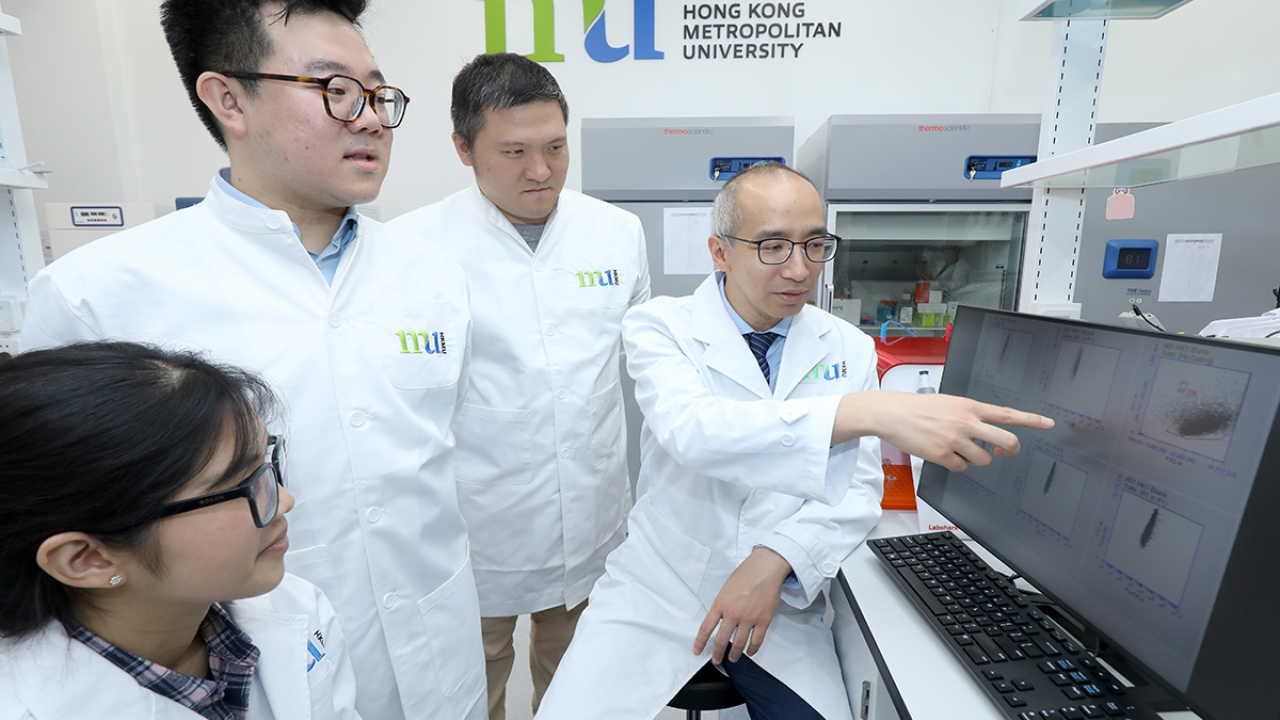
HKMU powers ahead with new Shenzhen Research Institute
A new Shenzhen base is accelerating the University's drive for applied research and innovation
[The content of this article has been produced by our advertising partner.]
Hong Kong Metropolitan University (HKMU) is strengthening its research footprint in the Greater Bay Area with the establishment of its Shenzhen Research Institute, a platform designed to help bridge industry, academia and research and translate research into real-world impact.
Earlier, HKMU President Prof. Paul Lam Kwan-sing emphasised that the University must focus its research efforts on specific strategic areas given its status as a self-financing institution, which came with comparatively limited resources. He called for HKMU research to be application-oriented, with the dual aim of tackling real-world problems and enhancing teaching and learning.
Strategic base on the Mainland
The first phase of the Institute, in operation since last June and officially opened in March, offers 670 square metres of wet and dry laboratory space. Plans for the second and third phases are underway and will add a further 800 square metres of laboratory space.
The Institute is currently home to a team of about 20 principal investigators and researchers from the University, as well as about 30 research and other staff members recruited by the Institute and based at there.
Turning to its research focus, Prof. Kwok says the Institute concentrates on four major areas in its early stages, with 12 projects underway: biomedical life science, net zero and environmental technologies, quantum technology, and digital fabrication and art-tech.
Other plans include joint explorations into optoelectronic engineering and healthcare robotics with the Zhongshan Institute of Changchun University of Science and Technology, and into wireless communications with Shenzhen Technology University.
Room for growth
The Institute was successfully registered as a public institution on the Chinese Mainland in December last year.
“This status allows the Institute to engage with different stakeholders across the country, including government, industry and tertiary institutions, to receive support for research projects and talent recruitment,” Prof. Kwok explains.
The Institute is actively applying for various Mainland research grants and funding, diversifying its research funding sources. For a start, it has obtained its first grant, of about RMB 2 million, from the Science, Technology and Innovation Bureau of Shenzhen Municipality.
Prof. Kwok believes that HKMU will benefit from the close connections between its Mainland partners and local enterprises, which could expedite the commercialisation of research outcomes and benefit society.