Emperor Otto the Great and Research: New Coffin, New Findings
Because Emperor Otto the Great's tomb required restoration, his remains were also examined. Historians and surgeons now know considerably more — and the emperor will soon receive a new resting place.
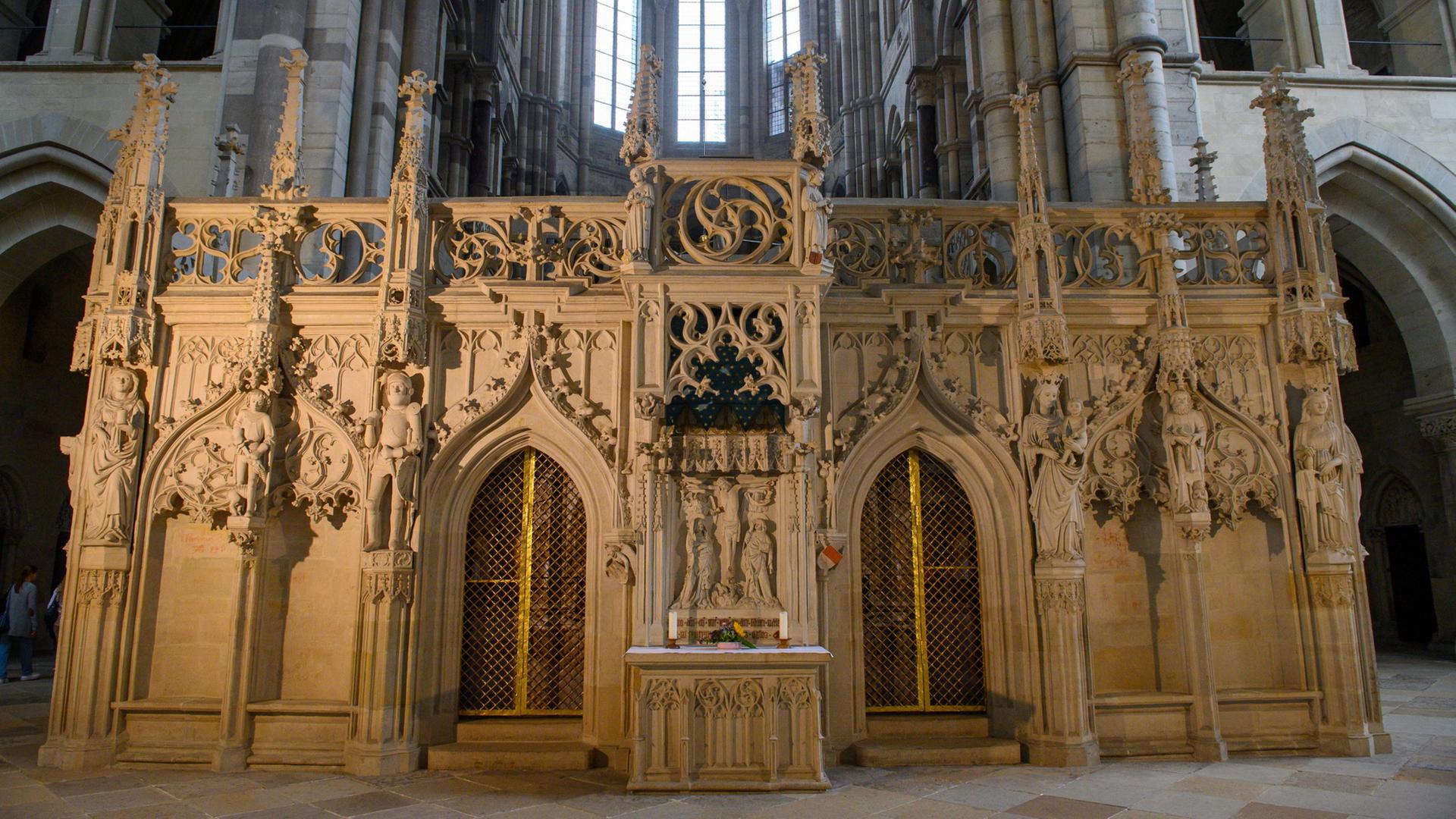
Since the beginning of 2025, the high choir of Magdeburg Cathedral has been both a construction site and a laboratory: the severely damaged burial site of Emperor Otto I, one of the most important European rulers of the Middle Ages, was in urgent need of securing.
The Cultural Foundation of Saxony-Anhalt, heritage conservation authorities, archaeologists, the cathedral congregation and the Protestant Church in Central Germany worked closely together to save the fragile limestone sarcophagus and permanently stabilise its location.
Archaeology Between Risk and Discovery
Otto the Great (912–973) is a key figure in European history: crowned emperor in Rome in 962, he elevated Magdeburg to an archbishopric in 968 and chose to be buried there alongside his first wife Editha, who had died young. His sarcophagus is therefore a monument of European significance — and was in acute danger, as routine monitoring revealed in 2024.
Hairline cracks in the limestone, corroding metal clamps, a marble slab weighing around 300 kilograms resting on walls just centimetres thin: it was on the verge of collapse, says Saxony-Anhalt's Minister of Culture Rainer Robra. "We had to protect Emperor Otto the Great from having his remains damaged." The liturgical use of the church was, however, largely able to continue.
Rest for the Dead vs. the Urge to Research
The tomb had to be opened completely; cement-like patches from earlier repairs were removed, along with rusting iron clamps and nails — these had been causing the stone to crack over the decades rather than stabilising it. Inside, a wooden coffin was discovered, its lower portion severely damaged by moisture. It too had to be opened.
An imposition on the peace of the dead, but a necessary one, as Senior Church Councillor Albrecht Steinhäuser emphasises: "Consistently honouring the peace of the dead would have meant that sooner or later the sarcophagus would collapse. And that would have been an even greater disturbance of that peace."
The marble slab and the old sarcophagus of Emperor Otto the Great's tomb.
The Emperor in the CT Scanner
The opening of the tomb offered a unique opportunity for an international research project: 40 scientists from various disciplines set to work, first addressing the key question of whether Otto the Great was even still in the tomb. It had demonstrably been opened multiple times. With tombs of this kind, the substitution of remains is not an uncommon phenomenon, explains State Archaeologist Harald Meller. In Magdeburg too, it was entirely possible that the remains could have belonged to someone else: "Only the genetic comparison provided certainty that Otto is indeed Otto."
Proof came from a comparison with genetic material from Emperor Henry II, held at Bamberg Cathedral. This made it possible to establish a third-degree kinship. Anthropologist Harald Ringbauer from the Max Planck Institute in Leipzig describes it as a stroke of luck: "It was truly a chain of very fortunate circumstances that in 2025 we were able to take samples from not one but two Ottonian emperors."
Diagnosis: Tooth Decay and Arthritis
The investigations also provide insights into the life, suffering, and possible cause of death of the emperor. The skeleton was placed in an MRI scanner at the University of Magdeburg. According to the results, Otto was muscular and in good physical condition even at the age of 61, though with mild arthritis. There are some lesions at the back of the skull — most likely war wounds. Otto was also missing three teeth. He had not attended to his oral hygiene: "Cavities," says Frank Tavassol, head of oral and maxillofacial surgery at the University of Halle. "We assume that he simply never brushed his teeth — there was no reason to do so back then."
Research will continue in the future, primarily focused on Otto's appearance: skin, hair, and eye color. Combined with forensic methods, a facial reconstruction is conceivable, says state archaeologist Meller: "We will of course be able to give Otto a face again."
A new coffin for an ancient emperor
Alongside the research, a new coffin has been designed — contemporary in style, not historicizing. The Kunststiftung Sachsen-Anhalt had put out a competition for the commission. "A once-in-a-century task," says director Manon Bursian. "When the request came in asking us to take care of designing a coffin for this great emperor Otto, you are filled with reverence — a truly unique task in one's lifetime."
An elongated body of titanium, whose lid incorporates a slight twist: the model for the new coffin of Otto the Great.
And so it proved to be for Halle-based artist Silke Trekel. The new coffin is an elongated body of titanium, whose lid incorporates a slight twist. A golden band marks the royal symbol, while silver complements the material palette. Everything is designed to remain stable even a thousand years from now: "It is a very beautiful, modern form. The material is titanium, gold, and silver. Extensive material research has paid off, so that Otto can slumber on in peace for another 1,000 years."
Reinterment in the cathedral
On 1 September 2026, the restored limestone sarcophagus will be returned to its place in the High Choir. That morning, the remains of Otto the Great will be placed in the new titanium coffin and lowered into the stone sarcophagus. The ancient marble slab will seal the tomb once more — most likely for many centuries to come.