Scores of the world's most powerful people have gathered in New York for the UN's annual leader summit.
US President Donald Trump dominated the early headlines from the event with a speech that threatened Iran with annihilation and rejected global efforts to control AI.
Here are four other takeaways from day one of the UN General Assembly week-long summit.
Leaders condemn Israel, Netanyahu's office responds with a bird meme
Many world leaders used their speeches to condemn Israel, not only for its actions in Gaza, deemed a genocide by a UN inquiry, but also its invasion and occupation of southern Lebanon and increasing settler violence against Palestinians in the West Bank.
UN Secretary-General Antonio Guterres said the expansion of West Bank settlements, considered illegal under international law, were "bulldozing the path to peace and raising the spectre of ethnic cleansing".
Jordan's King Abdullah II said the global community should be considering sanctions or other measures against Israel.
"We have a record of using them elsewhere," he said.
"Yet with Israel, resolutions end where they begin: on paper. The result is a state without restraint."
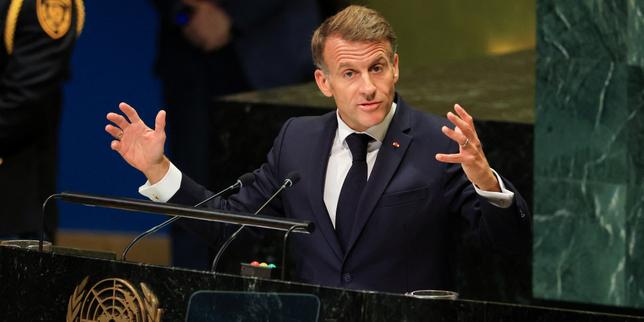
Speaking after Mr Trump declared that the US had "ended the war in Gaza", French President Emmanuel Macron said: "Some boast of a supposed peace. But that peace has not reopened humanitarian access for a single second."
"Are we simply to stand by and watch this spectacle that should shame us all?" he said, per a Reuters translation.
The office of Israeli Prime Minister Benjamin Netanyahu mocked the leaders on X with an apparently AI-generated video showing parrots at the UN podium, repeating the words "blame Israel".
Mr Netanyahu rejects allegations of genocide and has blamed settler violence on "juvenile delinquents", though human rights groups have documented repeated instances of Israeli authorities supporting and enabling their attacks.
In a video message, Mr Netanyahu vowed to use his address later this week to "tell the truth about our heroic soldiers".
The leaders of the UK, Brazil, Türkiye and Qatar were among others who criticised Israel.
But despite the words, the UN does not appear poised to take any further immediate action against Israel. Its key ally, the US, holds veto power in the Security Council.
Albanese continues to push for AI action after Trump rejects 'globalist scheme'
Yesterday Australian Prime Minister Anthony Albanese was one of 22 world leaders to issue a call for global guardrails on AI.
Mr Trump sharply smacked down that proposal during his speech today, saying the US would not "stifle growth of something that will be bigger than the industrial revolution".
British Prime Minister Andy Burnham picked up on the comparison in his own speech, noting that the industrial revolution "brought huge suffering and exploitation" for workers.
"Things got a lot worse before they got better," he said. "So this time we need to get it right."
Mr Burnham said the UK would put AI "at the heart" of the G20 when it took over the presidency of the club of nations next year.
"We will work towards agreeing [to] a single set of global principles and standards," he said.
Mr Albanese declined to directly respond to Mr Trump's comments, but said he was glad AI was on the agenda for Mr Trump's upcoming summit with Chinese president Xi Jinping.
"We'll wait and see what comes out of the meeting," Mr Albanese said.
And at a sideline event, alongside the leaders of France, Spain and Kenya, Mr Albanese helped launch a "road map" to protect children from the dangers of AI. He warned against waiting too long to take action, "like I think we did on social media".
"We should have moved earlier," he said, referring to Australia's age limit for social platforms.
"Let's not make the same mistake. Let's learn from it and make sure that we shape AI in the interests of humanity."
The road map is focused on challenges that are separate to the threats posed by rogue AI and runaway superintelligence, which have dominated recent discussion.
They include chatbot safety, AI-generated sex abuse material and pornographic deepfakes, and AI literacy. More specifics are expected to be announced at a Paris meeting later this year.
Zelenskyy requests a 'winter package' of American weapons
Ukrainian President Volodymyr Zelenskyy was among the world leaders who spoke to Mr Trump on the sidelines of the summit.
Afterwards he told the Wall Street Journal he had asked for a "winter package" of weapons, including Patriot anti-missile systems.
He also said he expected Mr Trump to "try to negotiate some sort of energy ceasefire".
Mr Zelenskyy said such a ceasefire would be necessary for Ukraine to stop attacking Russian oil refineries, which Mr Trump partially blames for rising diesel prices.
Since Mr Trump's election, the US has continued delivering on Biden-era commitments to Ukraine but has pressed NATO allies to fund any new assistance.
Mr Trump only briefly mentioned the Ukraine-Russia war in his UN speech, repeating a longstanding prediction that it would end soon.
Trump's 'Cuba will fall' comments prompt walkout
Mr Trump also used his speech to take aim at Cuba, whose communist regime has long been an American adversary.
He said the US wanted a "fundamental change in the situation in Cuba" and would not allow "a haven for foreign adversaries to threaten America on our doorstep".
The Trump administration has previously said its goal is regime change in Cuba. It has cut Venezuelan oil supplies to the island nation, where power blackouts have become more frequent.
"It's an absolutely failed state," Mr Trump told the UN.
"It's failing like never before. And it will fall."
But he also said Secretary of State Marco Rubio was "deep into negotiations" with Cuba.
"Let's see what happens," Mr Trump said.
The Cuban delegation walked out of the assembly hall during Mr Trump's remarks.
Later, Cuban President Miguel Diaz-Canel wrote on X: "We will continue fighting for peace, defending our sovereignty, and working together to overcome the ruthless aggression imposed on us by the United States government."