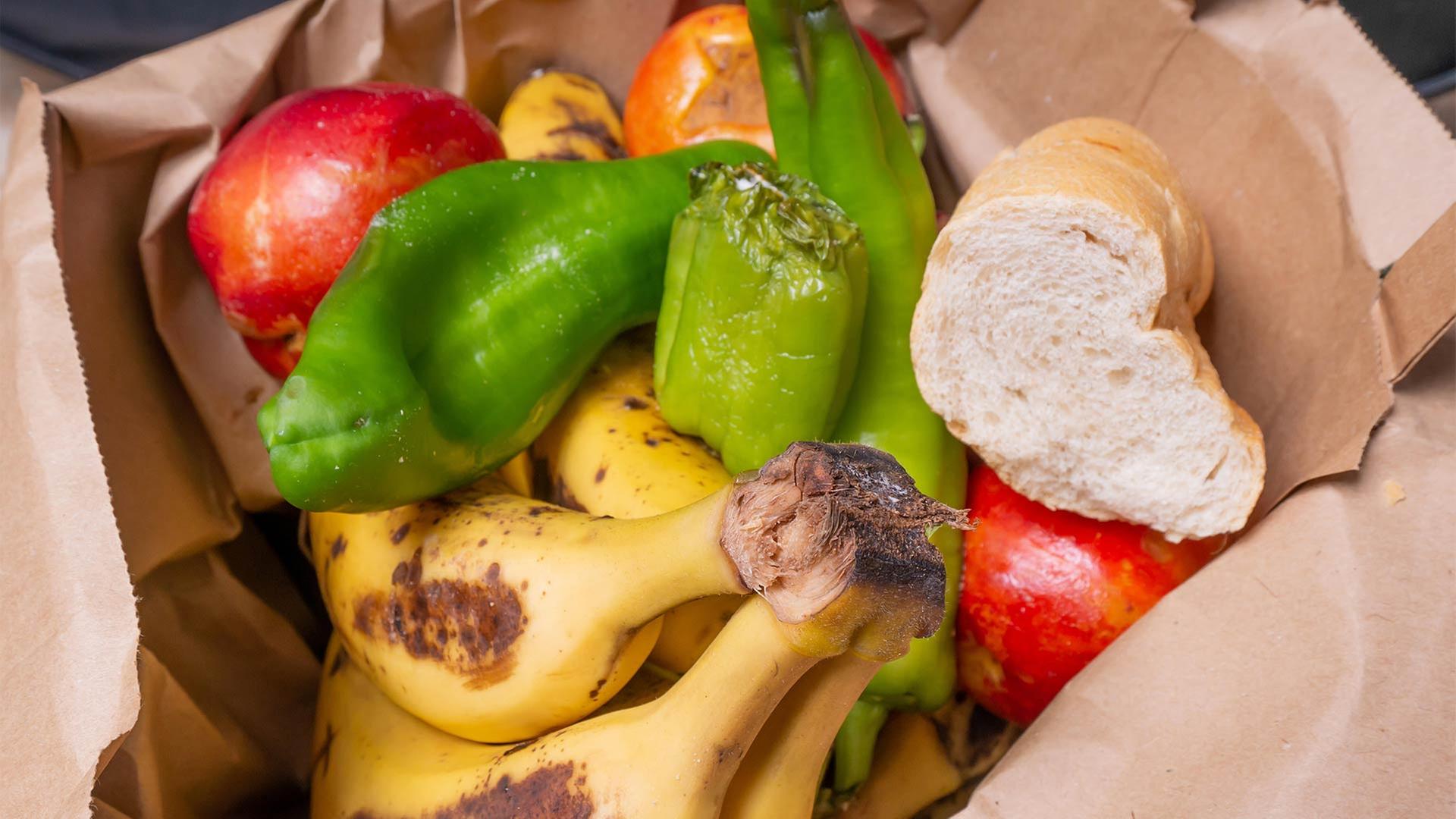
Food Waste: Too Much Food for the Bin
Every year, almost eleven million tonnes of edible food end up in the rubbish in Germany. Why has barely anything changed in years? And what can we learn from our neighbours?
In a suburb of Saarbrücken, a team from the ARD business magazine Plusminus accompanies the refuse collectors. Today, organic waste is being collected. The bins are well filled. Spot checks reveal that many of them contain whole loaves of bread alongside food scraps and fruit waste.
Signs of a consumer society in which there is clearly too much. Inside the jaws of the refuse truck, everything is quickly ground up, prepared for later disposal. What the bin men see is also reflected in the statistics.
Households throw away the most
Since 2019, around eleven million tonnes of food waste have ended up in the bin year after year. Of this, 58 percent comes from private households, nearly 6.3 million tonnes. The catering industry accounts for 16 percent, food processing for 17, retail for seven and agriculture for two percent of the waste.
It was precisely for this reason that the last cabinet under Chancellor Angela Merkel had already set the course for reducing food waste. In 2019, Julia Klöckner, as Federal Minister of Agriculture, presented a national strategy for waste reduction. The goal: to halve the amount of waste by 2030, through voluntary measures. Not a great deal was achieved.
Retail sector satisfied with its own progress
The German Food Association is also involved in strategies to reduce food waste. It points to initial successes in its own sector. According to spokeswoman Manon Struck-Pacyna, food losses among participating retail chains as well as wholesale and retail trade had been reduced by 25 percent. That was quite a remarkable figure, she said. And work was ongoing together with policymakers to make further improvements.
A reduction of 25 percent sounds like a lot at first. However, since retail overall produces only seven percent of total food waste, a quarter of that still amounts to less than two percent of the overall waste volume.
France: A model of carrot and stick
Neighbouring countries such as France, by contrast, have for years been pursuing an approach that obliges retailers to donate surplus food. The organisation "Banque Alimentaire" is one of the institutions that accepts these goods. It now supplies many socially disadvantaged people throughout the country.
The organisation is comparable to the German Tafel, but sees itself more as part of a social programme. In the Bas-Rhin département near Strasbourg alone, 68,000 people are regularly supplied with food that would otherwise be thrown away. Across France as a whole, the figure is 2.4 million people in need.
Every day, volunteer helpers from the organisation travel to wholesalers, supermarkets and bakeries to collect surplus food. The products are sorted centrally and later collected by aid organisations such as the French Croix Rouge or Caritas before being distributed.
Food waste in France almost halved
The concept has been implemented in France for ten years. Retailers have since internalized it, but can also derive a financial benefit from the program. Jean Serrats, the president of the regional organization in Strasbourg, points out that every time a store donates something to the Banque Alimentaire, it is entitled to a tax deduction of 60 percent on the value of the goods. It is therefore worthwhile for companies to donate food rather than throw it away.
The corresponding law to combat food waste was introduced in 2016. At that time, per capita waste in France was still 108 kilograms; today it is only 58 kilograms per capita. By comparison, food waste in Germany has remained unchanged for years at 75 kilograms per capita, which is significantly higher than in the neighboring country.
So would the French model be a blueprint for Germany? The Federal Ministry of Agriculture states that it does not favor compulsion and wants to maintain voluntary food donations. It has also achieved good cooperation with food banks, through which around 1.5 million people are regularly supplied per year.
Large packaging contributes to high waste volumes
Since the bulk of waste in Germany is generated in households, the question arises as to why they are not able to reduce food waste further. Berlin-based food scientist Nina Langen sees one reason in packaging sizes, which she says are still far too large.
She explains that 50 percent of what people throw away is fruit and vegetables. In supermarkets, these are frequently not sold individually but only in pre-packaged bundles. Just one onion, a small quantity of potatoes, or a single banana, for example, are often not available in discount stores. With meat and cheese too, only large packages are often available. The result is more waste, because too much is left over and spoils, says Langen.
Are voluntary measures sufficient?
Langen co-initiated a project called Miss Mit. The goal: consumers measure their waste and document it in a diary in order to reduce it. While this worked successfully among participants, the response rate was extremely low, according to Langen: only 250 completely filled-in datasets were returned.
Better results were achieved through an app that reminded participants via push notification to enter their data. Half of these notifications were also opened. In order to achieve a real effect, people need to be repeatedly prompted, the researcher concludes.
The German approach, which relies solely on voluntary action, has so far barely reduced food waste. The French model, by contrast, shows that a genuine reduction can indeed be achieved through mandatory measures and the involvement of retailers.