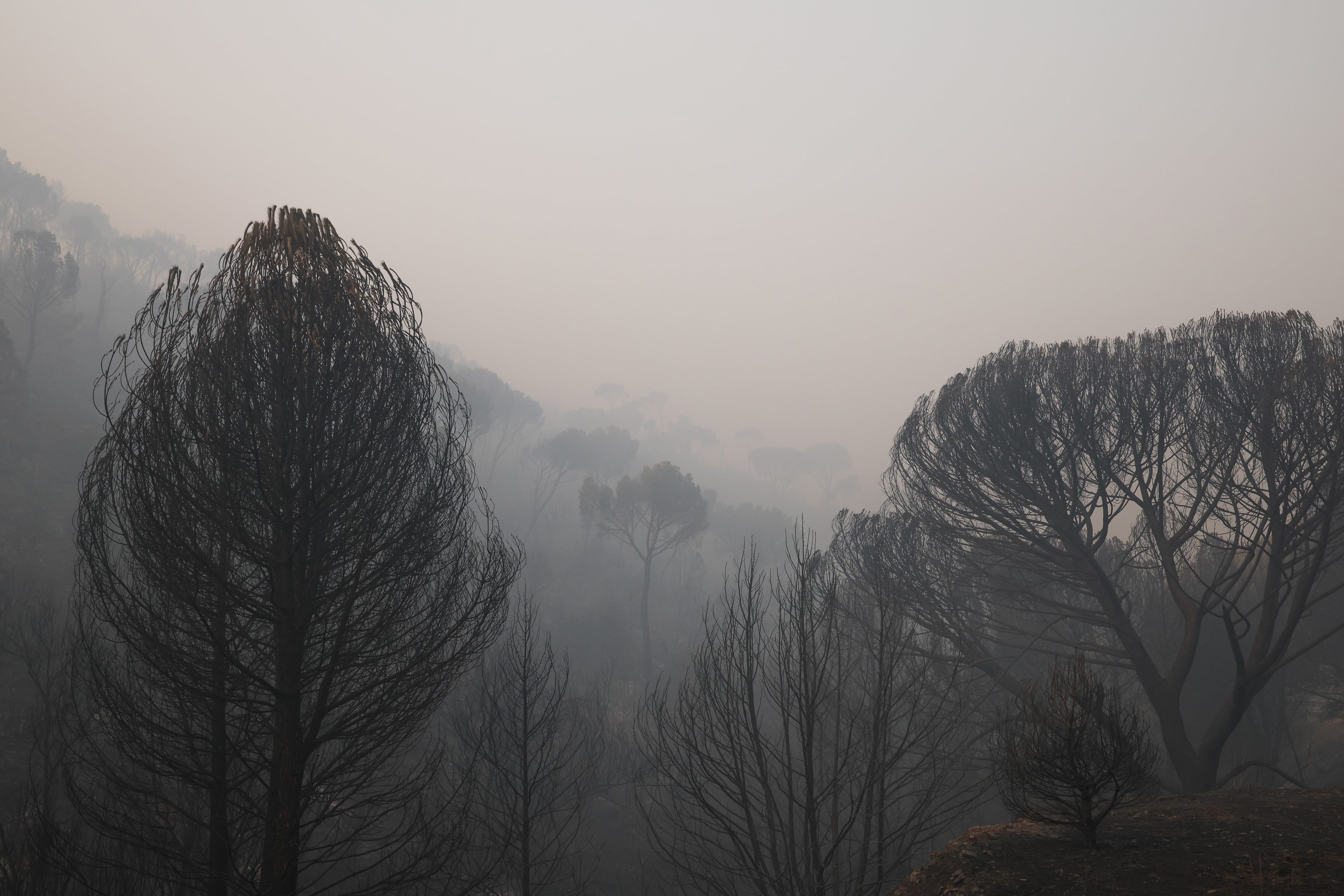
The large wildfires affecting Spain that remain active have already scorched more than 113,000 hectares, according to analysis based on data from the European Forest Fire Information System (EFFIS) and estimates compiled by EL PAÍS for those fires whose perimeters had not yet been incorporated into that European measurement system.
According to the Copernicus system, 366 fires of at least 30 hectares have been declared in Spain this year, burning a total of 207,257 hectares of land. Throughout all of 2025, there were 350 fires, which burned nearly 393,079 hectares, a record number since the statistical series began in 2006.
The largest active fires
Madrid-Ávila-Toledo. The largest fire remains the one affecting areas in the provinces of Madrid, Ávila and, to a lesser extent, Toledo — a combination of several fires that started at different points and eventually merged to create the largest burned area on record in Spain, now totaling 66,357 scorched hectares. The vast majority of these are in the province of Ávila, particularly around the Navaluenga outbreak, with approximately 44,000 hectares burned, of which 73% is forest and 12% farmland. In Madrid, in the San Martín de Valdeiglesias area, 15,849 hectares have already been scorched, 75% of which is forest. Interior Minister Fernando Grande-Marlaska signed an order on Monday afternoon temporarily suspending harvesting operations using agricultural machinery in the three affected provinces.
Guadalajara. In La Mierla the situation is improving, although small outbreaks with "small latent combustions" remain, which are difficult to locate. The burned area amounts to 33,022 hectares, 63% of them woodland.
Castellón. Although the burned area is still smaller, greater concern surrounds the situation of the fire affecting La Vall d'Uixó, in Castellón, with 10,046 hectares burned since July 25, 64% of them forest.
In Valdesamario (León), 2,027 hectares have burned since July 22, 44% of them forest. Other smaller fires are recorded in Ciudad Real (one of 703 hectares, another of 1,002), and much smaller active fires exist in Córdoba (186 hectares), El Valle (Granada, 146), Villagonzalo (Badajoz, 36), Balboa (León, 20 hectares) and Farrera (Lleida, 15).
According to an early Monday evening update from the General Secretariat of Civil Protection, under the Ministry of the Interior, there are 11 active fires, four of which require resources from that ministry (all of them part of the great fire in central Spain: Burgohondo — Ávila —, San Martín de Valdeiglesias — Madrid —, Villa del Prado — Madrid — and Almorox — Toledo —) and five requiring the Military Emergency Unit (Burgohondo, San Martín de Valdeiglesias, Villa del Prado, La Vall d'Uixó — Castellón — and La Mierla-Puebla del Vallés — Guadalajara —).
Of the active fires, those already mentioned in Burgohondo, San Martín de Valdeiglesias, Villa del Prado and Almorox are at operational level 3. Remaining at level 2 are La Vall d'Uixó; Balboa, Encinedo and Valdesamario (León), Valderrábano (Palencia), Valle de Mena (Burgos), and at level 1 only La Mierla.
Under control are Castropodame (León), Rábano de Aliste (Zamora) and Brieva (Segovia), all at operational level 2, as well as Navatalgordo (in Ávila), the latter at level 3.
Evacuations and returns
In the Ávila, Madrid and Toledo fire, 63,152 people have been evacuated and another 27,797 have been confined to their homes. Of those evacuated, 31,865 come from the Community of Madrid, 25,087 from Ávila and 6,200 from Toledo. Those confined number 19,062 in Madrid and 8,735 in Ávila, with no figures available for Toledo.
In Castellón, 16,000 people have been evacuated from 18 municipalities, although 6,000 were expected to have been able to return to their homes by this Monday.
In Madrid, 13 localities have been evacuated: Chapinería, Navas del Rey, Colmenar del Arroyo, Fresnedillas de la Oliva, Robledo de Chavela, Navalagamella, Aldea del Fresno, Zarzalejo, Pedanía de Peralejo, Rozas de Puerto Real, Cadalso de los Vidrios, Cenicientos and the Urbanización Encinar del Alberche. A further 4 are under confinement: San Martín de Valdeiglesias, Valdemaqueda, Villa del Prado and Pelayos de la Presa.
In Ávila, the evacuated localities number 16: Sotillo de la Adrada, Navahondilla, Casillas, Santa María del Tiétar, La Adrada, Piedralaves, Casavieja, Burgohondo, Hoyo de Pinares, Villanueva de Ávila, Urbanización La Atalaya de El Tiemblo, Pedro Bernardo, Higuera de las Dueñas, Gavilanes, Mijares and Fresnedilla. Three are under confinement: Navaluenga, El Tiemblo and Cebreros.
In Toledo, 13 localities were evacuated this Monday (wholly or in part): La Iglesuela del Tiétar, Sartajada, Almendral de la Cañada, Buenaventura, Navamorcuende, Real de San Vicente, Hinojosa de San Vicente, Castillo de Bayuela, Garciotum, Nuño Gómez, Pelahustán, Almorox (the urbanizations of Parque El Romillo and El Pinar). At around 10 p.m., Grande-Marlaska reduced that list to just the first two. Residents of the remaining localities will be able to return to their homes.
Affected roads
According to a report from the DGT issued at 8:20 p.m. this Monday, 49 roads have been closed due to the fires, of which only one is a national road, the N-403, in the provinces of Ávila (Las Cruceras), Madrid (San Martín de Valdeiglesias) and Toledo (Almorox).
In the Community of Madrid, sections of the M-501, M-512, M-855 (Navas del Rey), M-507, M-540 (Villa del Prado), M-510 (Valdemorillo), M-521 (Quijorna), M-531, M-537, M-539 (Robledo de Chavela), M-533 (Zarzalejo), M-541 (Pelayos de la Presa), M-548 (Cenicientos) and M-957 (San Martín de Valdeiglesias) are also closed.
In Ávila, the other affected roads are the AV-502, AV-503, AV-504, AV-512, AV-562 (Cebreros), AV-561 (El Hoyo de Pinares), AV-901, AV-902 (Burgohondo), AV-904 (Guisando), AV-P-703 (Casillas), AV-P-705 (Mijares), CL-501 (Santa María del Tiétar) and CL-505 (Las Navas del Marqués).
In Toledo, the roads with closures this Monday were the CM-5001 (El Cornicabral), CM-5002, TO-1375 (El Real de San Vicente), CM-5005, CM-543 TO-1451 (Escalona), CM-5006, CM-5053 (La Iglesuela del Tiétar), CM-5100 (San Román de los Montes), TO-1364, TO-1368 (Castillo de Bayuela), TO-1385 (Almendral de la Cañada) and TO-1560 (Almorox). At 10 p.m., Marlaska reduced the list to just the CM-5006 and the TO-1358.
Finally, the Castellón fire has disrupted traffic on eight stretches of the CV-200 (Aín), CV-203 (Caudiel), CV-205 (Tales), CV-215 (l'Alcúdia de Veo), CV-219 (Eslida), CV-223 (Nules), CV-2261 and CV-230 (la Vall d'Uixó).


