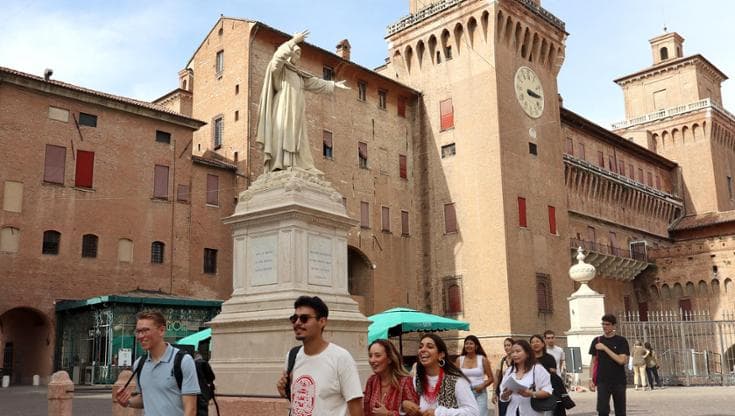
Founded in 1391, the University of Ferrara is one of the oldest universities in Europe. Today it is a multidisciplinary institution comprising 13 Departments, with 70 degree programmes across all major fields of knowledge and a community of nearly 30,000 students.
A further distinguishing feature is its relationship with Ferrara, a university city built to a human scale, compact and easy to get around. Teaching facilities, libraries, laboratories and spaces for university life are embedded in the urban fabric, in an environment that allows students to balance the quality of their education with the quality of their daily lives.
For the 2026/27 academic year, the educational offering is expanding with five new predominantly distance-learning bachelor's degree programmes: Digital Communication, Industrial Engineering, Health Psychology, Biological Sciences for Health, and Exercise and Sport Sciences for Health. These programmes bring the total number of degree courses to 70 and respond to some of the major changes taking place in society and the world of work: digital transformation, artificial intelligence, process innovation, prevention, health and wellbeing.
A new mode of study
The five programmes are not entirely online degrees. The designation "predominantly distance learning" refers to a teaching model in which theoretical lectures can be followed mainly online, while examinations and activities for which direct interaction and hands-on experience are essential — such as laboratory sessions, practical exercises, internships and technical-professional activities — remain in person.
Compared to traditional programmes, which are characterised by primarily in-person attendance, this new model therefore offers greater flexibility in organising one's studies, while maintaining contact with lecturers and tutors, access to university services and participation in the university community.
The ability to follow many activities remotely makes these programmes suitable not only for those who have just completed secondary school, but also for those who are working, live far from Ferrara, have family or personal commitments, or wish to return to education. The flexibility relates to the mode of attendance, not to the quality and rigour of the university education.
Digital Communication
The Digital Communication degree prepares students to work within online communication ecosystems, in which content, social platforms, data and artificial intelligence are increasingly interconnected.
The programme covers the design of digital content and campaigns, community management, results analysis, crisis communication and sustainability issues. Specific attention is devoted to the critical and informed use of artificial intelligence tools applied to content production and evaluation.
The programme is aimed at those who wish to work in communications for companies, institutions, agencies, cultural organisations and third-sector bodies, combining theoretical knowledge, laboratory work and practical skills.
Industrial Engineering
Industrial Engineering integrates the competencies of computer and industrial engineering with managerial, organisational and economic tools. At the heart of the programme are the management of complex processes, digital transformation, artificial intelligence applied to production systems and sustainable innovation.
The course includes two predominantly online years and a third year characterized by in-person activities, laboratories, and internships at companies. A structure designed to combine the flexibility of distance learning with direct contact with organizations and the productive world.
It is aimed at those who want to acquire multidisciplinary technical preparation and contribute to the design and optimization of processes in businesses and organizations.
Psychology for Health
The degree in Psychology for Health is dedicated to the study of psychological wellbeing and the prevention of distress, following an integrated perspective that considers together the biological, psychological, and social dimensions of health.
The program encompasses biomedical sciences and the main areas of psychology: general, developmental, social, clinical, dynamic, and health psychology. Students acquire tools to analyze individual and collective needs, collect and interpret data, and contribute to the design of wellbeing promotion interventions.
Distance learning lessons are integrated with in-person laboratories and internships. The course is designed for those interested in understanding the behaviors and needs of individuals and communities across different health contexts.
Biological Sciences for Health
Biological Sciences for Health offers training in life sciences with particular attention to human, animal, and environmental health.
The program delves into the biochemical, biomolecular, and biomedical aspects of biology and enables students to develop skills in applying the scientific method, laboratory techniques, analysis, and quality control.
Online theoretical training is complemented by practical laboratories and in-person internships, which are essential for gaining familiarity with experimental tools, procedures, and methodologies. The course is aimed at those interested in biology and its applications in research, diagnostics, biological control, and the various sectors related to health.
Motor Sciences for Health
The degree in Motor Sciences for Health explores the role of physical activity in prevention, the maintenance of wellbeing, and health promotion throughout the different phases of life.
The program includes the study of movement sciences, functional assessment, and the design of physical and sports activity programs, including those adapted to different ages and physical conditions.
Predominantly distance-based teaching is integrated with practical activities and in-person internships. The course is aimed at those who wish to work in the fields of physical activity, sport, prevention, and psychophysical wellbeing, designing interventions grounded in solid scientific knowledge.
With the five new programs, the University of Ferrara thus broadens access to university education and updates its teaching methods. A transformation that does not break with its historical continuity, but projects it into the present: since 1391, a knowledge capable of spanning the ages and adapting to the needs of those who study.