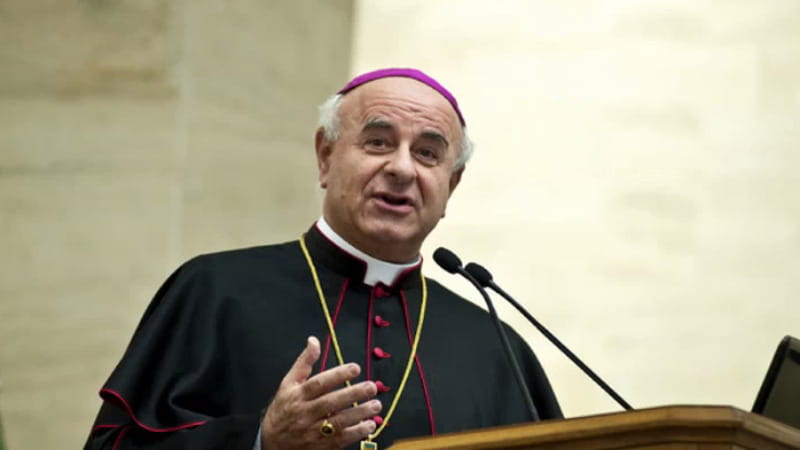
The EU Commission, with its decision to cut two million euros from the Venice Biennale, found itself at the centre of attention at the presentation of the 83rd International Film Exhibition (2–12 September), amid criticism, reflections, and statements from the president of the Venetian institution Pietrangelo Buttafuoco ("we will find a judge in Berlin," he assured) and the Festival director Alberto Barbera, who described himself as "bewildered."
"A fellow traveller is leaving us, but the Biennale certainly cannot submit... we do not engage in politics, we do not follow the beat of others' drums, we are called here to pursue research at an international level in the field of the arts. By obeying their wishes, we would be betraying the principles of autonomy, freedom of expression, and the pursuit of imagination and creativity that have been the hallmarks of this institution for 131 years," the Biennale president stressed at the opening.
"No fewer than three letters from the European Commission: that is who the fellow traveller is who has let us down — they received three detailed responses and kept repeating the same questions as if those precise answers had never existed." Buttafuoco also cited, regarding the EU Commission, "a highly effective headline" identified by the press: 'It cuts two million from the Biennale and gives six billion in six months to Putin.' "That is where the water becomes murky, and it is certainly not here," he added.
Despite the European Commission having decided "to punish Biennale Cinema," he recalled, "the film activities will of course continue. The institution's solidity allows for this, and we will continue to do so and wish to do so for the reasons we have just set out." For this reason, "we will find a judge in Berlin," because "we consider this creative space a vital necessity, since its objective is the concrete support of young people, and therefore the concrete support of the future, and it is the encouragement of their dreams — always in order to build that city, I say this in the dense silence, which is the city of poets, certainly not that of the European Commission."
Barbera also underlined how "the knock-on effect of this threatened cut by the European Community does not appear to have any consequences on our activities — I have not been asked to give up anything or to cut anything from what are and will remain the planned activities for this year and next year." This "is what I can say; I do not know what else to add, other than to highlight my bewilderment at a decision that frankly seems to me difficult to understand, both because it targets a department of the Biennale that has nothing to do with the controversies that were artificially stirred up around Biennale Arte," he observed, "and also because of what seems to me an absence of legal grounds to support a decision that remains unjustified, and which I hope will be shown to be such through the subsequent stages of the dispute between the Biennale and the European Community."
As for which areas will be affected by the cuts, Barbera recalled that "all the contributions coming from the European Community's Media programme are earmarked for specific projects. The two million euros represent three years' worth of contributions — for 2026, 2027 and 2028 — in support of the activities of the Venice Production Bridge and Biennale College. But the Biennale fortunately has other resources capable of filling this sudden budget shortfall, which amounts to approximately 700–750 thousand euros per year, given that we are talking about two million spread across three editions. In practice, the Film Festival's activities will not be affected in the slightest."
Reproduction reserved © Copyright ANSA