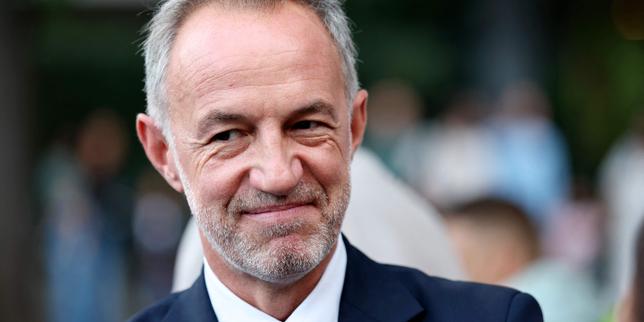
As he stood at a lectern in Perth's convention centre, Peter Coleman must have known he would be inviting trouble.
It was May 2017 and the then chief executive of Australia's biggest oil and gas company, Woodside, was there to deliver some home truths to his fellow travellers.
The gas industry, he told the audience, had "lost the trust of the public".
Gas, he said, risked being seen as an unreliable and unaffordable source of energy, despite Australia being one of the world's biggest exporters of the fuel.
And he said the public was right to expect reasonable returns in tax payments, given they owned the resources.
The comments did not go down well.
Recalling the speech almost 10 years later, Coleman tells the ABC it made him a social pariah.
"I was kicked out of the boys' club for a while, that's for sure," Coleman says.
For all the industry harrumphing, however, Coleman doesn't regret making the comments.
If anything, he laments they have proved prescient.
One culprit emerges: Santos
As Coleman feared, the past decade has been torrid for the image of Australia's gas industry, especially on the east coast.
Periods of extreme profitability abroad have been overshadowed by a deepening reputational crisis at home.
Soaring domestic gas prices have fuelled the backlash, sent some manufacturers to the wall and caused real pain for electricity consumers.
Now, in a bid to end the upheaval, the federal government is proposing a dramatic intervention.
It wants to impose a national reservation scheme under which exporters would have to set aside an equivalent of 20 per cent of their annual production for the local market.
And for the first time, some of the biggest players in the industry are cautiously backing such an imposition.
Their tentative support is less to do with enthusiasm for government meddling than simmering anger that it could have come to this.
It is an anger that is directed at one player in particular.
"All roads lead to Santos's GLNG project," says Saul Kavonic, head of energy research at MST Financial.
Kavonic, one of Australia's most respected oil and gas analysts, says the tensions stem from the once-in-a-generation investment boom that opened up the country's east coast gas market to exports.
During that rush, Kavonic says, three giant plants took shape on Queensland's Curtis Island, turning coal seam gas into liquefied natural gas (LNG) that could be put on ships and sent overseas.
Among them were Asia Pacific LNG (APLNG), operated by Origin Energy, Queensland Curtis LNG (QCLNG), run by Shell, and Gladstone LNG, managed by Santos.
All three struck huge, long-term deals to supply gas to buyers overseas.
All three were built with two "trains", or giant refrigerators that chill and condense the gas to a liquid form about one-600th of its original size.
But only two of the plants had the gas they needed to meet their overseas commitments and supply domestic customers.
"The GLNG project is fundamentally in a tight spot where it's only got enough gas to meet its long-term LNG contracts," he says.
"Therefore, it doesn't have more gas left over to sell to the domestic market.
"In fact, it needs to buy gas out of the domestic market just to meet its contracts."
By his estimates, Santos and its GLNG partners have vacuumed up an extraordinary amount of gas — an equivalent of 20 per cent of eastern Australia's supplies since 2016 — that would otherwise have been available to local users.
Domestic gas diverted offshore
One particularly glaring example, Kavonic says, was a deal between Santos and Australian energy utility AGL in 2015.
Under the deal, AGL sold a huge amount of gas to Santos for export until 2028.
But Kavonic says that, in doing so, AGL and Santos sold out domestic users given the gas had originally been provided to AGL by Shell at a low price so it could be marketed to locals.
It is for this reason, Kavonic says, that frustration with Santos has boiled over among the other Queensland exporters.
He says both APLNG and QCLNG have long been net suppliers to the domestic market and have had enough of copping the blame for what he says are Santos's failures.
"If you look at where the market's going and if you accept that some form of gas market intervention is likely … ultimately, that has a cost associated with it," he says.
"The question is, is that cost going to be placed on the two LNG projects, which have already been proactively … selling additional gas into the domestic market?
"Or are you going to place this cost on the project which has actually been contributing to the problem?
"Because to date, the cost has been imposed on those who've been behaving well and the project which has not been behaving well has been getting off scot-free."
'Hoodwinked' by Santos and GLNG
It's all a far cry from the way Santos pitched the project to governments and the public.
At the time, Santos stressed GLNG would have "no direct implications for domestic gas prices" and that it would "not divert gas from local markets to export markets".
The company told regulators the development was "therefore unlikely to contribute to a future shortage of gas in the domestic market".
But even as Santos was assuring the public on one hand, it was telling shareholders a very different story.
Investor presentations from 2011 show Santos knew opening Australia's eastern market to exports would lead to "permanent … upward pressure on gas prices".
As one of Australia's biggest oil and gas operators, it said this exposure would transform Santos's fortunes and be a commercial boon.
What's more, former company insiders say that, while attempts were made to "rationalise" the project into a single train — in other words, a project roughly half the size — it pressed ahead with a larger development despite being short of gas.
Paul Farrow, the national secretary of the Australian Workers Union, says the company knew all along it did not have sufficient gas resources to cover its export commitments.
He says the consequences of that decision have been disastrous for gas users such as manufacturers, many of whom employ his members.
"Multiple governments that have been hoodwinked by Santos in the past, by GLNG in the past," Farrow says.
"Santos, GLNG, they know what they produce.
"You'd have to ask how do you enter into a 20-year contract (for) production that you can't produce yourself?"
Peter Coleman is more sympathetic to Santos and GLNG, noting there are other factors behind the woes bedevilling the gas market on the east coast.
For one, he says, historic fields in the Bass Strait, which for so long were the backbone of supply, have simply been running out of gas.
He says governments in Victoria and New South Wales also made short-sighted calls to ban gas exploration even though they still depended heavily on the fuel.
Nevertheless, he suggests the industry broadly and GLNG in particular, made mistakes that have cost the companies themselves and the wider public dearly.
"Under our tax system and under most tax systems in the world, the taxpayers actually become shareholders in the industry," Coleman says.
"When we spend too much, that over-expenditure becomes a deduction (against taxable income).
"So the revenues that the community expected or government expected to receive are less because we're actually paying off over-investment that we had in some of these facilities."
To make matters worse, Coleman says there is a direct link between overinvestment in gas export capacity and the prices paid by domestic consumers.
For companies to make a profit on that overinvestment, he says, producers have to sell the gas for a higher price than they otherwise would.
"If I've overinvested to develop that gas, then of course I need more revenue or a higher price to make a profit."
Federal Resources Minister Madeleine King declines to be drawn on the historic decisions made by the likes of Santos and GLNG.
She says the government is not interested in pointing the "finger of blame" at any one player and that "gas exploration is complex".
"What any proponent thinks they can access under the ground sometimes just changes as their project goes further along its pathway," King says.
Despite the diplomacy, King insists the government is intent on requiring gas producers to supply the equivalent of 20 per cent of their exports to the local market, by the middle of next year.
And she stresses that existing contracts will be sacrosanct, meaning producers will be under no obligation to break their supply deals with foreign buyers.
"We're really firm that (20 per cent) is the figure that will get us to our destination, which is about having more affordable gas for Australian consumers and Australian businesses," she says.
Asked if the government will apply the scheme equally to GLNG as it does to other exporters, King declined to comment.
The AWU's Farrow is adamant the government must apply the policy to GLNG regardless of its objections.
He says the project lies at the heart of so many of the east coast's gas market problems and it would be a "crying shame" if the venture is not held accountable.
"It would just send a message that you can destroy our system and get away with it as long as you've got the lobbyists to dispatch down to Canberra to make as much noise as you possibly can," Farrow says.
"That shouldn't be rewarded.
"Secondly, I think that will have price implications as well."
Kavonic is just as strident.
For all its shortcomings as a domestic gas provider, Kavonic says Santos excels at one skill above all others: lobbying.
He says the company has been "exceptionally effective" at escaping previous attempts to jawbone more supplies out of the exporters on the east coast.
Central to its lobbying success, he says, has been its forceful and unashamed use of the sovereign risk card.
He notes GLNG counts among its financial underwriters two important Australian trading partners — South Korea through its state-owned KOGAS and Malaysia via its oil and gas arm PETRONAS.
However, he says claims any reservation policy affecting GLNG would imperil those relationships are little more than a fig leaves.
"The investors in that project knew about some of the risks with GLNG, and its lack of reserves coverage, and the risk that it wouldn't have enough gas, and invested it in any way," Kavonic says.
More pointedly, Kavonic says the very credibility of the reservation scheme — and its chances of success — hinge on the government's ability to stare down vested interests.
If the government cannot get a scheme over the line in the current circumstances, when it has the public or tacit support of two of the three Queensland exporters and a Federal Opposition that itself took a reservation policy to the last election, he says it probably never will.
"I think fundamentally for the reservation policy to have a chance of working, it has to apply the obligation equally across three projects," he says.
In response to questions, Santos shrugged aside any criticism of GLNG or the development's effects on the local gas market.
A spokeswoman for Santos said the company had historically supplied the most of any exporter to the east coast market during winter, claiming it had delivered "62 per cent of the seasonal shortfall" between 2023 and 2026.
The spokeswoman insisted that "neither GLNG nor the Queensland LNG industry as a whole had caused gas shortages or spikes in domestic gas prices", instead blaming development bans in NSW and Victoria.
She said Santos did not intend to contract new gas supplies from the domestic market to meet any LNG shortfalls from this year onwards.
"More gas supply is the only sustainable way to put downward pressure on gas prices, as the ACCC has also long acknowledged," the spokeswoman said.
Coleman says, like it or not, Australia will need gas for many years.
One way or another, he says the GLNG project will need to provide more.
"I think there's a point where … you've just got to say, OK, we've run our bes