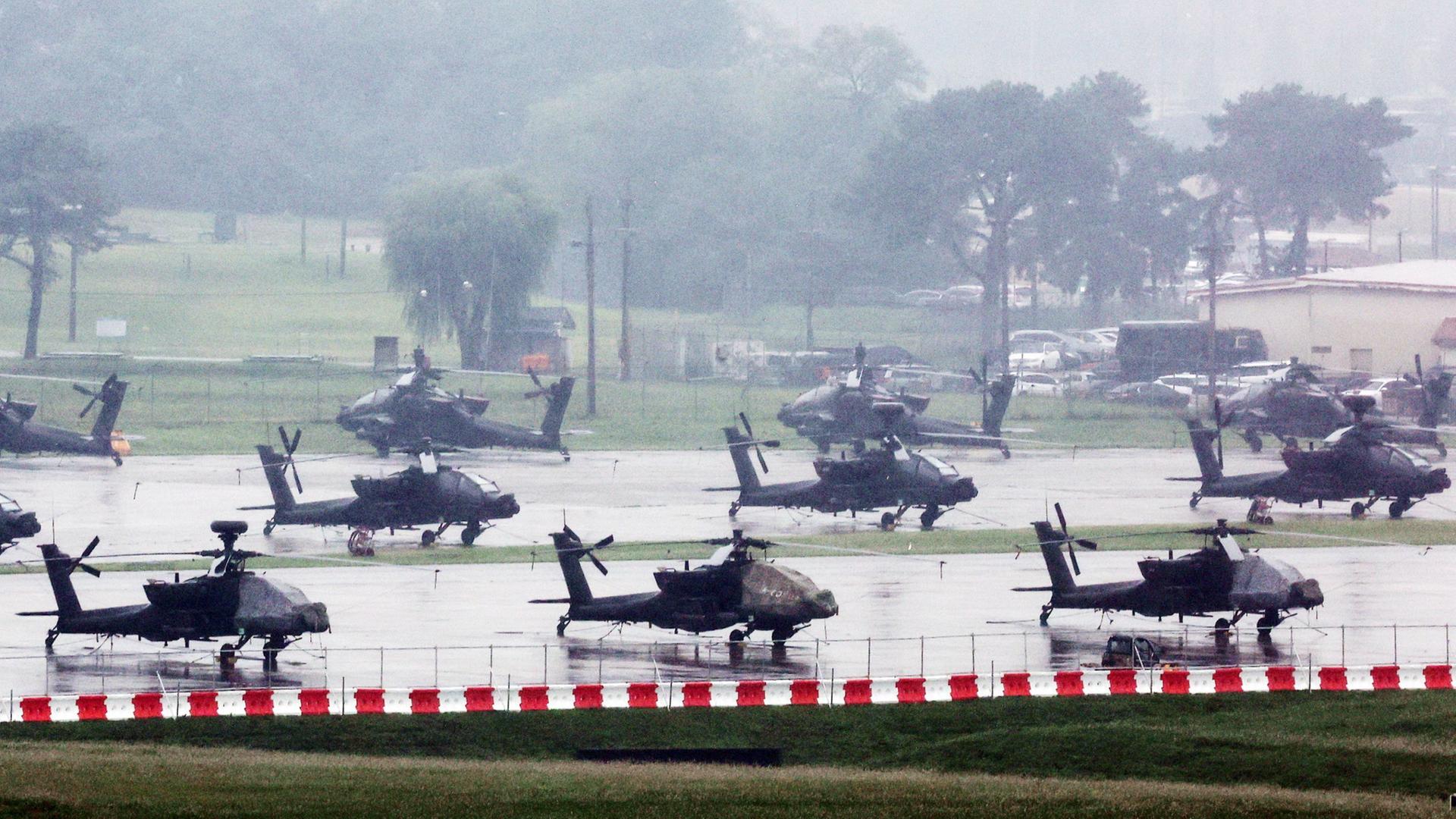
After Trump's Criticism: South Korea and US End Military Exercise Early
The traditional US-South Korea military exercises are running significantly shorter than planned this year. US President Trump had previously criticized the drills as a "hostile signal" — and accused Seoul of lacking support.
The United States and South Korea have ended their joint military exercise "Ulchi Freedom Shield" six days earlier than originally planned, as announced. South Korea's military confirmed this. South Korean government officials had already announced this step on Wednesday without providing an official explanation.
US President Donald Trump had instructed the Defense Department last Sunday to significantly reduce the joint exercises — one day before they were set to begin. On his online platform Truth Social, he cited his reportedly good relations with North Korean leader Kim Jong Un as well as South Korea's refusal to participate in the US war against Iran as reasons.
He said he was not happy that the US had agreed to such joint exercises a long time ago. They were sending a "completely inappropriate and hostile signal."
Trump also confirmed on Wednesday, when asked, that he expected to meet Kim this year. South Korean President Lee Jae Myung had likewise called for direct talks with the North Korean leader in mid-August.
North Korea Still Sees "Provocative Character"
North Korea's leadership claims the annual exercises are rehearsals for an invasion of the nuclear-armed country. Pyongyang also made clear that the early end of the exercise would not be sufficient to bring about a return to talks.
Kim's influential sister Kim Yo Jong stated on Wednesday, according to North Korean state media, that it changed nothing about the "provocative and offensive character" of the exercises. They remained hostile military exercises directed against North Korea. The following day, the country fired approximately ten ballistic missiles toward the sea.
Kim also said she was unaware of any communication between the leaders of North Korea and the United States. She did acknowledge, however, that North Korea's leader held "good memories" of Trump and that the two maintained a still-positive relationship.
As recently as Tuesday, South Korean President Lee had emphasized that the exercises with the United States reflected "no intention to attack North Korea or to escalate tensions on the Korean Peninsula." The fundamental aim was not to "regard anyone as an adversary," he stressed according to a statement from his office. Rather, it was about "ensuring the daily lives of the people in safety and peace."
Exercises Without Simulated Counteroffensive
As part of the command post exercise originally planned for eleven days, the simulation of defensive operations in the event of a North Korean attack had been scheduled through today. A second phase running until August 27 had then been planned to simulate counteroffensives. The number of joint field exercises was also reduced. Instead of the originally planned 14 exercises, only seven were to take place, according to the South Korean military.
North Korea is largely isolated internationally, partly due to its missile program and the development of nuclear weapons. Politically and economically, however, the country is increasingly being supported by China and Russia.