Persistent Drought: Low Water Levels on Rhine and Danube Disrupt Shipping
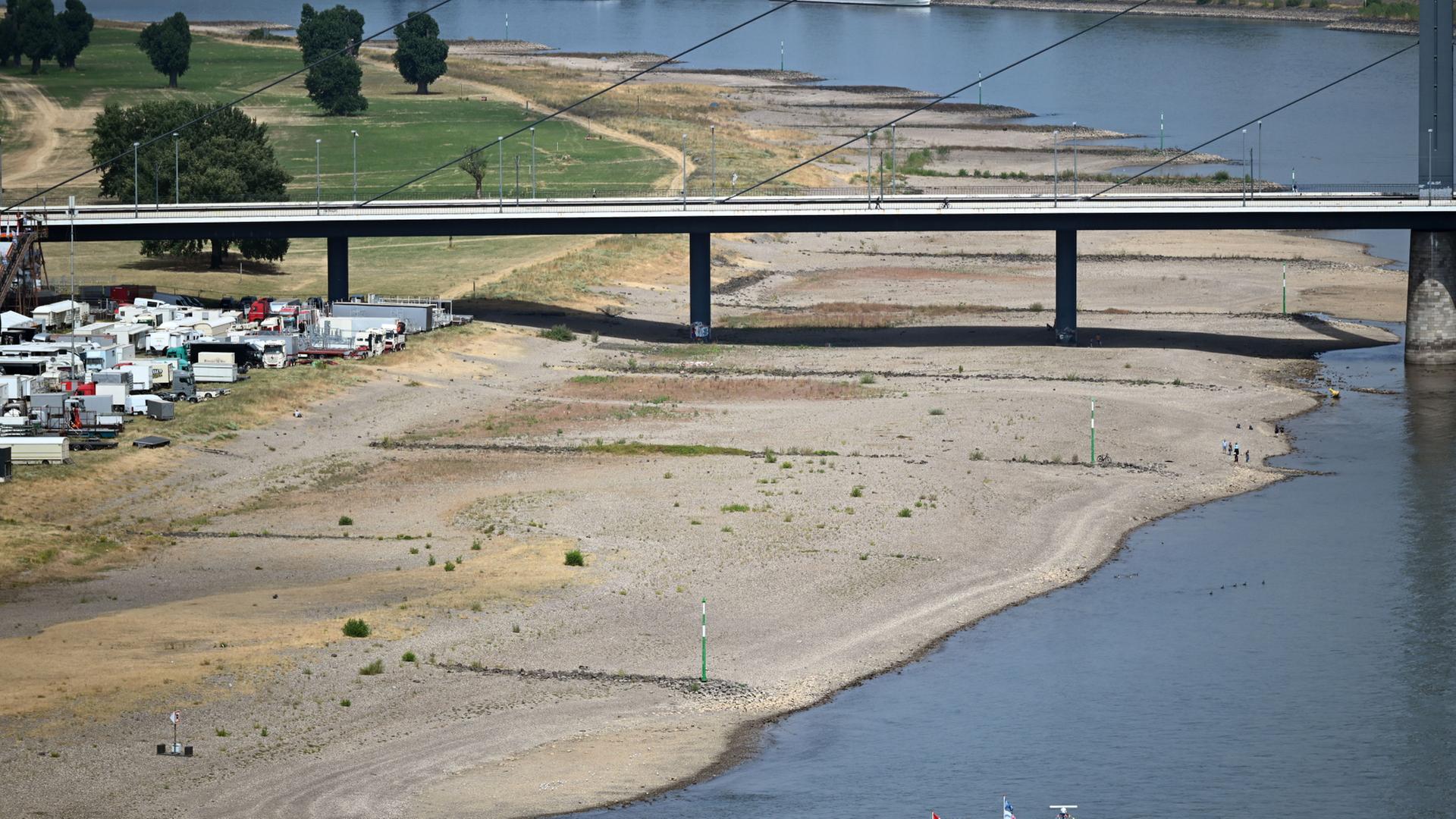
Visible gravel banks, dried-out riverbanks and side channels without water – the rivers are suffering from the lack of rain. Historically low water levels are severely hampering shipping on the Danube and Rhine.
The Rhine and the Danube have not seen this little water in a long time. In some places, historically low water levels have been recorded. The cause is the high temperatures and persistent drought affecting many regions.
In Kaub in the Rhein-Lahn district, for example, a level of 29 centimetres was measured. This corresponds to a navigable channel of 1.43 metres. According to official forecasts from the General Directorate of Waterways and Shipping, water levels could fall even further – below the lowest level ever recorded, which was 25 centimetres in 2018.
"Meaningful Inland Shipping No Longer Possible"
The low water level is having significant consequences for shipping. "Below a water level of 40 centimetres at Kaub, meaningful inland shipping is no longer possible," the IHK Working Group Rhineland-Palatinate announced. In recent days, vessels had already only been able to travel on the Rhine with greatly reduced cargo loads, which has driven up costs.
For the unrestricted operation of large motor vessels, the water level on the Rhine would need to rise by at least one metre.
Billions in Damage Due to Low Water Levels
Freight transport on the river continues even during low water, the Association of German Inland Shipping reported. An official closure of the Rhine "as a rule" does not occur, said deputy managing director Fabian Spieß: "Shipping continues for as long as it is safely possible."
According to the IHK, supply shortages are threatening for raw materials such as coal, crude oil and natural gas, which are typically transported by ship. These products stand at the beginning of numerous industrial supply chains, meaning that a wide variety of industrial companies are affected. The economic damage caused by the historic low water levels of 2018 is estimated at 2.4 billion euros.
Some Shipping Companies Suspend Danube Operations
The Danube is also suffering from the drought. In some stretches, the river has as little water as it has had in 30 years. Near Pöchlarn on the Danube, the current water level is just under one metre – normally it is usually around three metres.
From Germany through Austria to Romania, fully loaded vessels are therefore unable to navigate certain sections. In some cases, shipping companies have had to completely suspend their operations on the river.
In Greifenstein in Austria, several vessels are stranded on dry ground.
Cruise Ship Runs Aground
Tourists are also affected. In Bulgaria, 186 passengers and 52 crew members had to abandon their cruise ship after it ran aground in the Danube in northwestern Bulgaria.
The "Viking Ullur", sailing under a Swiss flag, normally operates on the Danube between the Hungarian capital Budapest and Romania. The grounding was caused by poor visibility and "the low water level of the Danube," the Interior Ministry in Sofia announced.
Debate Over Expansion of Navigable Channels in the Rhine
Climate change is posing ever greater challenges for inland shipping. With an eye on the Rhine, business associations are calling for a rapid expansion of the navigable channel, particularly in the Middle Rhine. There are plans to selectively grind down rocks in the Rhine and remove sandbanks that obstruct inland shipping vessels.
Environmentalists consider this dangerous. "This will change the flow of the Rhine, without anyone really knowing what will happen as a result," said Sabine Yacoub, the Rhineland-Palatinate state chairwoman of the BUND. There is a risk that ecologically valuable riverbank areas, which serve as nurseries for numerous fish species, could also be adversely affected. There are fears that the construction work could cause damage, while the water level in the river may still prove insufficient in the future.