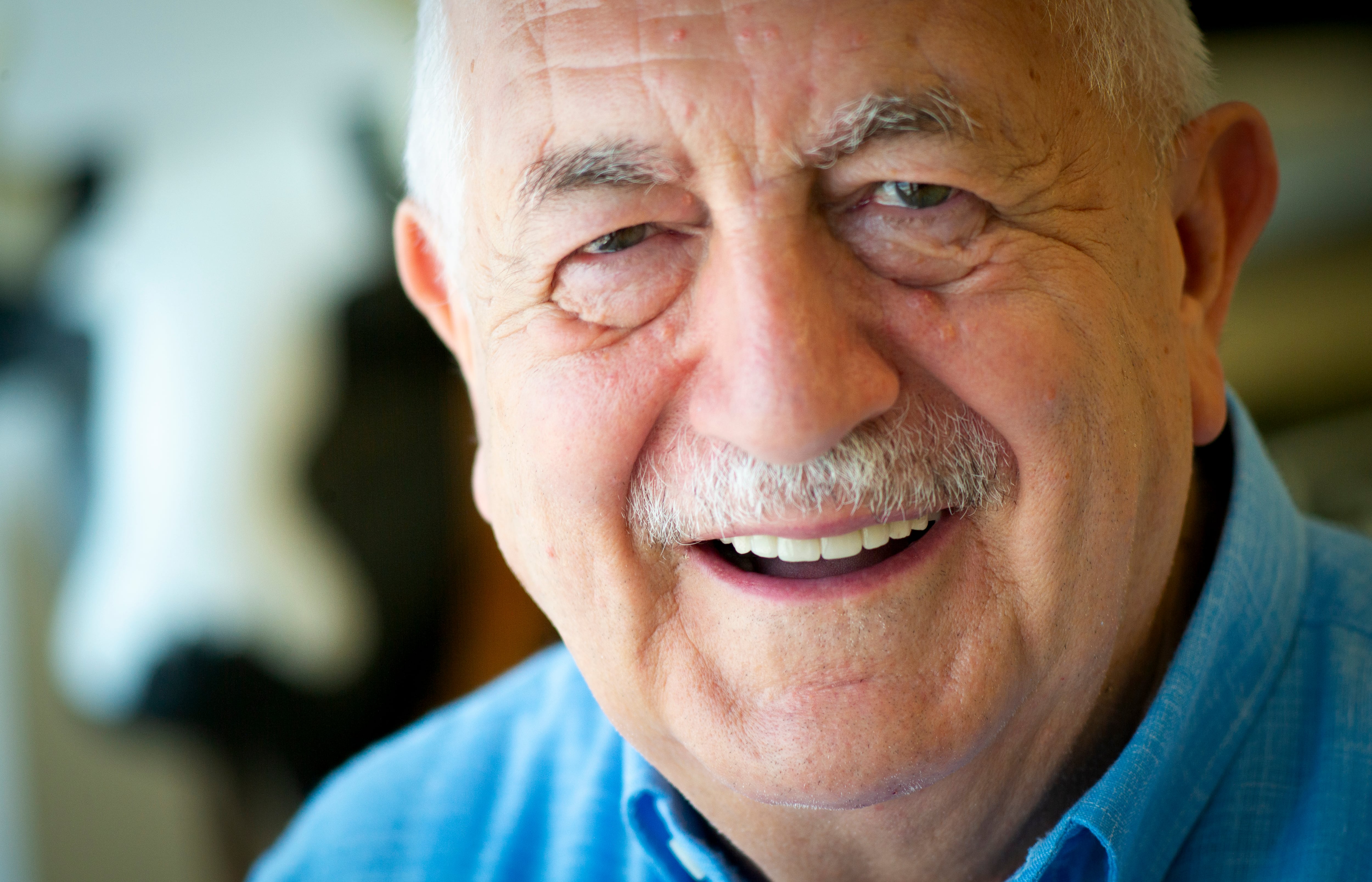
Mr. Vicent, as his employees call him, comes every morning to the vast warehouse that Ale-Hop has in Oliva (Valencia), a few kilometres from his hometown of Gata de Gorgos (Alicante), where it all began, and gets to work armed with a pen and notebook. Around him, young employees bustle about in a scale recreation of one of his accessories and gift shops, which are omnipresent on beaches, at stations, airports and shopping streets in Spain, Italy, Portugal and Croatia, and recognisable by the life-size cow sculpture at the entrance. Grimalt settles in, most affably, for the conversation accompanied by Raúl, one of his four sons who, along with two of his brothers, handle the day-to-day running of this family business. It is the son who tells the anecdote: one year, on the eve of Fallas, a ninot-making competition was organised among the employees, and the one his father liked most was one depicting him with his ever-present pen hooked to his shirt pocket and an ink stain. And he liked it because it was essentially him. Buoyed by the good-humoured atmosphere, I take an object from my bag and show it to the owner of all this.
How much does this fan I bought at Ale-Hop cost?
Between 7 and 8 euros.
Seven. Do you know the prices of all your items?
I try to, and if not, I can give you a range. We have between 5,000 and 6,000 product lines, depending on the season and the size of the shop, and we rotate them. I always say this is a high-risk business, that I'm a mix of shopkeeper and futurologist. We're in summer now, but three months ago we already decided what to order to sell this winter. And you can get it wrong. We depend on people's tastes, spending power and fluctuations. If you insist on getting it right 100% of the time, go into another business. If you get half of it right, things work. By the way, now, besides fans, we also sell personal electric fans.
Right, because of the heatwaves. But they're not exactly pretty.
Well, [laughs]. It's about making people's lives more comfortable, more cheerful. And you have to be able to see that — that's our effort. I'd prefer it were less hot, but since it keeps getting hotter, it's a matter of making the most of it, helping people and adapting. And as for pretty, it's like the saying goes: better to be cool and let people laugh.
Who manufactures your products?
Suppliers from all over the world, but we design all our products ourselves. We have a strict rule against cutting and pasting. We try not to copy anyone, but we do learn from everyone. We try to reinvent things. A pair of sunglasses is a pair of sunglasses, but we try to make ours have something of our own, something unique.
Your shops have a lot of things, but what do you sell?
Well, look — excitement. These aren't essential goods. I sell treats, fun items that you don't know you need until you see them. I like to think they're things that make people happy. We have to go looking for our customers, catch their eye. They buy when they're on holiday, travelling, out for a stroll, when they're in a good mood. And I love that. It's what I've tried to do all my life. Making a living while also trying to enjoy it and making others enjoy it too.
What did you want to be when you were little?
My father was a farmer and I started working with him at 13 years old, and then at night I would go to a private school to complete my basic studies and accounting. Afterwards I worked in a small plastics factory in the village and doing the bookkeeping for a small construction company, and that opened my mind. With zero qualifications, zero economics, zero languages and zero training, I started asking myself questions about how to earn a living.
And what did you answer yourself?
That I had to buy and sell things, leave the village, but without abandoning it, because that's where I'm happy. The first thing we did, with another young friend of mine, was to respond to a newspaper advertisement from a man in Barcelona who wanted wicker suitcases to fill with detergent. In the village, basketry and wickerwork have always been a trade, so we ordered one and off we went, half hiding it from our parents, to Barcelona to show him the sample. Then we started ordering and selling Mexican hats, which we sold from a van at village fairs, at bullfights in Las Ventas. We even went to the Munich Olympics to sell them. We started buying and selling other things and everything has come from there.
Nothing stood in your way.
Never. I have travelled all over the world without knowing English. I have toured gift fairs throughout Europe, shops in the United States, factories in Asia, seeing how they sell and how they manufacture there, on the ground. That's my way of doing business. What I wanted was to earn a living and have a good time and make day-to-day life enjoyable for the people who work with me. At first we didn't have shops, we bought wholesale for others. We worked very hard, but at night talking about work was forbidden. And here we still are. My children did study and they know English — their mother was absolutely determined to make that happen.
Where did you get the idea of calling your shops Ale-Hop and putting a cow at the door?
I wanted to open shops, but I had no money. I have always been allergic to banks, very much a save first and invest later kind of person. So I didn't open my first shop until 1990, in the village, and then in 1991 one in Denia, which was called Clave Denia. When we eventually opened the one in Valencia in 2001, we thought about giving it a different, more international name, and we commissioned the name from a young man who had an agency in Denia. He brought us three options and suggested Ale-Hop, which sounds like a circus, like a pirouette, and is understood in every language. The cow comes from my trips to Delhi. I saw a great deal of poverty and the respect people had for that animal. The cow struck me as a symbol: it doesn't bother anyone, it gives us milk and meat, and that stayed with me. But this has a story — shall I tell you?
Please.
I travelled to India in 1990, and one afternoon, tired, I sat down in a café in the old town of Delhi. I was feeling a bit low, and a man came by and showed me a kind of little notebook of things he was selling: keyrings, small aluminium pieces. We agreed on a contract. He delivered. The next time I went to Delhi, he invited me to his home and showed me the paper we had signed, framed on his living room wall. He told me he had been a judge, that he had quit because he didn't want to sign things he was compelled to sign, that he was surviving by selling things and that that contract had changed his life. Years later he invited me to his daughter's wedding and you should have seen the luxury: he is now a wealthy man. I have suppliers like that, of more than 30 years, in India, in China, who are friends for life.
Are you also concerned about the working conditions of your suppliers' workers?
A lot, a lot. I've traveled extensively throughout Asia and spent many trips agonizing over whether I was doing the right thing or not. I believe there is enough economy and means for everyone to be happy; the problem is that humans are clumsy and that balance gets thrown off. I think Europe is where we've done things best, compared to everything I've seen, because I've seen things that make your stomach hurt, but of course, individually, one doesn't have the complete remedy. I also think that I help bring some wellbeing to people, but there is a lot of work to be done. I try to choose, among suppliers, the one who does things most ethically.
Have you ever been approached to go into politics?
Yes, I served as a town councillor in my village as an independent, but I wouldn't go back even drunk — it was awful. Let's say I like making decisions and having them carried out. Here I'm making them all day long, and there it was very hard to get things moving. I had a terrible time; it's not for me.
I'll confess that I always thought Ale-Hop was a foreign chain. Why do you think that was?
Well, we've always been ones to keep a low profile and get on with our little things.
What need do you have to come in to work every day, when you could be sailing on your boat or relaxing in your mansion?
I have neither a boat nor a mansion. I live here (he points to the warehouse, laughing). Look, I have a comfortable position, of course, though I don't consider myself rich. My children are the ones running the company; I wouldn't need to work, but what is need? Everyone's is different. And mine is for this to work, so I try to do my bit to make it work as well as possible.
That's why you know what the fan costs.
For example. Look, my father-in-law used to say that balance is desirable but difficult. So, working too little is bad, and working too much is also bad. Too little money is bad, and too much money is also bad. You can get carried away, lose your balance. Too much of anything is usually harmful.
Well, there are those who think money is never enough.
Well, everyone has their own concept of a business. Mine is that the suppliers are happy, that the people who work with us are happy, that the owners of the premises where the shops are located and the customers are happy. That we pay wages and taxes on time and that, if the bank calls you, it's to congratulate you or give you good news.
What is a luxury for you?
Look, it's not for me to say, but I'm a very poor consumer — I'm someone who needs nothing. That's my motto. So, luxury — terrible concept for me. My wife is somewhat the opposite and insists that I buy clothes and things, but I'm allergic to that, because I get by with nothing. Look, I don't use a computer, I'm constantly asking people to print things out for me, and I carry the papers in an Ale-Hop backpack which, incidentally, is reflective so you can spot it from far away. What I do always do when I go out is look at shop windows to see what they have and whether they look good or not.
Come on, surely the seller of little indulgences treats himself to one now and then.
Look, these are my indulgences (he shows on his phone some children accompanied by Asian people, all smiling at the camera). These are my grandchildren: they're on a trip through China. That is luxury.
THE COW THAT SELLS
From the age of 15, Vicente Grimalt (Gata de Gorgos, Alicante, 75 years old) wanted to make a living, and enjoy it, by leaving and without leaving his hometown at the same time. The son of farmers, he knew how to make the most of his town's craft tradition, which specialises in basketry and wickerwork, and the tourism boom, to sell gift items to people from all over the world. He has 360 shops across Spain, Italy, France, Portugal and Croatia, located in high-footfall areas, providing employment to more than 2,600 people. The brand has just redesigned the image of the cow that greets customers in each and every one of its shops, and which inspires its slogans with taglines such as: "Estamos como un cencerro" ("We're completely mad") and "Somos la leche" ("We're the best"). In 2025, its parent company, Clave Denia, turned over 170 million euros.