Berlin AfD Candidate Brinker: Lead Candidate Without Governing Prospects
Kristin Brinker is running for the third time as the AfD's lead candidate in Berlin. Her party can expect gains. But a governing option seems unlikely; no one wants to form a coalition with her.
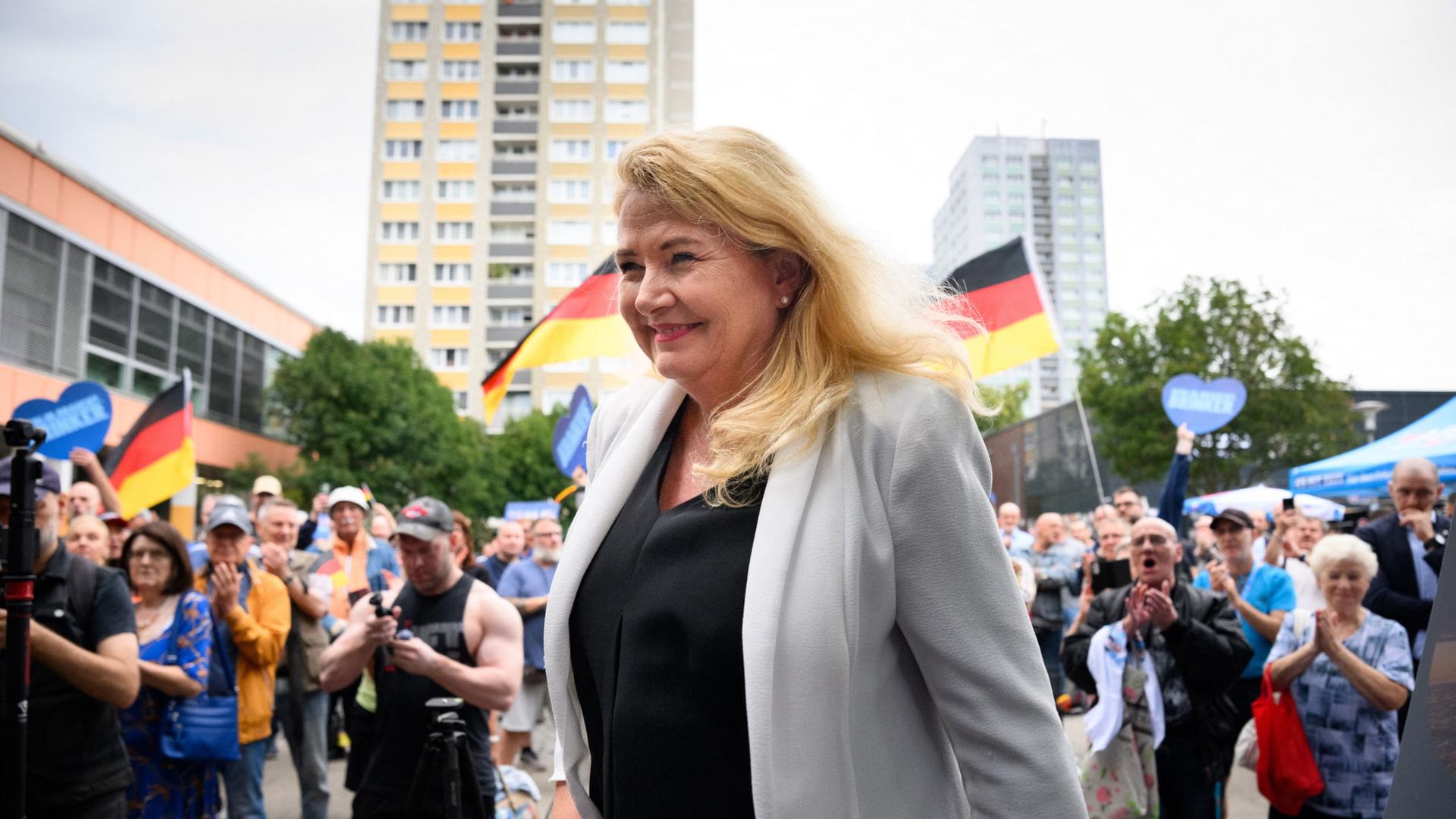
It's visible from a distance in the Tegel pedestrian zone: the blue umbrella with the large letters: AfD. Kristin Brinker, the lead candidate — blonde hair, pink top, dark blue jacket, party newspaper "Blauer Bote" tucked under her arm — is canvassing for votes.
Not an easy task here in northern Berlin. Tegel, known for its former airport and picturesque lake, is located in the Reinickendorf district — where the AfD finished only as the fourth-strongest force in the last election in 2023.
Federal Issues Dominate
"What actually puts me off a little is your closeness to Russia," says one passerby. — "Alice often lets things show that are unworthy of someone with her qualifications." — "He said that the AfD is generally against women's rights and children's rights," a female passerby says indignantly, referring to Höcke. — "Well, I don't know the context in which he said that, and that's why it's always very difficult to respond to something like that, because I don't know the circumstances," Brinker replies.
The 54-year-old frequently tries to steer away from federal issues: "Now we're here for the Berlin election, and we have quite different pressing issues here — perhaps we can still convince you."
"Many people ask about federal issues that we can't necessarily resolve at the state level," says Brinker. The state programme plays "more of a secondary role. And that of course makes things difficult when you're campaigning in a state election." The native of Saxony-Anhalt has been a member of the House of Representatives since 2016 and has led the state association since 2021.
Signs of Normalisation
At the campaign stand in Tegel, however, there is also support: "I'm rooting for you," calls out an elderly woman. "I really hope the AfD gets a chance now, because they will save our country," says another. When asked what expectations she has of the AfD, she becomes more specific, speaking about pensioners "who have to rummage through bins to earn a little extra money." And about her son, who has been looking for an apartment for a long time and cannot find one. Occasionally a truck honks as it passes by, and Brinker waves back cheerfully; occasionally a passerby calls out "Thank you" to the campaigners.
Many sympathisers are annoyed by the way other parties treat the AfD. "Banning them is not a solution," says one passerby. "Why are there so many people who want to vote for them?" People are more open, says lead candidate Brinker, and "far less reluctant to show that they sympathise." She presents herself as willing to engage: "I approach everyone."
Housing First for "Locals"
How the AfD envisions Berlin can be seen clearly through two issues: housing and transport. Two issues that concern Berliners the most, as polls show. The core demand on housing policy: state-owned apartments should be given preferentially to long-standing Berlin residents. "Apartments are not asylum homes," reads a headline in the "Blauer Bote," the AfD newspaper for the capital that Brinker carries with her on the campaign trail.
On the issue of transport, the AfD firmly backs the car - "motorised private transport" is described as an "indispensable component of urban mobility" in their manifesto. Brinker reveals in an interview with the ARD Mittagsmagazin that she herself is a "passionate driver." During a drive through the bustling district of Neukölln, the property manager outlines her transport solution for Berlin, which in some surveys ranks as the country's traffic congestion capital.
"Here you can clearly see in this image the typical Berlin perimeter block development, and we think it makes more sense to route the main motorised traffic along the main roads and cycle traffic along these side streets."
Demands and rhetoric have sharpened
While Kristin Brinker strikes a notably moderate tone on the campaign trail, radical forces within the Berlin AfD have gained influence under her leadership. On the subject of migration and asylum, the 2021 manifesto stated:
"Enforce deportations and enable remigration." Today the AfD additionally demands "an immediate moratorium on the acceptance of asylum seekers in Berlin," a moratorium on all naturalisation proceedings and a "state office for immigration, asylum and remigration." Elsewhere it states that lasting security in Berlin can "only be achieved through a consistent remigration policy." Remigration: a buzzword of the extremist New Right.
"Even I have had enough by now"
Kristin Brinker long avoided using the term publicly. In Tegel, she now defines it as "returning people who have no residency permit, who have exhausted all legal avenues - and of course also those who have committed serious crimes here." The manifesto cites a concrete figure only once: the "immediate deportation of all up to 20,000 persons in Berlin subject to a requirement to leave."
Brinker rejects the accusation that her party has shifted to the right. "We simply say what we want and what we believe is right. If all other parties form a popular front against us, then sooner or later what we will probably witness in Saxony-Anhalt will happen - namely an AfD majority government." "Popular front" - yet another term Brinker would not have used a few years ago. "That may be," says Brinker. "But even I have had enough by now."
Home turf in the East
A change of scene - one day later, outside the Linden-Center in Neu-Hohenschönhausen in the eastern Berlin district of Lichtenberg. In the last state parliament election in 2023, the AfD received 13.8 percent here - well above the overall Berlin result of 9.1 percent. Brinker is welcomed like a star; passers-by take photos and collect autographs. A crowd gathers in front of the stand. "They stand up for citizens," says one passer-by, "and that is my main concern - that we are not forgotten."
A young man doing vocational training states his expectations: "Cut taxes, that's the first thing. Create more housing. I'm worried about not being able to find a flat." And here too, a similar phrase is used about the AfD as the day before in Tegel: "Because they want to save Germany."
"In 1989, nobody believed the Wall would fall either"
In order to implement the high expectations of its supporters, the Berlin AfD would need a governing option. However, the other parties that can safely expect to re-enter the House of Representatives according to polls (CDU, SPD, Greens and Left Party) rule out any cooperation with the AfD. Brinker calls the other parties' "firewall" a "protective barrier for their own power options" and predicts: "They will fail with that!"
She then invokes a historical comparison, not for the first time: "In 1989, nobody believed the Wall would fall either." The party is far from the option of governing alone. In the ARD pre-election poll, it received 18 percent.