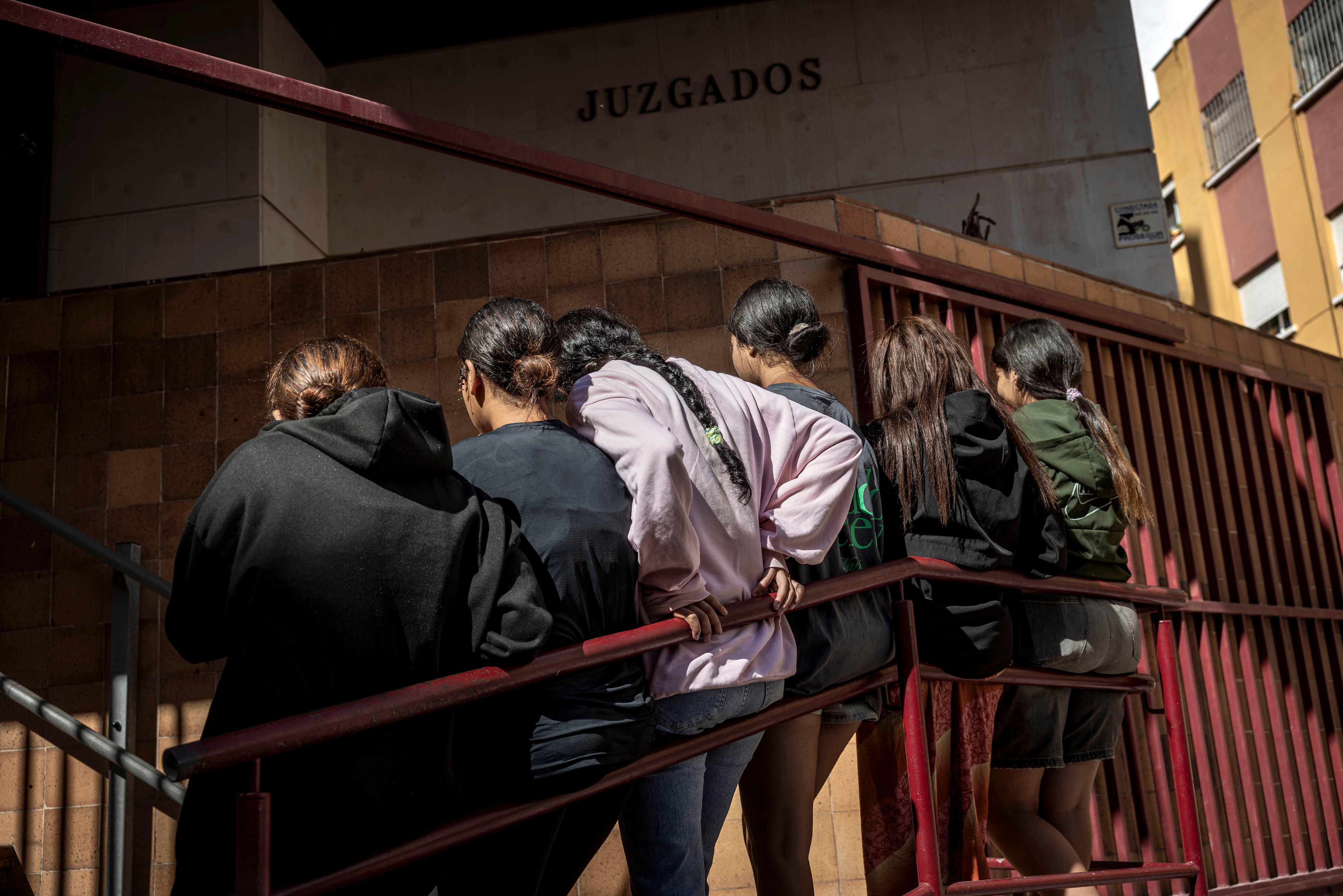
At eight o'clock on Wednesday evening, the football pitch in Ceuta's El Príncipe neighborhood switches on its lights to illuminate those still making the most of the match. Also a small circle of girls talking beside the stands, huddled together, very serious. Suddenly, a young woman runs past the entrance gate toward them, arriving in tears, stumbling. The others go out to meet her and cry out: "Douae, how did you escape?" — they embrace, joining her in her weeping. Douae has fled from one of the youth centers that the Government has set up in Ceuta to house the unaccompanied minors who crossed over at the end of July. She is 17 years old and is the fourth girl at this pitch to escape, the seventh in total. Before midnight, Noura will join them — the eighth.
All of these migrants, of Moroccan origin, were placed in youth centers at the beginning of September after more than a month living in the informal camps established with the support of local residents, such as this one in El Príncipe or the one in Sidi Embarek, which remains in operation. They were relocated to two facilities managed by two different organizations (Samu and Engloba), located side by side within the Naves de El Tarajal industrial area. According to a complaint they filed with the police, within a few days they began to suffer mistreatment at the hands of the staff in charge of them, including insults, abuse and a lack of medical care. There were also physical punishments and constant threats of being expelled to Morocco. Contacted by this newspaper, neither company wished to make a statement.
"They constantly call us whores, they hit us, they punish us if we ask to use a phone or a pillow," says Nezha, speaking rapidly. She escaped on Tuesday along with two other companions and stumbles over her words as she tries to summarize what happened. She has a bruise on her thigh which, she insists, is the result of a beating by center staff. The others also have bruises and injuries of various kinds, which they have photographed and included in the police report. "We escaped, but there are many more still inside who haven't managed it. We're doing this for them too. When we have a health problem, they don't take us to the doctor, and they insult us until we put up with it. There's a girl still inside who wasn't even given assistance when she vomited blood," she says. According to her account, the abuse and insults directed at that particular minor are related to her sexual orientation.
One of the most serious episodes they describe took place on the night of September 10th. Two men in security uniforms entered the area where the young women were sleeping, woke them up and directed sexually charged insults at them along with explicit threats of rape. "I wasn't working that day, I wasn't there that night, but the girls told me about it. I tried to find out who they were and I reported it," says one of the center's support workers. She asserts that these episodes of abuse have not occurred in her presence, although she is aware of what the girls describe. "I try to calm them down when they want to escape, I explain to them that they won't be better off on the street," she says. The support worker notes that fights among the young women are frequent, and that punishments do occur in her presence, though not of a physical nature.
It was precisely during one of these fights on Tuesday that a group of four minors took advantage of the security staff moving upstairs to intervene, and escaped. Staff went after them, but they scattered across the industrial estate. During her flight, Yasmine, 16, crossed paths with a volunteer from Médicos del Mundo, which maintains its mobile unit on the premises to assist the dozens of migrants living in informal settlements in the area. "She appeared having an anxiety attack, with bruises and a contusion on her back," the healthcare worker explained. A psychological report and an injury report were drawn up, and both were incorporated into the complaints. According to sources from the organisation, they were aware of incidents of this kind in the improvised youth centres, but until this week had not been able to confirm them because they are not permitted access. They point to a problem of insufficient training among staff at these centres and a lack of comprehensive healthcare for the minors, many of whom are in highly vulnerable situations.
Ongoing investigation
On Thursday, the Ceuta juvenile prosecutor's office received a report containing the police complaint and the medical and psychological reports. Statements were taken from the young women, and that same morning the city's department for minors, which holds their guardianship, intervened. The two male security guards involved in the incident of 10 September were identified and relieved of their posts, with the stipulation that they be replaced by women, both now and going forward. One of the educators whom the minors accuse of repeatedly hitting them was also identified.
At the same time, a new location was sought for those who had filed complaints, and they spent the night at another facility set up for unaccompanied minors. "We cannot take them in again, we cannot go back to how things were at the beginning," said Ahmed Enfed-Dal, president of the El Príncipe residents' association. The group that escaped on Wednesday arrived at his neighbourhood, taking advantage of a scheduled outing from the centre that allowed the girls to go outside. "They came back here telling us what had happened and it breaks my heart, but we cannot set up a camp here again, because that is not a solution. We don't have guardianship over them, they need to take responsibility," he explained.
Despite this, Hafida Mustafa, another local resident who helped set up the improvised camp in August, is looking for solutions. At least for that night. She will take one of the girls into her home, and tries to find places for the others until the following morning when they have to go and give their statements. "Look at the state of this one, she has an infection on her foot," she says, pointing to a wound on Yosra's instep. "Even when they were here sleeping on the ground, they weren't in this condition," she says critically. Those who fled the centre on Thursday, like Noura and Douae, arrive without their mobile phones or any of their belongings. They fled with only the clothes on their backs and returned to the previous location that had sheltered them for nearly a month at the start of the crisis. "But that cannot happen again, this has to stop," Hafida insists, to no avail. A day later, three more minors appeared at the camp, also from the same centre.
Zineb also left, but she did not return to El Príncipe: she crossed the border again. "I couldn't take any more humiliations. Among us there are those who wear the hijab and those who don't, but they insult and beat you all the same. I couldn't take it anymore, I went back to Morocco, even though I'm not happy here with the situation I'm in now, on the street, but there's nothing I can do," she writes from there. On Saturday, September 12, she went to the border crossing and returned voluntarily. "I wasn't supposed to go back to Morocco, I was supposed to move forward and build my future there, because I have a little brother there whom I have to support and take care of," she explains. According to her fellow residents at the center, she is one of four who have returned voluntarily, an option that, they admit, they are increasingly weighing. Meanwhile, the investigation is ongoing.