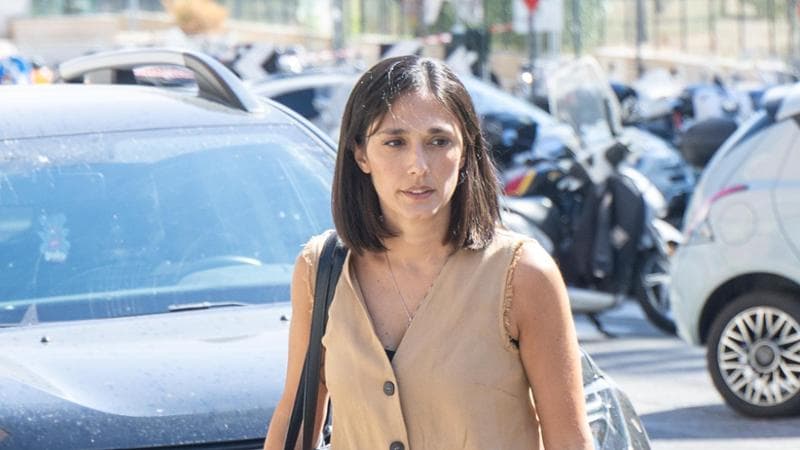
ABC Investigations has discovered audio published by a Kremlin-controlled TV network that claims to capture a couple accused of spying for Russia speaking from behind bars about their arrest, the criminal case and what they really think of Australian life.
The audio plays and a woman starts speaking in Russian.
"I don't care that they're listening to our conversation right now," the voice declares.
"I made a mistake when I migrated to a different country, and I wanted to return.
"But unfortunately, we were arrested."
The recording is purportedly of Kira Korolev, a former Australian Army private and accused Russian spy.
She and her husband Igor are locked up in separate Queensland prisons, awaiting trial on espionage-related charges.
The couple are accused of working together to obtain sensitive information regarding national security interests.
For the past two years, they have maintained their silence in Australia.
But ABC Investigations has discovered audio and interviews published by a Kremlin-controlled TV network that claim to capture the Korolevs speaking from behind bars about their sensational arrest, the criminal case and what they really think of Australian life.
The ABC has been unable to independently verify the authenticity of the audio.
Loading...Matthew Sussex, an expert in Russian strategic policy at the Australian National University, said in an era of deepfakes it was important to remain sceptical, particularly when the information was published by Russian state media.
"Russia Today (now called RT) has long been known as an organisation that distributes propaganda effectively,"Dr Sussex said.
"But it's also not surprising that [it] would choose to air stories that cast Australia in a very bad light."
The ABC's discovery of the audio raises questions about how Russian state-controlled media supposedly gained access to the Korolevs in prison.
Prisoner phone calls are recorded and may be monitored, except for those made to lawyers or to the Ombudsman. Under Queensland law, it is an offence for media to interview a prisoner, or obtain a written or recorded statement from them, without the approval of the chief executive of Queensland Corrective Services (QCS).
QCS said approval had "not been given in this case" but would not say whether a breach by the Korolevs was being investigated or if authorities were already aware of the interviews.
The Australian Federal Police (AFP) and the domestic spy agency, the Australian Security Intelligence Organisation (ASIO), refused to comment.
An ABC investigation has also uncovered fresh details of Mr Korolev's former life in Russia.
'I thought they were robbers'
It was before dawn on a winter's morning in suburban Brisbane in July 2024 when Australian authorities raided the two-bedroom apartment of 40-year-old Ms Korolev and her 62-year-old husband.
Their arrests made international headlines, with ASIO and the AFP heralding the operation as the first time an espionage charge had been laid since new laws aimed at countering foreign interference came into effect in 2018.
Two months later, Russia's state-controlled international news network published a bold headline: "This is all completely fabricated," it read in Russian.
RT claimed to have spoken with "a Russian woman arrested in Australia on suspicion of espionage".
The ABC has translated the article, which included a series of questions and answers with Ms Korolev, as well as edited audio embedded in a video that featured photographs from the couple's personal archives.
"The most terrifying thing, of course, was the arrest," Ms Korolev purportedly told RT in a September 2024 article.
"Five in the morning, armed people burst in, separated me and Igor, did not even allow us to say a word to each other."
In a separate "interview" with Mr Korolev the following year, he allegedly described the police raid as "like in the movies".
"At that time, we had just arrived from Russia, we had jet lag, so we were no longer asleep," he was quoted as telling RT.
"The police broke in, knocked down the door. At first, I thought they were robbers — it happens all the time here.
"The only thing I managed to say to my wife was: 'Don't be afraid, everything is fine.'"
According to RT, Ms Korolev said she was immediately taken away for "interrogation" before being placed in a cell with a Russian-speaking person she believed was a decoy.
"When I was brought to watchhouse … [an informant] who spoke Russian was immediately planted next to me. She instantly began to extract information from me," she purportedly said in the audio.
The couple were initially charged with preparing for an espionage offence, but in June their charges were upgraded to conspiracy to commit espionage, which carries a maximum penalty of life imprisonment.
It is alleged Ms Korolev, then an Australian Army private working as an information systems technician, had travelled back to Russia without telling her Australian Defence Force bosses and instructed her husband on how to log into her official military account to access sensitive information with the intent of handing it over to Russian authorities.
Ms Korolev's lawyer has told the ABC his client instructs she is not guilty and intends to contest the allegations.
The RT articles branded the police allegations as an agenda "against Russia".
"[Police] even accused me, saying you told your husband on the phone that you have become even more patriotic towards Russia than before," Kira said in the RT interview.
"So it would appear that my guilt lies in the fact that I love my homeland very much … and in the West, unfortunately, very many thoughts cannot be expressed."
Ms Korolev purportedly told RT in the audio that they travelled to Russia for IVF because "the healthcare system in Australia is very outdated".
The article claimed the authorities had questioned Ms Korolev for taking army "souvenirs" back to Russia.
"I brought an army sleeve patch with the Australian flag to Russia and, absolutely without any hidden motive, I brought a booklet … one we were given at a training in which they tell us how to survive in the forest," her recording said.
"Absolutely stupid things … as if I brought some secrets.
"[Police] say: No, this is information about how to train soldiers in Australia. And now Russia knows how to do it. I said, 'Yes, they can probably look at Google to see how to do that.'"
The claims have never been reported in Australia before.
Dr Sussex said the articles were aimed at a Russian audience.
"A lot of the messaging that was coming out of this was identical to what the Kremlin chooses to focus on when it comes to the sort of anti-Western tropes that it likes to deploy," he said.
"Chief amongst those is this idea that Australia, like any other Western country, is morally backward, isn't really a democracy, you don't have freedom of speech, you don't actually have any rights.
"And this is a very, very powerful sentiment that gets deployed domestically in Russia."
In his interview, Mr Korolev also accused Australian authorities of targeting the couple because they had refused to cut ties with Russia.
"I believe that the accusation is politicised, far-fetched and ordered from above,"he said.
"During our life in Australia, we did not renounce Russian citizenship although we were pushed to do so.
"We also criticised some aspects of life in Australia, for example, local medicine, the high cost of living, school education."
From Moscow to Perth
Ms Korolev had lived in Australia for more than 10 years before her arrest.
She told RT that she originally moved to Perth for a master's degree in film and television but had always planned to return to the "Motherland".
"Everything happened so quickly," the article read.
"I realised that my husband Igor could come here … I began to fight for us to stay here."
According to RT, Mr Korolev told them he worked mainly in the construction sector and in factories in Australia.
"I have never been on social welfare. From the first day I arrived, I started working. All our property here was bought absolutely legally: all taxes and duties were paid," he was quoted as saying.
By 2020, they had both become Australian citizens, with their personal YouTube channels showing the pair making the most of what the country has to offer — travelling, snorkelling, fossicking for gold and getting up close with wildlife.
Loading...According to the articles, Ms Korolev decided to join the ADF after growing tired of her job at a cleaning company.
"Quite by chance, I saw a poster that said that women were being recruited into the army," she told RT.
"I just called that phone number and went to the first information session.
"My husband and I were told that there is a vacancy in which you would not have to be a soldier but just do administrative work."
Ms Korolev held the rank of army private and worked as an information systems technician.
She passed a security clearance, which is required for all ADF recruits.
ABC Investigations has unearthed new details about her husband's past that raise fresh questions about the ADF's vetting capabilities.
Official Russian government records, obtained by the ABC, show Mr Korolev spent years working at a notorious private security and special services company called Atoll.
It was allegedly used by Russian oligarch Boris Berezovsky, who helped propel President Vladimir Putin to power before a bitter falling out, and his untimely death in London.
Berezovsky's former head of security Sergei Sokolov, who ran Atoll, has reportedly described the company to Russian media as a "powerful security system", involving information gathering, reconnaissance and "undercover work".
Mr Korolev had worked with the security firm for several years in the late 1990s, when Berezovsky was reportedly accused of using the company to spy on the family of then-President Boris Yeltsin.
Exiled Russian journalist and security expert Andrei Soldatov said this should have "raised some flags" for the ADF during their vetting of Mr Korolev's wife.
"Atoll was a very interesting beast," he said.
"The people they recruited were very adventurous, smart, intelligent. I would say they were the first soldiers of information wars in Russia."
But Mr Soldatov said the lack of sophistication in the Korolevs' alleged espionage was not unusual, with Russia increasingly relying on "ad-hoc" agents.
"The methods [have] changed and now Russian agencies are relying more on disposable agents or agents with no professional training just because it suffices," he said.
ABC Investigations worked with TriTrace Investigations managing partner Ilia Shumanov to unearth the government records, which did not list Mr Korolev's position with Atoll.
They showed Mr Korolev had later worked for a Russian bank, Flora Moscow.
Mr Shumanov, who is also a Transparency International Russia board member, said it was not a conventional promotion for someone with no publicly traceable banking career.
"Igor Korolev's career trajectory does not look like a series of accidental job changes,"he said.
"It reflects the steady advancement of someone valued for his security expertise, access to sensitive information and the trust of influential figures."
Mr Korolev's social media account on Odnoklassniki — often described as the "Russian Facebook" — listed his service in the navy in the 1970s.
The ABC could not independently verify his military experience.
"I think that his work for Atoll is more important and more significant because back in the Soviet Union, almost everyone had to serve in the military or in the navy," Mr Soldatov said.
"But of course, there are some questions like, what about the unit he served with, I would ask these questions."
The ADF did not respond to the ABC's questions about whether Mr Korolev's past was flagged as part of his wife's security vetting.
Instead, it said: "Defence is continuing to assist the AFP with its investigation and prosecution."
'There are absolutely no h