Final Sprint to the Berlin State Election: How the Campaign Unfolded
A last-minute change of lead candidate, a terrorist attack, corruption investigations: Berlin has experienced an extraordinary election campaign. Not least for this reason, the race for first place is closer than ever.
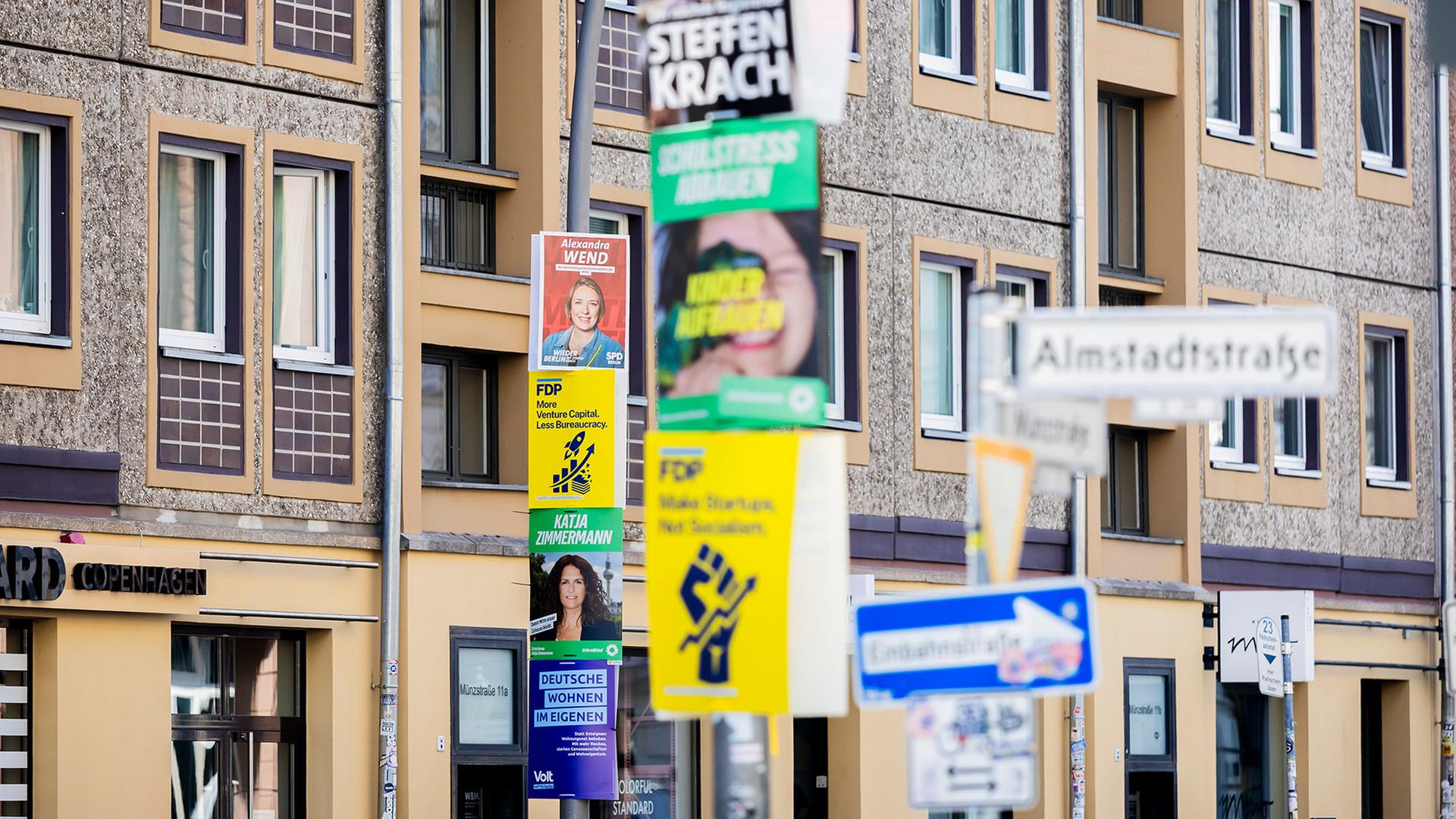
The really intense phase of election campaigns normally begins when the first posters go up. In Berlin, that happened from 2 August onwards. By that point, however, the capital had already endured many weeks that were far more intense than the usual build-up to the final stretch. The Berlin election campaign had been underway ever since it became increasingly clear, following the major power outage in January, that the Governing Mayor and CDU lead candidate Kai Wegner had lied about his crisis management. And that as a result, not only Wegner personally was in serious trouble, but so was his party.
Then, on 10 July, the cards in the campaign are reshuffled: Kai Wegner withdraws as the CDU's lead candidate. His party is at that point in freefall in opinion polls, having slipped to fourth place in rbb's BerlinTrend. Suddenly out in front is the Left Party, which more than any other party stands for the issue that matters most to voters in the city: housing and rents.
An attack brings a topic into focus
Replacing the lead candidate just over two months before the election is a risk. But with the new man, Finance and Culture Senator Stefan Evers, the CDU also has a new opportunity — provided he can make himself known and establish a profile quickly enough. An unforeseen event gives Evers precisely that chance.
On 25 July, an Islamist drives a car into people celebrating at the Christopher Street Day parade in the heart of Berlin. One woman dies, and many others are seriously injured. The attack briefly pushes the topic of internal security further into the campaign's spotlight.
Evers versus the Left
A terrorist attack could have been a moment when the campaign paused, but the opposite happens. While the Greens work to arrange a joint show of solidarity among the democratic lead candidates, Stefan Evers gives a television interview that sets the tone for the weeks ahead. Controversial statements about the terrorist attack from the Left Party's Neukölln district branch hand him the perfect opening.
The CDU lead candidate accuses the Left Party of "denial of reality" with regard to Islamism. But that is not the party's only problem, he adds, as it also has to contend with "increasing antisemitism." Evers has found his main campaign theme: the fight against extremists of every stripe and the warning against the Left Party as a "security risk for the capital."
A tight race, a sharp tone
Left Party lead candidate Elif Eralp, who is seeking to become the first woman with a migration background to enter the Red City Hall, accepts the challenge. She too hits hard: against a CDU that is dividing the city and would rather coddle greedy landlords than do anything about the crisis in the housing market. A two-way battle for first place is becoming ever clearer. The CDU and the Left Party have been neck and neck for weeks, with the Left Party most recently holding a narrow lead.
Beyond these two parties as well, the tone of the election campaign is at times rough – and it often goes beyond verbal attacks. Berlin police have recorded an unusually high number of cases of violence and property damage during this campaign, including destroyed election posters. There have been 501 incidents since August 2nd. Five years ago, there were 122.
Conspicuously Inconspicuous
The fact that the Berlin election campaign often looks like a two-way fight between the CDU and the Left Party is also due to two other competitors keeping a lower profile. The Greens have made it their declared strategy to avoid pointed demands and public disputes. The memories of past election campaigns are still too uncomfortable – when controversy over the car-free Friedrichstrasse or the announcement of wanting to eliminate half of all Berlin's parking spaces likely cost the party votes.
The AfD also comes across as less conspicuous in Berlin than elsewhere. This is largely due to their lead candidate Kristin Brinker, who is not the kind of megaphone that many other AfD frontrunners tend to be. Behind her deliberately conservative, middle-class demeanor lies a strategy. Anyone who sells a radical election manifesto with a friendly smile can hope to attract not only frustrated non-voters but also disappointed voters from other parties.
And Then an Investigation Earthquake
Eleven days before the election, news of searches at the home of SPD lead candidate Steffen Krach and his party shook Berlin politics. The accusation is that Krach, during his time as regional president in Hanover, leaked insider knowledge about a major real estate deal and may even have accepted bribes. Krach rejects all allegations, and the presumption of innocence applies. But for the SPD, already struggling and cemented in fifth place in the polls for months, this is a worst-case scenario.
However, this is not only a concern for the Social Democrats. The CDU, the Left Party, and the Greens are also worried. Because if the SPD truly collapses, there might not even be enough parties left in Berlin for a three-way coalition government. According to the polls, two-party alliances have not held a majority for months.
Everything Still to Play For
In the latest ARD BerlinTrend poll, there were just five percentage points between the parties in first and fourth place. So alongside the Left Party and the CDU, the AfD and the Greens can also still hope to cross the finish line first on Sunday. Just before the vote, everything still seems possible in the election to the House of Representatives. For the parties, this means even more than in previous years: campaigning right up to the last minute.
Broadcast: rbb24 Abendschau, 18.09.2026, 19:30 / Video: rbb24 Abendschau, 18.09.2026, Laurence Thio/Jonas Wintermantel/Samira El Hattab in conversation with Leonie Schwarzer