Bundeswehr on NATO's Eastern Flank: Why Germans Are Also Helping Build Poland's "Eastern Shield"
Poland is fortifying its borders with anti-tank ditches and concrete hedgehogs. German soldiers are also helping construct the "Eastern Shield." The project is intended to strengthen the defense of NATO's eastern flank.
Northeastern Poland, a military restricted area, just a few meters from the border with Russia: Beyond the barbed wire fence lies the exclave of Kaliningrad — Russian territory.
The entire Polish-Russian border stretches more than 230 kilometers. Poland wants to secure it on land — with the protective barrier known as "Tarcza Wschód," or "Eastern Shield" in German.
Construction Works Shielded From View
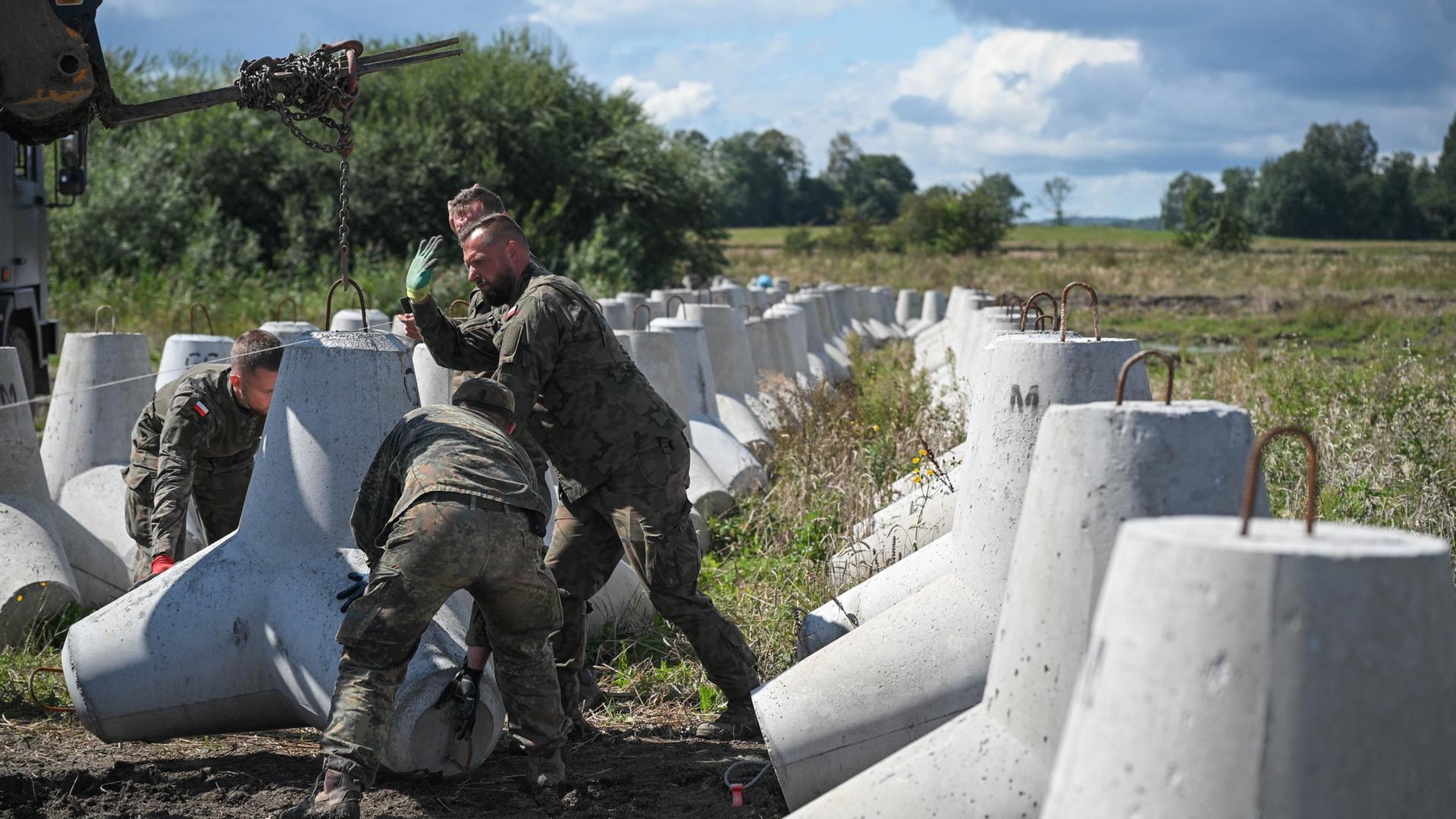
Adrian Chodorowski is a first lieutenant in the Polish military and is deployed on site. "We are building fortifications here. The potential adversary will then be looking at an anti-tank ditch," he says. Behind it comes the first row of reinforced concrete hedgehogs. Then follows an open area for mines, the lieutenant explains. "And after that there is a second row of tank obstacles."
The construction work is shielded from view: no access for civilians. Under military supervision, the media are allowed only a few hours to look around.
Poland and Germany Seek Closer Cooperation
German combat engineers have also been on site since the end of June, pitching in. There are now 40 soldiers. Polish and German combat engineers are digging defensive ditches and placing tank hedgehogs weighing several tons. They are working hand in hand, says Lieutenant Aimee — only her first name is given for security reasons. The greatest motivation is the cooperation between the Polish and German forces, simply to build camaraderie.
Poland and Germany are pursuing closer cooperation in defense. Both countries have sealed this with an agreement. The Polish and German defense ministers signed it in Warsaw in June.
It explicitly addresses the expansion of deterrence on NATO's eastern flank — together, as strategic partners.
Volunteers Help at NATO's External Border
Barely two weeks after the signing ceremony, the first German combat engineers arrived at the "Eastern Shield" construction site. "I volunteered for this. It's something that concerns all of us in some way," says Staff Sergeant Jakob. Because the fortification protects not only Poland's border, but also NATO's external border.
Polish General Stanisław Czosnek emphasizes that the project is "not only a Polish project," but part of a broader, regional defense architecture of the alliance. The "Eastern Shield" is directly connected to what is known as the Baltic Defence Line.
Defense measures along NATO's eastern flank are therefore being coordinated across borders. "We are working with the Baltic states, with Finland and Sweden — that is, with the Scandinavian countries as well," said Czosnek.
Protective Barrier Designed to Stop Hostile Groups
Poland has been expanding its military for years. The country now invests 4.8 percent of its gross domestic product in defense. Its armed forces number 220,000 men and women. That figure is set to rise to half a million, including active military personnel and reservists. Poland is among the first states to make use of funds from the new EU financial instrument SAFE — Security Action for Europe.
The "Eastern Shield" is one of Poland's largest defence projects. The protective barrier is intended to stop enemy troops in the event of a possible attack.
Russia should not engage in military adventures
Major General Tilo Maedler heads the staff of the EU and NATO operation. "The better prepared we are to defend ourselves, the less likely it is that Russia will engage in any military adventures," he says. That is the message of this day: "We stand ready to fight for our freedom, for our democracy."
In addition to the border with Russia, the "Eastern Shield" is also set to be built along the Belarusian border. Construction work is expected to continue until 2028.