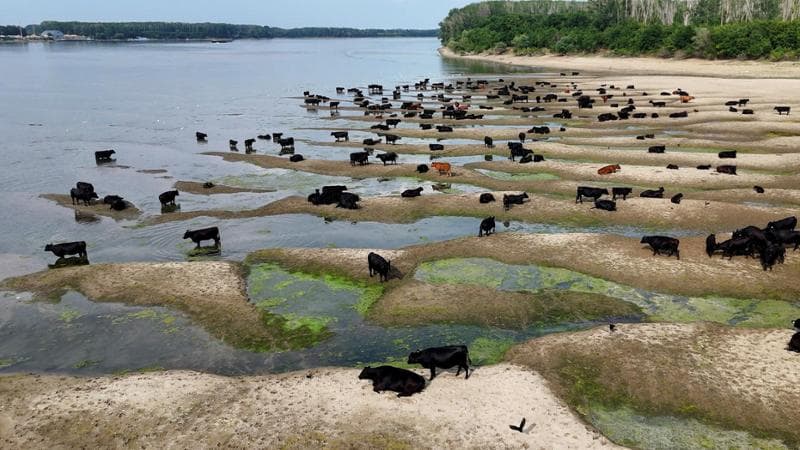
The Danube has lost more than just its beautiful blue color. Heat and evaporation have reduced its waters to their lowest level in thirty years. Near its mouth, the flow rate is barely a third of what is normal for this time of year: 1,700 cubic meters instead of 4,700. The riverbed is dotted with newly emerged islands. Bathers can wade across wide stretches of it on foot.
With another rise in temperatures expected from mid-week and 38 degrees forecast for Rome, as well as Vienna, Prague and Budapest, Europe's rivers are gasping along with the rest of nature. Scientists gathered in the World Weather Attribution group have made clear that this drought is linked to climate change. Heatwaves in Western Europe would have been 80 times less likely without the increase in carbon dioxide in the atmosphere.
**June the hottest month**
Europe, despite being one of the most virtuous regions in terms of greenhouse gas emissions, is warming at twice the rate of the global average. The month of June was the hottest on record for the continent since measurements began, running three degrees above the 1990–2020 average. This was measured by the Copernicus service. According to mortality estimates, 10,000 people lost their lives due to scorching temperatures in June across the whole of Europe.
In addition to the Danube, the crisis is affecting the Rhine, Loire, Elbe and Po. Waters slowed by drought are also hampering tourism and the economy. Romania has restricted irrigation along the Danube. The threat also looms over the Po.
River cruises on the second longest river in Europe, hugely popular with tourists (and with the Hungarian economy), have in some cases been cancelled, transferred to smaller vessels, or broken up by bus transfers.
Also moored in port are several barges carrying grain, of which Romania is a major exporter. To reduce their draught, some are being lightened of their cargo, sailing with reduced loads.
**The Danube runs dry**
Supply difficulties along the Rhine have forced the Thyssenkrupp plant in Duisburg to scale back production. Near its mouth, the river — one of Europe's busiest commercial corridors — recorded a flow rate of 715 cubic meters per second last week. That is the lowest figure since 1976, according to Rijkswaterstaat, the Dutch water authority.
The previous Danube drought, in 2022, had caused several Nazi vessels sunk during the war to re-emerge. Today, excessively high river temperatures caused by heatwaves have forced Hungary to reduce the output of the Paks nuclear power plant.
**The drought observatory**
The European Drought Observatory, fed by Copernicus satellites, shows the most severe situation in the eastern part of Europe, along the course of the Danube, in western France and in the Po Valley. A moderate level of drought, meanwhile, covers Spain. It is no coincidence that some of these regions are the hardest hit by wildfires. Vegetation that grew lush thanks to the abundant rainfall of spring has dried out in the heat, providing rich fuel for fire.
This week too, Effis, the European Forest Fire Information System, forecasts "very extreme" risk conditions in France and Spain. The danger extends as far as Great Britain and Finland. Portugal will reach 40 degrees this week, while Great Britain will once again exceed 35.